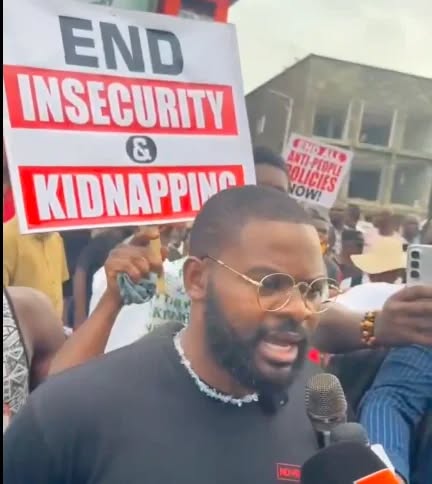
Popular Afrobeats singer, actor, and social activist, Folarin Falana, widely known as Falz, on Friday joined scores of Nigerians in Lagos to commemorate Democracy Day with a strong message to the Federal Government, condemning what he described as worsening insecurity, deepening economic hardship, and persistent corruption across the country.
The award-winning entertainer made the remarks while addressing participants at a June 12 protest organised by a coalition of civil society organisations, labour unions, youth groups, community associations, social movements, and faith-based organisations. The demonstration, held in Lagos, drew citizens from different walks of life who gathered to express growing frustration over the country’s economic challenges and security concerns.
The protest, which coincided with Nigeria’s annual Democracy Day celebrations, transformed into a platform for citizens to voice concerns about rising inflation, increasing food prices, unemployment, and what many described as the government’s inability to effectively tackle insecurity.
Standing before a crowd of demonstrators carrying placards and chanting pro-democracy slogans, Falz said Nigerians could no longer ignore the harsh realities confronting the nation. He argued that despite the country’s vast natural and human resources, ordinary citizens continued to suffer due to poor governance and the mismanagement of public resources.
According to him, corruption remains one of the major obstacles preventing Nigeria from achieving meaningful development and improving the quality of life for its people.
“Apart from the insane corruption and gross mismanagement of our resources, I think everybody can see the worsening insecurity. It’s unbearable now,” Falz declared to loud applause from the crowd.
The singer lamented the increasing incidents of kidnappings, violent attacks, and killings being reported across different parts of the country. He noted that insecurity had become a daily reality for many Nigerians, with citizens increasingly fearful of travelling on highways, engaging in farming activities, or even carrying out routine business operations.
He stressed that one of the primary responsibilities of any government is the protection of lives and property, adding that many Nigerians felt abandoned in the face of escalating security threats.
Falz also expressed concern over the economic difficulties confronting citizens, saying that rising costs of living had pushed millions of Nigerians into hardship. He noted that many families were struggling to afford basic necessities, while small businesses continued to battle soaring operational costs.
The entertainer urged Nigerians not to lose hope despite the challenges, emphasizing that democracy gives citizens the power to hold leaders accountable through peaceful and lawful means.
He encouraged the public to actively participate in the democratic process, insisting that elections and civic engagement remain important tools for demanding better governance.
According to him, citizens must continue to speak out against injustice, demand transparency from public officials, and insist on policies that improve the welfare of the people.
The June 12 protest attracted a diverse mix of participants, including student activists, labour leaders, human rights advocates, and ordinary residents who marched through parts of Lagos while calling for urgent government action on insecurity and economic reforms.
Several protesters carried banners with messages demanding accountability, improved security, job creation, and measures to address the soaring cost of food and essential commodities.
Others used the occasion to highlight concerns over unemployment and the declining purchasing power of Nigerians.
Speakers at the event argued that Democracy Day should not only be a celebration of Nigeria’s democratic journey but also an opportunity to assess whether democratic governance has translated into tangible benefits for citizens.
Many participants reflected on the significance of June 12, a date that symbolizes the struggle for democratic rule in Nigeria following the annulment of the historic 1993 presidential election widely believed to have been won by late businessman and politician Moshood Kashimawo Olawale Abiola.
For several demonstrators, the ideals of justice, accountability, and good governance associated with the June 12 struggle remain unfinished goals that require renewed commitment from both leaders and citizens.
The protest remained peaceful as participants marched and listened to speeches from activists and public figures. Security personnel monitored the gathering while organisers repeatedly urged demonstrators to maintain order and avoid confrontations.
Falz, who has built a reputation as one of Nigeria’s most outspoken entertainers on social and political issues, has consistently used his platform to advocate for governance reforms, human rights, and accountability. His involvement in previous civic movements, including campaigns against police brutality and calls for institutional reforms, has made him a prominent voice among young Nigerians seeking change.
As the Democracy Day demonstrations concluded, participants reiterated calls for urgent action to address insecurity, improve economic conditions, and strengthen democratic institutions. For many in attendance, the message was clear: Nigerians expect more from their leaders and are increasingly determined to use democratic channels to demand accountability and better governance.
The event served as both a commemoration of Nigeria’s democratic journey and a reminder that many citizens believe significant work remains to be done before the promises of democracy are fully realised.