An international relations expert, Prof. Joshua Bolarinwa on Thursday said relations between Nigeria and China have evolved into a strong and multifaceted partnership driven largely by economic cooperation.
He, however, noted that while the partnership had yielded significant benefits, issues such as trade imbalance, debt sustainability and the need for greater local participation in projects must be addressed.
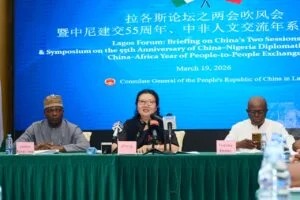
Bolarinwa, a Director of Research at the Nigerian Institute of International Affairs(NIIA) made this known at the Lagos Forum on China’s Two Sessions and symposium marking the 55th anniversary of China–Nigeria diplomatic relations.
The forum was organised by the Consulate General of the People’s Republic of China Chinese in Lagos.
Bolarinwa said since the establishment of diplomatic relations in 1971, both countries had built one of the most significant bilateral relationships between an African nation and a major global power.
According to him, China has emerged as one of Nigeria’s key trading partners, with bilateral trade expanding across sectors including manufacturing, telecommunications, construction and energy.
“Chinese companies have played a central role in addressing Nigeria’s infrastructure deficit through the construction of railways, highways, airports and energy facilities,” he said.
According to him, many of these projects are linked to China’s Belt and Road Initiative which focuses on enhancing infrastructure connectivity and trade across regions.
Bolarinwa added that the partnership had contributed to improving Nigeria’s transportation network, facilitating economic activities and supporting long-term development goals.
He further explained that the relationship operated within a broader continental framework through the Forum on China–Africa Cooperation(FOCAC), which served as a key platform for dialogue between China and Africa.
“Through this mechanism, policies on trade, investment, infrastructure development and capacity building are coordinated,” he said.
Speaking on the 2026 Two Sessions, Bolarinwa noted that the meetings came at a time when China was navigating a complex global environment.
He said that the environment was shaped by economic transformation, technological competition, and shifting geopolitical dynamics.
He identified key priorities from the sessions as economic stabilisation, high-quality development, technological innovation, and the expansion of the digital economy.
According to him, China is also focusing on industrial modernisation, green development and investment in emerging technologies such as artificial intelligence and advanced manufacturing.
“These policy directions would shape China’s global economic engagement and partnerships, particularly with developing regions.
“For Africa, especially Nigeria, the policy direction from the Two Sessions provides insight into China’s future strategies and areas of cooperation,” he said.
He added that continued emphasis on infrastructure, industrial development and technology collaboration indicated that Africa would remain a key partner in China’s global engagement.
Looking ahead, Bolarinwa emphasised the need to strengthen economic cooperation, expand people-to-people exchanges and promote mutually beneficial development.
“If well managed, the China–Nigeria partnership holds significant potential for advancing Nigeria’s development objectives and fostering a more dynamic Africa–Asia relationship,” he said.