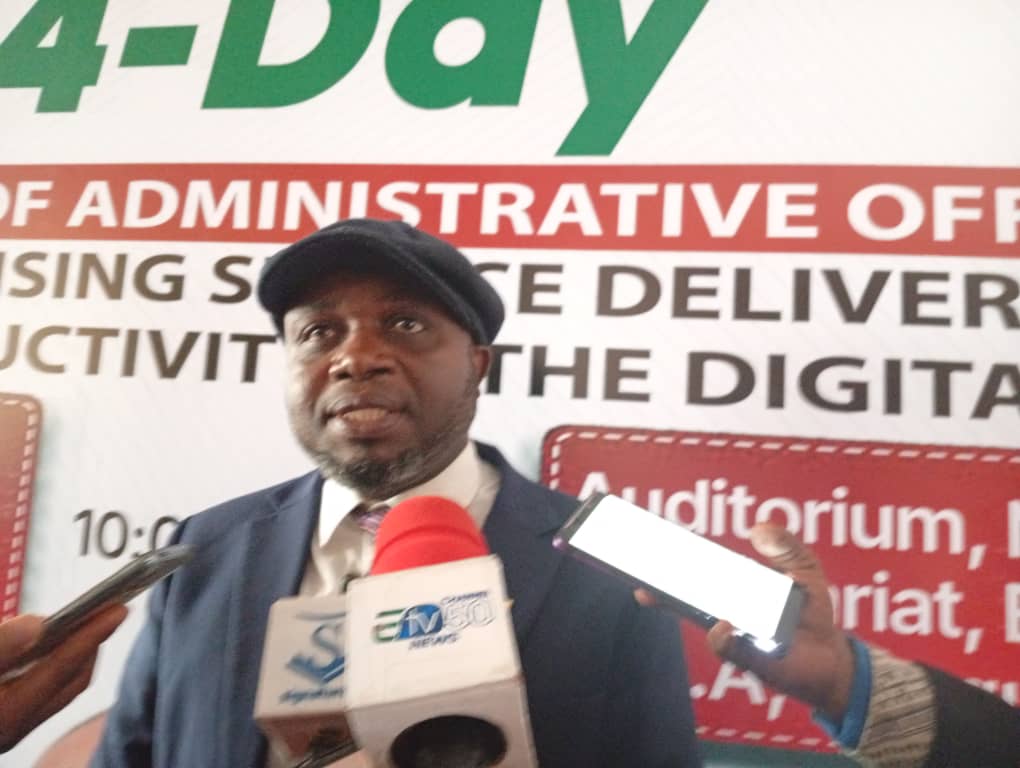
Enugu State Government has drawn a direct line between its civil servants’ digital competence and the state’s ambitious economic future, with the Secretary to the State Government declaring that the path from a $4.4 billion to a $30 billion economy runs squarely through workforce transformation.
Speaking at the opening of a four-day intensive training for administrative officers on Tuesday in Enugu, Prof. Chidiebere Onyia, representing Governor Peter Mbah, made clear that career advancement in the state’s civil service now hinges on digital proficiency and performance – not seniority or mere attendance.
“We are at an inflection point where the civil service must evolve from analogue bureaucracy to digital enabler,” Prof. Onyia told participants. “The economic future we envision is only achievable if the people implementing policy have the tools and skills to execute in a digital-first environment.”
The programme, themed “Optimising Service Delivery and Productivity in the Digital Age” and organised by the Office of the Head of Service, represents more than professional development. According to Prof. Onyia, who delivered a goodwill Message on behalf of the Governor, is a strategic imperative for a state government in a hurry to transform its economy by leveraging technology and institutional efficiency.
Prof. Onyia emphasised that the state’s vision relies heavily on civil servants who adopt digital tools and maintain ethical productivity in their work. Dedication, adaptability to digital transformation, and consistent performance have become the primary criteria for career progression, he said, adding that the government will not condone laziness or absenteeism.
“I commend the Head of Service for organising this critical training, which spans a 32-hour module aimed at enhancing proficiency in e-government tools,” Prof. Onyia said. “The programme will be highly interactive, bringing together top-tier resource persons and participants to co-create knowledge.”
The programme reflects a growing recognition across Nigeria’s public sector that continuous learning is no longer optional in an era of rapid technological disruption. The intensive nature of the 32-hour training module underscores the government’s determination to build genuine competency in e-governance tools as a baseline requirement rather than an optional advantage.
Dr. Godwin Anigbo, Head of Service, positioned the training as foundational to Governor Peter Mbah’s broader vision of creating a smart, agile, and reform-driven public service capable of driving sustainable development. He stated that the training is designed to sharpen skills, improve service delivery, and enhance professionalism and efficiency among civil servants.
“Strong institutions don’t emerge by accident – they’re built through deliberate investment in human capacity,” Dr. Anigbo told participants. “You are the agents of change and stakeholders in the state’s development. Governor Peter Mbah’s vision to build a smart, agile, and reform-driven public service for sustainable development is achievable.”
Dr. Anigbo noted that the projected growth of the state’s GDP depends on strong institutions and the capacity of the people driving policy implementation. He emphasized that the training will accelerate policy implementation and strengthen governance, as a capable civil service is central to systemic reforms.
The training curriculum addresses three critical competency areas that reflect the demands of 21st-century governance: E-Governance and Technology Adoption; Enhancing Communication and Presentation Skills; and Legal and Ethical Frameworks. These areas were specifically chosen to bridge the gap between traditional civil service operations and the digital-first approach required for modern governance.
Significantly, Dr. Anigbo announced that the government plans to institutionalize such training, making digital skills development routine for all civil servants by 2026. The administration also intends to provide staff with the digital tools necessary to translate training into improved service delivery. “We plan to provide civil servants with digital tools to support their work and intend to make such training a routine for all staff by 2026,” he said.
This approach aligns with global trends where governments increasingly recognize that technology adoption without corresponding workforce development creates implementation gaps that undermine reform efforts. The Enugu initiative underscores a broader reality reshaping workplaces worldwide: the half-life of professional skills is shrinking dramatically. What workers learned a decade ago—or even five years ago—may no longer be sufficient for today’s challenges.
For civil servants specifically, the disruption is particularly acute. Citizens increasingly expect government services to match the speed and convenience of private sector digital platforms. Meeting those expectations requires not just new technology, but public servants equipped to leverage it effectively.
Prof. Onyia’s warning about career consequences for those who resist adaptation reflects this new paradigm. In today’s environment, organisations cannot afford to carry workers whose skills have become obsolete, particularly when ambitious economic targets depend on execution capacity.
For civil servants, the message from Tuesday’s opening session was unambiguous: continuous learning and digital adaptation are now mandatory, not optional—a reality that will determine both individual career trajectories and the state’s collective success in achieving its economic transformation goals.