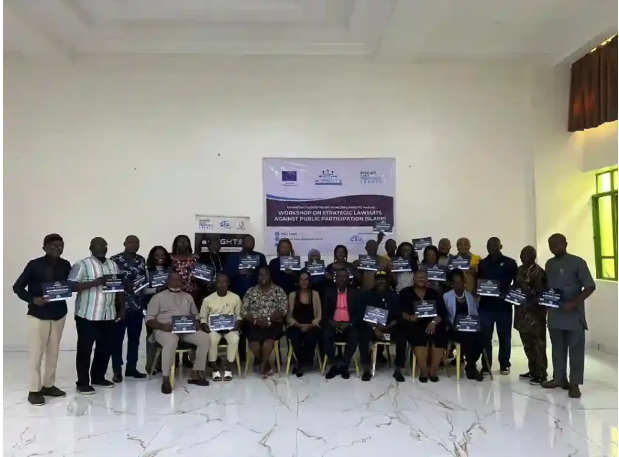
A growing number of Nigerian journalists are facing Strategic Lawsuits Against Public Participation (SLAPPs), cases often filed by powerful individuals or institutions to intimidate reporters and suppress public-interest journalism.
At a two-day workshop in Lagos, organised by Avocats Sans Frontières France (ASF France) under its Enhancing Digital Rights (e-RIGHTS) Project, media professionals, lawyers, and academics examined how SLAPPs weaken press freedom and discussed reforms needed to protect journalists.
Press freedom concerns take centre stage
The Chairman of the Nigeria Union of Journalists (NUJ) Lagos State Council, Mr. Adeleye Ajayi, represented by the Assistant Secretary, NUJ Lagos State Council, Comrade Olaid, opened the event with a warning that SLAPPs threaten democratic accountability.
“SLAPP cases are deliberately designed to intimidate, drain resources, and silence critical reporting,” he said.
“We must be equipped not only with journalistic skills but also with the knowledge to recognize when the law is being weaponized to stifle public interest journalism.”
He praised ASF France for its ongoing partnership, adding that the workshop “provides an opportunity to deepen our resilience and sharpen our legal awareness”.
How SLAPPs work and why journalists struggle to fight back
Legal Toolkit: Understanding the battlefield
Legal expert Dr. Abiodun Odusote, an Associate Professor at the University of Lagos, walked participants through the procedural safeguards available when facing SLAPPs.
He outlined tools such as challenging jurisdiction, filing for expeditious dismissal, and establishing public interest as a defence, noting that many journalists lack access to robust legal support.
He also stressed:
The need for stronger legal networks across states
The shortage of specialised lawyers
The importance of proper evidence storage and documentation
Ethical conduct to avoid claims of personal attacks or discrimination
“Do not disregard even the simplest legal issue,” he said. “And always frame your work in terms of public interest.”
Real-life SLAPP cases reveal deeper challenges
In a separate session, Dr. Folashade Rose Adegbite, Associate Professor of Law at the University of Lagos, dissected ongoing and recent lawsuits filed against Nigerian journalists.
She noted that women journalists experience more psychological trauma during SLAPP episodes.
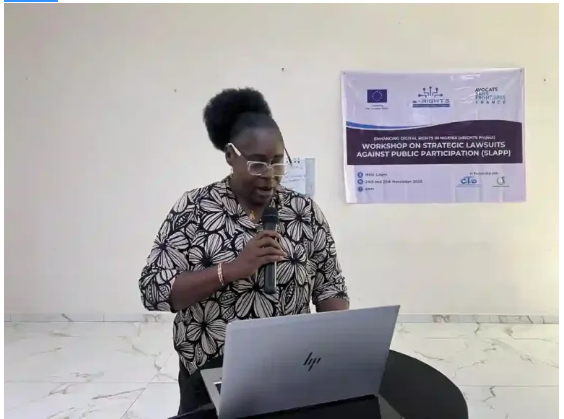
“The experience for women tends to be more emotionally exhausting,” she explained. “This is why support systems are crucial.”
Participants shared first-hand experiences of intimidation, legal threats, and attempts to silence investigations. The session highlighted the growing pattern of using cybercrime laws and police powers to suppress reporting.
Calls for anti-SLAPP legislation grow louder
A panel session on legal reform emphasised the need for explicit anti-SLAPP legislation in Nigeria.
Stakeholders outlined key priorities:
Cooperation between journalists, lawyers, and judges
Monitoring and evaluating previous media-law agreements
Public education through radio, TV, and digital platforms
Better documentation of SLAPP incidents
Constitutional reforms to limit abusive lawsuits
Sanctions and compensation for malicious litigation
One contributor warned that cyber laws and arbitrary police powers are increasingly used “to suppress society”, calling for clearer legal protections for freedom of expression.
Support networks: “Journalism is passion, but passion does not pay legal bills”
ASF France’s Country Director in Nigeria, Angela Uwandu Uzoma-Iwuchukwu, addressed the financial and emotional burden placed on journalists facing SLAPPs.
She described journalism as a passion-driven profession, yet one where reporters cannot afford legal defence when sued.

“Lawyers cannot work for free; they have families and financial obligations,” she said.
“These legal threats are designed to demoralise journalists and often, they succeed.”
She urged journalists to:
Verify all information, especially online content
Demand written evidence
Never attend police stations or sensitive meetings alone
Maintain emergency contacts
Use international networks when local support fails
She also highlighted the e-RIGHTS Reporting Platform, which documents SLAPPs and connects victims to legal and financial assistance.
What’s next
The workshop closed with a shared commitment to:
Advocate for anti-SLAPP legislation
Strengthen journalist–lawyer networks
Improve public education on digital rights
Expand support systems for at-risk reporters
Participants agreed that Nigeria’s democratic health depends on protecting journalists from legal intimidation.