The All Progressives Congress (APC) has declared that President Bola Ahmed Tinubu’s administrative record eclipses that of former President Olusegun Obasanjo and every other civilian leader in Nigeria’s democratic history.
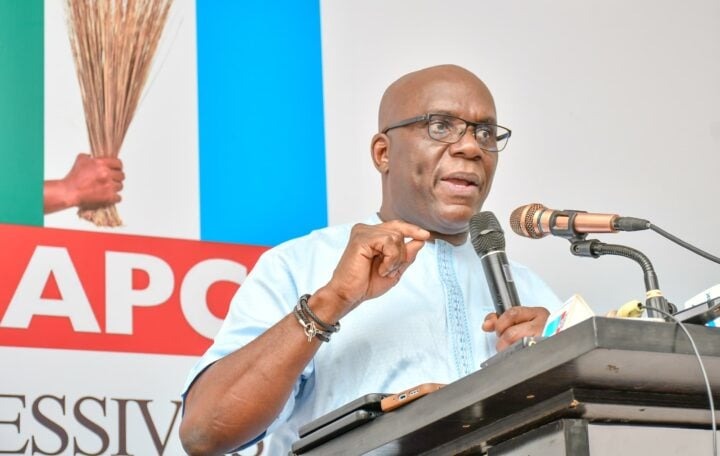
Speaking on Channels Television’s political program on Monday evening, August 24, 2026, APC National Publicity Secretary, Barrister Felix Morka, robustly defended the administration’s economic trajectory.
Morka asserted that President Tinubu has achieved more structural reform during his initial term than any of his predecessors, despite taking over an economy in profound distress.
”President Bola Ahmed Tinubu has outperformed any president in his first term. He has outperformed any democratically elected president in this country in their terms,” Morka said. Invoking the legal principle res ipsa loquitur, he added, “The indicators speak for themselves. This president inherited an economy that was in a complete mess.”
Rebutting comparisons with past democratic administrations, including those of Olusegun Obasanjo, Umaru Musa Yar’Adua, Goodluck Jonathan, and Muhammadu Buhari, the ruling party’s spokesperson insisted that current macroeconomic stabilization policies are laying a foundation for sustainable growth.
Regarding former President Buhari, Morka clarified that his administration acted as a critical buffer following prior leadership. “President Buhari was a stopgap president who came to keep the country from tipping over the precipice after 16 years of horrific maladministration,” he explained, noting that Buhari held the nation steady to allow President Tinubu to implement foundational economic overhauls.
APC National Publicity Secretary Barrister Felix Morka structured his argument around several core justifications for the administration’s performance:
Morka emphasized that short-term economic discomfort stems from long-overdue structural reforms, primarily the elimination of foreign exchange distortions and the petroleum subsidy framework.
He highlighted that President Bola Tinubu inherited an economy fraught with fiscal deficits, low revenues, and structural inefficiencies.
In citing res ipsa loquitur, Morka asserted that key macroeconomic indicators, such as increased government revenue generation and external reserves stability serve as tangible proof of progress.