Call the PR Team, Tell Them to Communicate It
Somewhere in this country, right now, a meeting is ending. A senior leader has just approved something big. A new tariff, a restructuring, a suspended service, it hardly matters. Hands are shaken, the tea goes cold on the table, and as people stand up the boss turns to an assistant and says: “Ah, call the PR team. Tell them to communicate it.” Tell them. Not ask them. Not consult them. Tell them.
Easy Life for Bosses, Hard Life for Communicators
It is a sentence so common that nobody hears how strange it sounds. Let us not fool ourselves, we have built a very comfortable arrangement. The bosses decide and the PR team defends. If the public applauds, the leadership was visionary. If the public is angry, the communication was poor. Heads I win, tails you lose. Life is easy for the decision-maker and hard for the communicator.
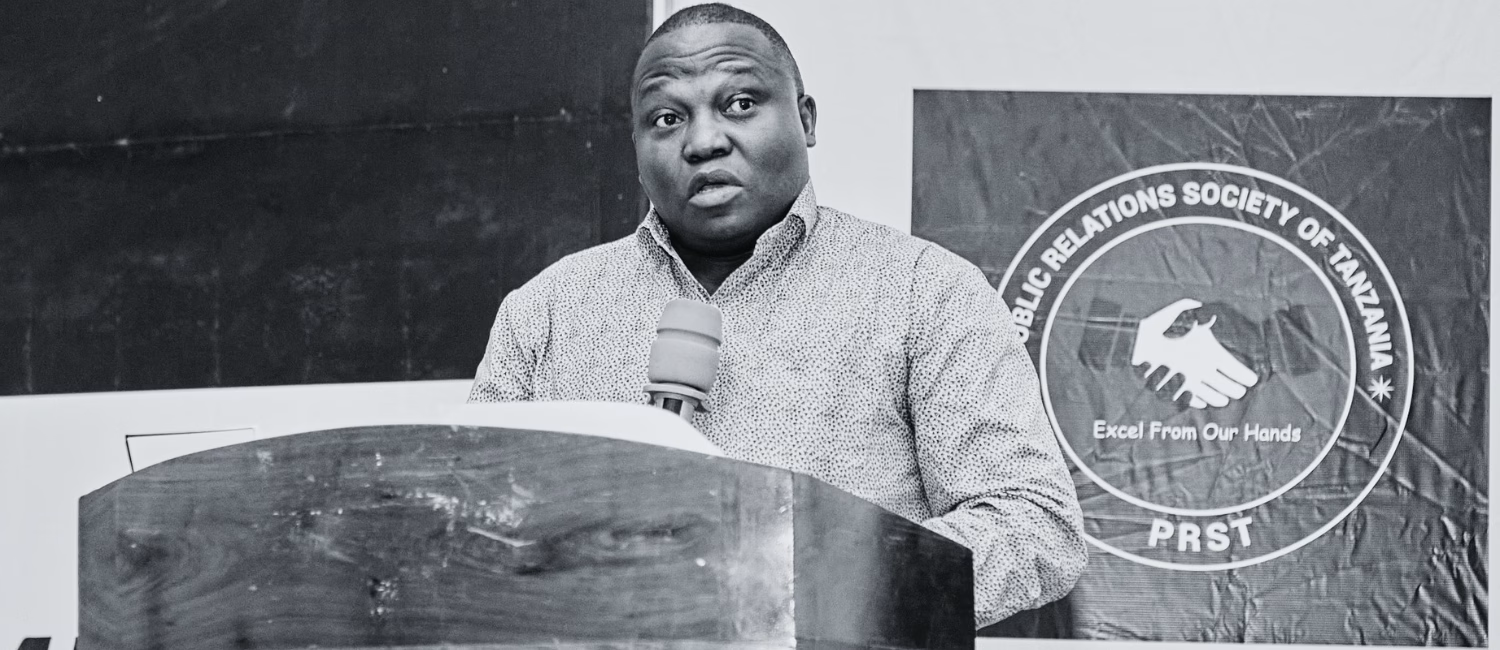
At the PRST Annual Meeting and Excellence Awards 2026, Dr. David Mrisho of St. Augustine University of Tanzania said aloud what many of us only whisper in corridors. Public Relations cannot be a department that communicates after decisions are made. Then he went further, and this is the part I cannot stop thinking about. Sometimes the most valuable advice a PR professional can give is not “here is how we should say it.” It is “perhaps we need to reconsider it.”
The Expensive Sentence Nobody Wants to Say
Imagine the silence in that boardroom. Because that sentence is expensive. It needs a professional with courage and a leader with patience. Many institutions have one of the two. Very few have both. Because the easy path is always open. Nod, smile, draft the statement, go home. Nobody was ever shouted at for agreeing with the boss. But a communicator who only agrees is not an adviser. That is an echo with a salary, and no institution has ever been saved by an echo.
Here is the irony we rarely admit. The same institutions that keep PR out of the decision will hold PR responsible for the reputation. It is like leaving your goalkeeper in the dressing room and then blaming him for every goal. Nobody does that in football. Why do we do it in leadership?
Trust Is Not Printed in the Annual Report
Then there is trust. We speak about it as if it were something we print in the annual report. Trust is not printed. It is earned when what an institution says matches what it does. When the gap between the two is wide, no slogan can fill it. No press release can. A banner at the launch certainly cannot. People may stay quiet, but they remember, and today they remember with smartphones. As Dr. Mrisho reminded us, a decision made at breakfast can become a national conversation by lunch.
So where do stakeholders go with their concerns? Employees have voices. Customers have voices. Communities and citizens have voices. In too many offices those voices end up in a suggestion box that nobody opens. A PR professional who carries those voices into the room before the decision is made is no longer just a communicator. That person has become strategic intelligence. Without that person, the voices still reach the room. They arrive later, through the newspaper and the WhatsApp group, and they are never polite.
Machines Draft, Humans Decide
And what about artificial intelligence? Yes, the machine can draft a statement in seconds. I welcome that. But who decides whether the statement is accurate, ethical and appropriate? A human being. The machine can read public sentiment. It cannot understand the history and the emotion behind a community’s anger. Being faster does not make us wiser. In an age where rumors run ahead of the official response, our only real advantage is credibility, and credibility takes years to build and moments to destroy.
So let me say plainly to leaders. Stop measuring your communication teams by the number of press releases and the volume of coverage. Ask better questions. Did their involvement help you understand your stakeholders better, alert you to emerging risks, or make more informed decisions before problems arose?
Earn the Seat, Not the Clean-Up Job
And to my fellow professionals. Nobody will hand us the seat on a plate. Earn it with business knowledge, data, ethics and the courage to tell leadership what it needs to hear, not only what it wants to hear. A PR team called after the decision is not a strategic partner. It is a clean-up crew.
So who do we want in the room next time? Will they clean up the mess, or ask the difficult questions before anyone creates it?