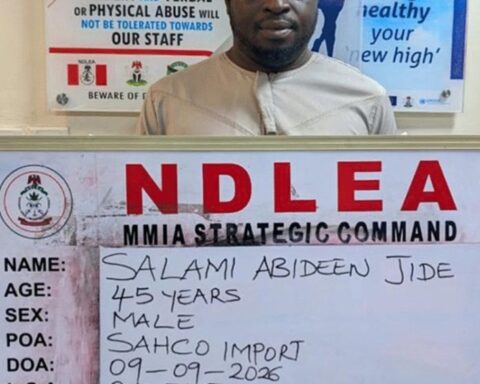
Security forces have arrested seven suspected commanders linked to Boko Haram and the Islamic State West Africa Province (ISWAP) at the Umaru Musa Yar’Adua International Airport in Katsina State immediately upon their return from the 2026 Hajj pilgrimage in Mecca, Saudi Arabia.
The high-profile arrests were officially disclosed by the Minister of Interior, Dr. Olubunmi Tunji-Ojo, at the Presidential Villa in Abuja. The announcement followed a milestone event where President Bola Ahmed Tinubu signed the National Identity Management Commission (NIMC) Act, 2026, into law.
According to government officials, the seven insurgents were intercepted by security operatives last Thursday as they arrived back in the country. They were swiftly processed and handed over to the Department of State Services (DSS) for interrogation.
“I’m happy to tell you that even last week, Thursday, seven of the known commanders of Boko Haram and ISWAP, at the point of coming back from Mecca, were arrested in Katsina at the airport and were handed over to the DSS,” Minister Tunji-Ojo stated.
The federal government described the operation as a monumental validation of Nigeria’s newly upgraded and integrated digital identity infrastructure. Previously, independent government databases operated in isolation, a loophole that historically allowed tracked individuals to slip through national borders.
The successful interception was attributed to core security layers working in tandem with NIMC Database Harmonization; The suspects’ National Identification Numbers (NIN) and biometric data were seamlessly accessible to border agents.
The Nigeria Immigration Service (NIS) database automatically cross-referenced passenger manifests with active criminal watchlists. The domestic platform is now actively linked 24/7 to Interpol’s global security network.
While celebrating the major security breakthrough at Nigeria’s air borders, the Minister acknowledged that challenges still remain elsewhere. “Our air borders are now effectively secured and automated, though our land borders remain a vulnerable area we are actively working to tighten,” Tunji-Ojo added.
The identities of the seven commanders, their specific operational cells, and details regarding how they initially obtained travel clearances have not yet been released by the DSS as investigations continue.