By Sonnie Ekwowusi
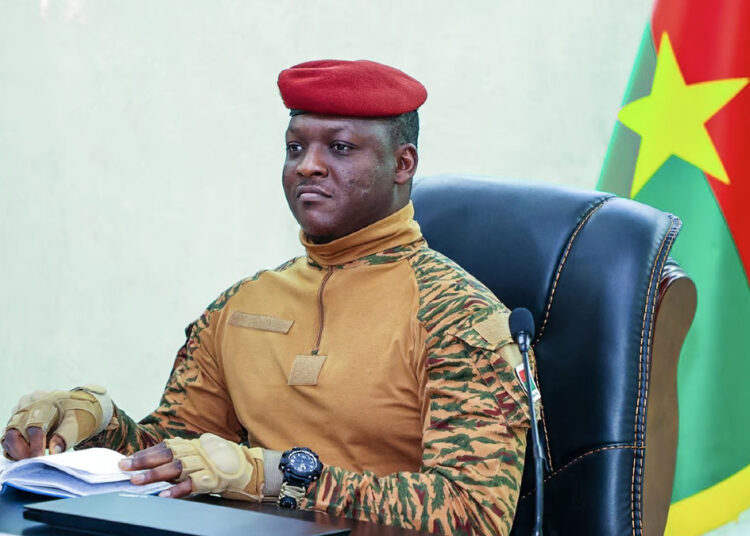
Burkina Faso’s irrepressible young military ruler, Ibrahim Traoré, has once again stirred continental debate with his blunt admonition that African countries should “forget about democracy.” In his telling, democracy is not merely flawed; it is bloody, imposed, and a modern instrument of subjugation. “Democracy kills,” he declares, urging Africans to run from it rather than embrace it.
In Traoré’s own words: “People must forget about democracy. If an African wants to tell you about democracy, you should run away. Democracy kills. Democracy as a Western ideal amounts to slavery, and it is killing. Wherever they want to install it in the world, it’s in the blood. There is no democracy in this world. They impose it when they want and they also kill it. Imperialism is the individual who wants to dominate the other, keep him in slavery and oppress him.”
These remarks, provocative as they are, cannot be dismissed outright. They speak to a growing frustration across Africa—one born not of theory, but of lived experience. In too many countries, democracy has failed to deliver its most basic promises. Elections are held, yet poverty persists. Governments are chosen, yet corruption thrives. Institutions exist, yet justice remains elusive. For millions of Africans, democracy has too often been reduced to a ritual devoid of tangible benefit.
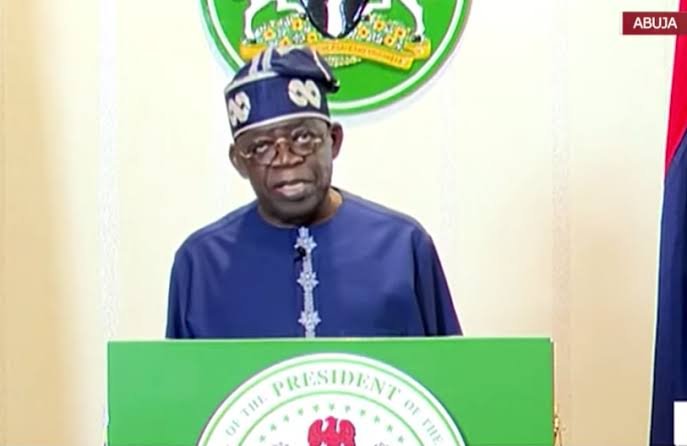
For example, Nigeria, the “giant” of Africa, is currently under the iron grip of President Bola Tinubu’s dictatorial, delusional and incompetent misrule. This is testing the limits of public patience and state capacity. Under the dictatorship of President Tinubu life has ceased to exist for many poor Nigerians. At the moment in Nigeria governance is in abeyance as the APC rulling party is only focused on how to return to power in 2027. Consequently, hope hangs in the balance.
The Nigerian streets are littered with walking corpses who pitiably regard themselves as human beings. All that President Tinubu is concerned with at the moment is how to return to power in 2027. To achieve this, he is poised to wipe away the five major opposition political parties so that he himself and his rulling party will be the only political party contesting the 2027 election.
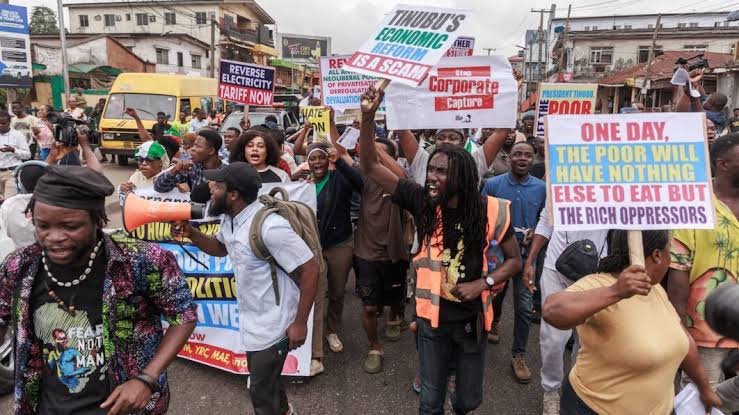
It sounds absurd but that is the reality in Nigeria at this moment. Meanwhile the Nigerian economy has collapsed with inflation eroding purchasing power and deepening hardship. Nigeria has just been named as one of the three countries in the world with most hungry people and most malnourished people. Hunger, unemployment, and frustration have become defining features of everyday life in Nigeria.
Even more troubling is the persistence—and in some areas, escalation—of insecurity. From insurgency in the North-East to banditry in the North-West to continuous killings in Kwara State and on the Plateau and communal violence elsewhere, the Nigerian state has lost the struggle to assert control and guarantee the safety of its citizens. This is why terror groups and criminal networks have adapted quickly, exploiting institutional weaknesses and porous borders.
The core issue is lack of responsibility on the part of the Tinubu government. Nigeria’s security architecture remains fragmented, under-resourced, and often reactive rather than proactive. Without a clearly articulated, homegrown strategy that integrates military action with intelligence, technology, economic development, and community engagement, the cycle of violence is likely to persist.
It is within this context that Traoré’s message finds resonance, particularly in Burkina Faso, where years of insecurity and governance failures eroded public confidence in civilian rule. Yet there is a glaring contradiction at the heart of his position. Having seized power in a September 2022 coup—ousting Lieutenant Paul-Henri Sandaogo Damiba, who himself had overthrown President Roch Marc Christian Kaboré—Traoré promised a swift return to democratic governance. That promise has since been deferred. The transition timeline has been extended to 2029, political parties have been curtailed, and citizens have been told, in unmistakable terms, to “forget” democracy.
This is no minor shift; it is a fundamental recalibration of Burkina Faso’s political trajectory. And it sends a troubling signal across the continent: that democratic failure may justify indefinite military rule. Yet to accept that conclusion would be to embrace a dangerous illusion.
The central question is not whether democracy has disappointed—clearly, in many instances, it has. The real question is whether the failures attributed to democracy are in fact failures of its practice rather than its principles. Democracy, properly understood, is not merely the conduct of elections. It is a system grounded in accountability, participation, and the rule of law. Where these elements are weak or manipulated, the result is not true democracy, but its hollow imitation.
Africa’s challenge, therefore, is not to abandon democracy, but to make it work.
On paper, democracy is compelling; in practice, it can be distorted into an engine of fraud. It promises participation, accountability, and freedom. Yet, as the French political thinker Alexis de Tocqueville observed in Democracy in America, even the system’s most celebrated model fell short of its ideals—susceptible to the tyranny of the majority, social inequality, and fragile institutions. Democracy, in other words, has never been a finished product. It is an aspiration that demands constant tending.
Africa’s experience has been more complex still. Democratic systems, often inherited wholesale from colonial powers, were grafted onto societies without the institutional foundations that make them work: independent courts, professional civil services, credible electoral bodies, and a civic culture that prizes accountability. The result, in too many places, has been democracy in form but not in substance—ballots cast without power dispersed; leaders elected without being held to account.
It is here that Traoré’s critique finds its audience. If the purpose of government is the welfare and security of the people, then outcomes matter. A system that cannot protect lives, create jobs, or deliver justice risks forfeiting its legitimacy, however procedurally correct it may be.
But this is only half the truth—and a dangerous half if taken to its conclusion.
The alternative on offer—military rule—has a long and sobering record. Across Africa, military regimes have often begun with promises of order and renewal, only to end in repression and decline. From Uganda under Idi Amin, to Nigeria under Sani Abacha, to the Central African Republic under Jean-Bédel Bokassa, the pattern has been grimly consistent: initial applause, followed by curtailed freedoms, weakened institutions, economic mismanagement, and eventual disillusionment. Without checks and balances, power concentrates; without scrutiny, it corrodes.
This is why the fixation must not be on democracy as a label, but on governance as a lived reality. The ultimate purpose of government is the welfare and security of the people. On this, Traoré is not wrong. But the means of achieving that purpose matter just as much as the end. Good governance cannot be sustained where citizens lack the power to question, to participate, and ultimately, to change their leaders.
The problem, then, is not democracy per se, but the failure to build the conditions that allow it to work. As Plato warned, political systems are only as good as the character and capacity of those who operate them. Democracy assumes civic virtue and institutional integrity that cannot be taken for granted. Where these are absent, outcomes will disappoint.
Yet the remedy is not abandonment but repair.
To dismiss democracy because it has been poorly practiced is akin to abandoning medicine because of a misdiagnosis. The task is to diagnose correctly and treat the underlying ailment: weak institutions, elite capture, impunity, and a deficit of public trust. Elections alone do not constitute democracy. A government that emerges from the ballot but governs without regard for the rule of law, economic justice, or public welfare cannot claim democratic legitimacy.
Good governance—effective service delivery, respect for rights, opportunity, and security—is the true test of any system.
Here, Africa’s own experience offers grounds for cautious optimism. Countries such as Ghana and Botswana demonstrate that democratic governance, though imperfect, can yield stability, legitimacy, and incremental development when institutions are respected and leaders are held accountable. Senegal has sustained civilian rule with credible transitions, while Namibia has combined regular elections with constitutional fidelity. These are not utopias, but they show that democracy—adapted and strengthened—can work.
Nor should the deeper moral dimension be ignored. Tocqueville argued that political institutions cannot endure without corresponding moral ties—that governance reflects the character of society itself. If democratic practice is to improve, it will require more than legal reform. It will demand a renewal of civic norms: integrity in public office, intolerance for corruption, and a citizenry willing to hold leaders accountable between elections, not merely during them.
This is the harder path. It is also the only sustainable one.
Traoré is right to insist that citizens care about results. However, he is wrong to suggest that those results can be secured by setting aside the very principles that make governments answerable. The choice between democracy and good governance is a false one. Properly understood, each requires the other.
Africa should not be fixated on democracy as a label. It should be fixated on governance that works—effective, accountable, and just. But history suggests that such governance is most likely to endure where power is limited by law, leaders are chosen and changed by the people, and institutions outlast individuals.
The continent stands at a crossroads. It can retreat into the false comfort of authoritarianism, or it can undertake the harder—but more necessary—task of building democratic systems that deliver.
Africa may not need to forget democracy.
It needs to finally make it work.
CONCLUDED