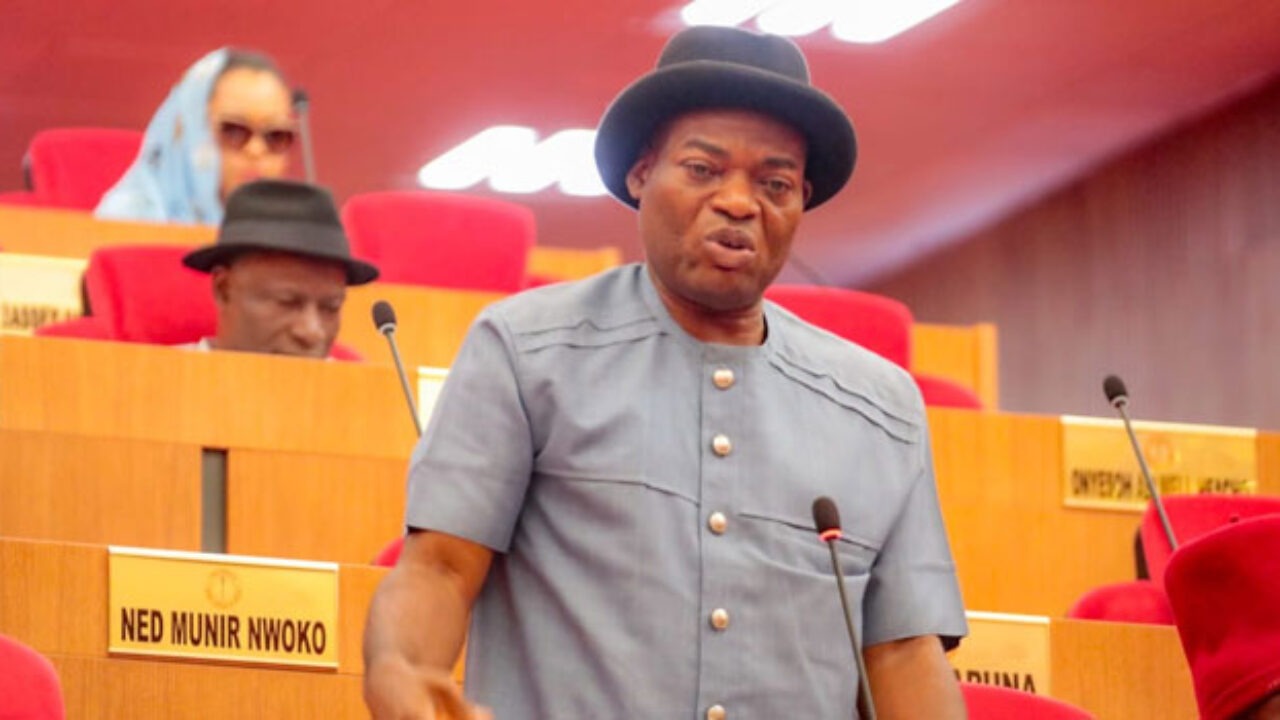
The shifting tides of Nigeria’s political landscape took a dramatic turn on Wednesday as the Senate confirmed Senator Tony Nwoye as the new Minority Whip, a development that underscores the growing influence of the ruling All Progressives Congress (APC) in the upper legislative chamber.
The announcement, which followed a unanimous decision by the minority caucus, came amid a fresh wave of defections that has significantly weakened the opposition bloc while consolidating the numerical advantage of the APC. Senator Nwoye, who represents Anambra North Senatorial District, steps into the role at a time of heightened political recalibration, with alliances being redrawn and loyalties shifting across party lines.
His emergence was necessitated by the exit of his predecessor, Senator Osita Ngwu, whose defection from the Peoples Democratic Party (PDP) to the APC sent ripples through the Senate. Ngwu’s move was not an isolated incident but part of a broader pattern of high-profile crossovers that have gradually tilted the balance of power in favour of the ruling party.
In a letter formally read on the Senate floor by Senate President Godswill Akpabio, Ngwu cited strategic political alignment as the driving force behind his decision. He pointed to the need to harmonize his legislative priorities with those of Enugu State Governor Peter Mbah and President Bola Tinubu, suggesting a pragmatic approach to governance that prioritizes cohesion over partisan divides.
Observers say the development reflects a broader trend within Nigeria’s political system, where ideological boundaries are often fluid, and political actors frequently reposition themselves in response to evolving realities. The APC’s growing dominance in the Senate has raised questions about the future of opposition politics, particularly the ability of minority parties to effectively check the ruling party’s agenda.
For Senator Nwoye, the new role presents both an opportunity and a challenge. As Minority Whip, he is tasked with coordinating the activities of opposition senators, ensuring party discipline, and articulating dissenting positions on key legislative matters. However, with the opposition ranks thinning, his ability to galvanize a cohesive and effective minority voice may be tested.
Political analysts note that Nwoye’s leadership style and experience could play a crucial role in redefining the opposition’s strategy in the Senate. Known for his grassroots appeal and legislative engagement, he is expected to bring renewed energy to the minority caucus, even as it grapples with internal fractures and external pressures.
Meanwhile, the APC’s expanding foothold in the Senate is likely to have far-reaching implications for legislative proceedings. With a strengthened majority, the ruling party is better positioned to advance its policy agenda, secure the passage of key bills, and influence critical appointments. This consolidation of power, while potentially enhancing efficiency, also places a greater responsibility on the minority to provide robust oversight and constructive criticism.
The latest defections have also reignited debates about the stability of Nigeria’s party system. Critics argue that frequent cross-carpeting undermines democratic principles and erodes voter confidence, while proponents contend that such movements reflect the dynamic nature of politics and the need for adaptability.
As the Senate continues its legislative business, all eyes will be on how these changes shape the institution’s dynamics. For now, the appointment of Tony Nwoye as Minority Whip stands as a symbol of both continuity and change, continuity in the Senate’s leadership structure, and change in the evolving balance of power that defines Nigeria’s democracy.