By Sonnie Ekwowusi
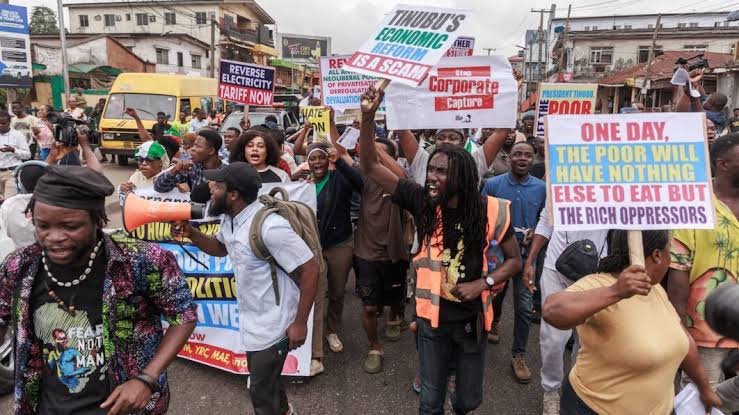
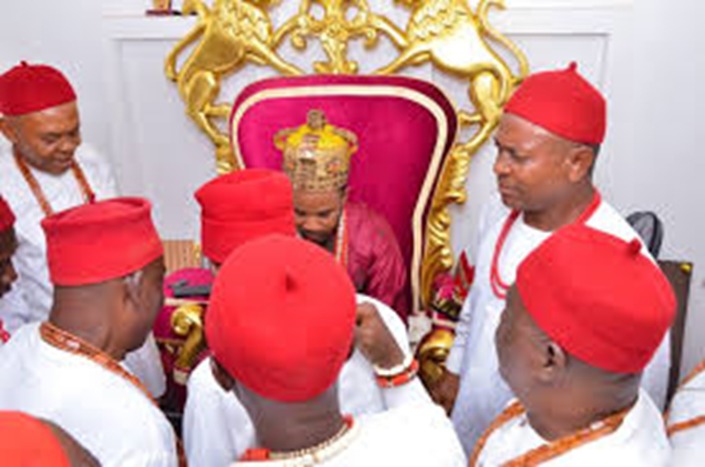
On March 30, 2026, protests erupted, accompanied by violence in parts of the Eastern Cape Province, located in the south-eastern part of South Africa, in response to the alleged coronation of Solomon Eziko as “Igbo King.” The demonstrators, who were opposed to the alleged coronation, took to the streets, leading to clashes and property damage, as described in multiple reports. The demonstrations later escalated, with some protesters marching to certain areas where they set vehicles ablaze and ignited public mayhem and disorder.
Amid the protests and rising tension, the Nigerian High Commission in South Africa issued a 10-point advisory to Nigerians residing in the country, cautioning them to maintain a low profile, suspend socio-cultural activities, and avoid provocative conduct. The Commission has effectively drawn attention to a hard truth: rights must often be exercised with restraint in volatile environments.
These are not arbitrary restrictions; they reflect a deep understanding of past episodes of xenophobic violence in South Africa, where minor triggers have spiralled into widespread unrest. In such a climate, caution is not cowardice—it is strategy. In a society as historically sensitive as South Africa’s, symbols matter, and the line between cultural identity and perceived sovereignty is easily blurred.
There is no doubt that Nigerians abroad, including the Igbo community, are entitled to freedom of association and cultural expression. In fact, the Constitution of South Africa guarantees these rights. Nigerians, including the Igbo community, are therefore well within their rights to organise, celebrate traditions, and even appoint leaders to coordinate communal affairs. Across Johannesburg and Cape Town, diaspora associations routinely elect presidents-general or chairmen to represent their interests.
However, such freedoms are not absolute. Within the context of rising tensions, cultural assertion—no matter how legitimate—can be misinterpreted, politicised, or even weaponised by hostile elements. The trouble lies not in Igbo people in South Africa exercising their right to cultural expression, but in the form and framing of such expression. Other Nigerian communities in South Africa tend to operate with measured visibility. Their activities—cultural festivals, meetings, dispute resolution, and welfare support—are essential to survival and dignity in a foreign land. Their leadership structures are rarely projected in ways that could be mistaken for territorial or sovereign authority.
Titles are often administrative rather than traditional. Ceremonies, where they occur, are typically modest, inward-facing, and carefully detached from the symbolism of state-recognised kingship.
This approach reflects a tacit understanding of South Africa’s legal and historical sensitivities, particularly in a society shaped by apartheid and its lingering anxieties about land, identity, and belonging.
However, the Igbo community in South Africa tends to be highly expressive and assertive in projecting its cultural identity. In stable environments, this is a strength—it builds solidarity and cultural pride. But in volatile settings such as South Africa, it may require strategic restraint to avoid misunderstanding or backlash.
Cultural rights exercised in a foreign land must be guided by prudence and sensitivity.
South Africa is a society shaped by the deep historical experience of apartheid, where issues of land, identity, and belonging remain emotionally and politically charged. In such an environment, symbolism carries weight beyond intention. Perception matters greatly; indeed, in this context, it is as potent as reality. South Africa’s periodic eruptions of xenophobic violence, notably in cities like Johannesburg and Durban, have seldom depended on careful distinctions. Rumour, symbolism, and spectacle often provide sufficient tinder.
A widely circulated video of the coronation of an Igbo king—however benign its intent—can be reframed as evidence of foreign encroachment.
The point, therefore, is not to deny the Igbo community—or any group—the right to organise or celebrate culture. Rather, it is to urge measured expression. When cultural leadership is projected with grand titles, elaborate coronations, or imagery that resembles sovereign authority, it may be misunderstood by outsiders as a claim to status beyond internal community coordination. This is why the expression of cultural identity should be exercised with restraint.
This is not a sign of cultural inferiority; it is an adaptation to context. It reflects an understanding that, in a foreign society, perception can shape acceptance as much as legality.
There is a difference between celebrating heritage and projecting authority. The former builds respect; the latter can unintentionally provoke suspicion. When you live in another people’s country, your rights travel with you—but so does the responsibility to exercise them with restraint, respect, and awareness of local sensitivities. To crown an Igbo king with a full public ceremony in South Africa may be read as an attempt to establish parallel authority.
This is where discretion becomes not merely advisable but essential. Cultural rights, though guaranteed, are not immune from the consequences of misinterpretation.
To be clear, no one suggests that Igbo people or Nigerians should erase their identity or suppress their traditions in South Africa or elsewhere abroad. The argument is simply that cultural expression should be calibrated to its environment. To “crown” a traditional ruler—complete with regalia, titles, and public ceremony—risks invoking a system of authority that, within South Africa, is neither symbolic nor casual.
In that sense, the call for the Igbo community in South Africa to be modest and unprovocative is not a denial of their rights—it is a strategy for peaceful coexistence and long-term security. Where cultural leadership is publicly dramatised in the language and imagery of traditional rulership—crowns, coronations, titles like “Igbo King”—it risks being interpreted, rightly or wrongly, as something more than internal community coordination. In a tense environment, symbolism can easily be misread as ambition. What is intended as cultural pride may be perceived as political assertion. The problem lies not in the existence of leadership, but in its presentation.
Cultural identity should therefore be expressed in ways less likely to trigger misunderstanding or hostility.
The Nigerian High Commission’s intervention should thus be read less as a rebuke than as a pragmatic appeal to caution. Its concern is not with the preservation of Igbo identity, but with the safety of Nigerians whose livelihoods could be imperilled by avoidable controversy.
There is, in any case, a simpler path. Cultural leadership need not mimic traditional sovereignty to be meaningful. Controversial traditional titles that invite political misunderstanding should be avoided. Quiet diplomacy with local authorities, and a preference for modest, inward-facing ceremonies, would preserve heritage while minimising risk. Diasporas, by their nature, straddle two worlds. They carry the weight of memory while navigating the realities of their adopted homes.
The challenge is not whether to retain identity, but how to do so without unsettling the delicate balance of coexistence.
In the end, the lesson is a familiar one. In a country such as South Africa, still grappling with the legacies of apartheid—where land, identity, and belonging remain politically charged—expressions of cultural identity, however genuine and well-intentioned, can quickly be misinterpreted as assertions of territorial or cultural dominance.
This is where prudence and discretion become not merely advisable but essential. Diaspora communities do not operate in a vacuum; they exist within host societies whose anxieties may not align with their intentions. Cultural rights, though guaranteed, are not immune from the consequences of misinterpretation.
CONCLUDED