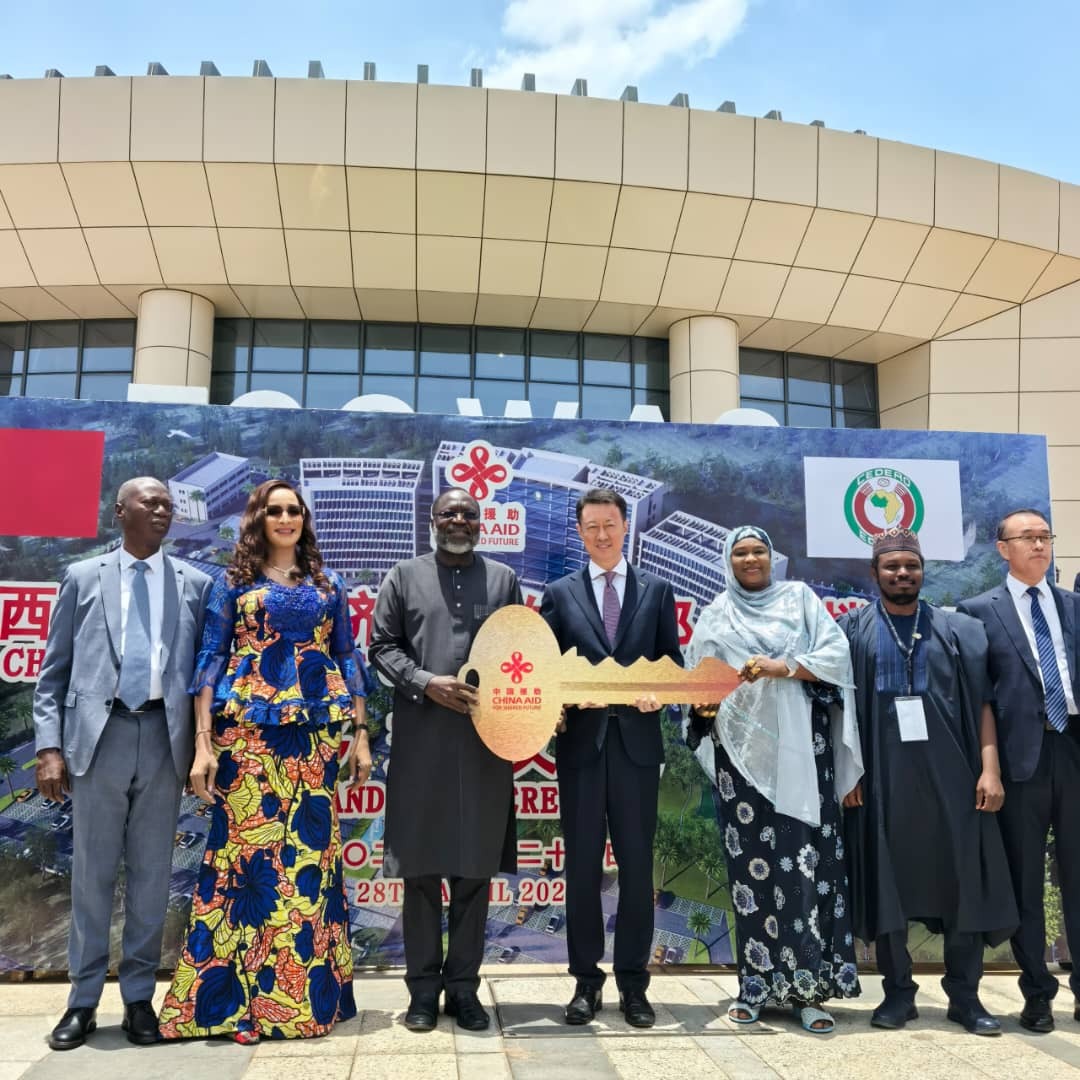
A significant chapter in regional diplomacy and international cooperation was written in Abuja on Tuesday as the Government of the People’s Republic of China formally handed over a newly completed $56.5 million headquarters complex to the Economic Community of West African States (ECOWAS). The landmark event, attended by top government officials, diplomats, and regional leaders, was widely described as a powerful symbol of deepening ties and shared aspirations between China and West Africa.
The imposing structure, located in Nigeria’s capital, stands not just as an architectural achievement but as a testament to a relationship that has steadily evolved over nearly three decades. Built with funding from the Chinese government, the complex is expected to serve as a central hub for ECOWAS operations, diplomacy, and regional coordination.
At the heart of the ceremony was China’s Ambassador to Nigeria, Yu Dunhai, who described the handover as a historic turning point. Speaking with a tone of pride and optimism, he reflected on the journey that has defined China–ECOWAS relations.
“This is a historical moment,” he said. “The China-ECOWAS relationship started roughly three decades ago, and it has always been guided by principles of mutual respect, equality, mutual benefit, and win-win cooperation.”
His remarks captured the essence of a partnership that has grown from modest beginnings into a strategic alliance spanning infrastructure development, trade, security cooperation, and cultural exchange. The new headquarters, he noted, represents not just a physical space, but a shared vision for the future.
For ECOWAS, the new facility comes at a time when the region faces complex challenges, from economic integration and security threats to climate concerns and youth unemployment. Leaders at the event emphasised that the modern complex would enhance the organisation’s capacity to coordinate policies and respond effectively to regional issues.
Nigerian officials, hosting the event in Abuja, praised the project as a reflection of Nigeria’s central role in West African affairs and its longstanding partnership with China. They noted that the country continues to benefit from Chinese investments in infrastructure, technology, and energy, while also serving as a gateway for broader regional cooperation.
Observers at the ceremony highlighted how the headquarters project mirrors similar Chinese-funded initiatives across Africa, where Beijing has supported the construction of key institutional buildings, roads, railways, and communication networks. However, this particular project stands out for its direct impact on regional governance and diplomacy.
Beyond bricks and mortar, the handover carried symbolic weight. It reinforced the idea that partnerships between global powers and regional organisations can be built on shared goals rather than competition. For ECOWAS, it also signals confidence in its mission to drive integration and stability across West Africa’s 15 member states.
Some analysts view the development as part of China’s broader strategy to strengthen its presence and influence in Africa through infrastructure diplomacy. Others see it as a mutually beneficial arrangement, where African institutions gain much-needed resources while China deepens economic and political ties.
As dignitaries toured the new complex, admiring its modern facilities, conference halls, and administrative spaces, there was a palpable sense of optimism about what it represents. For many, it is not merely a building, but a foundation for future collaboration.
The ceremony concluded with expressions of hope that the new headquarters would serve generations to come, fostering dialogue, unity, and progress across the West African region.
As the sun set over Abuja, the gleaming structure stood as a quiet yet powerful reminder: partnerships built on cooperation and shared vision can shape the course of regions, and perhaps, even redefine the future of global relations.