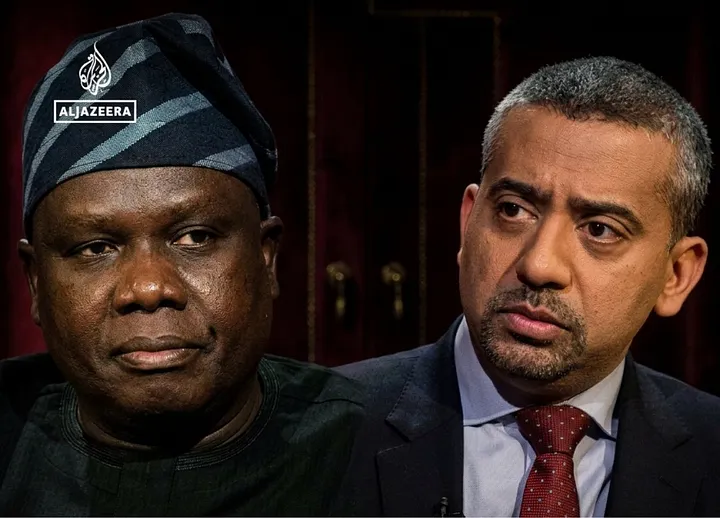
A Masterclass in Political Embarrassment on Al Jazeera
By Agbeze Ireke Kalu Onuma, AI-KO
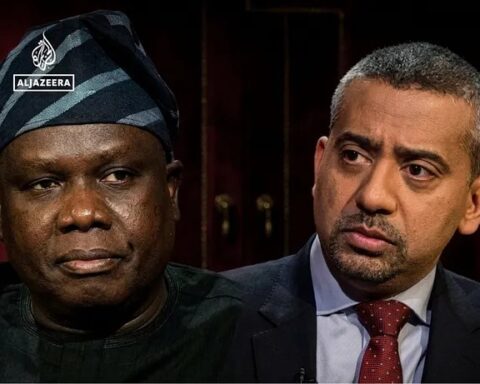
There is a specific, tragic kind of hubris required to take the dark, disjointed reality of the Nigerian experience and attempt to package it as a glowing success story on global television. It is one thing to stand before the compliant microphones of state-run media in Abuja and practice what might be called “statistical gaslighting” – telling a populace in darkness that they are actually bathed in light. It is an entirely different, catastrophic beast to export that same delusion to London, sitting under the harsh, unforgiving glare of Al Jazeera’s journalistic scrutiny. You know that feeling when someone walks into a room thinking they’re about to dominate the conversation – and then the lights come on, the cameras zoom in, and suddenly every past word they’ve ever spoken is sitting there, waiting? That is what Daniel Bwala’s appearance on Al Jazeera’s Head to Head with Mehdi Hasan felt like: not a defence of power, but a live autopsy of political convenience.
There is an old saying in public relations that any coverage is good coverage. After watching Daniel Bwala’s catastrophic appearance on Al Jazeera’s Head to Head with Mehdi Hasan, even the most optimistic spin doctor would struggle to…
To understand the sheer absurdity of Bwala on Al Jazeera, one must first trace the trajectory of the man himself. You do not need to look far back into the archives to find a Daniel Bwala who breathed fire against the very establishment he now defends. During the 2023 election cycle, as a spokesperson for the opposition PDP and Atiku Abubakar, Bwala was the ultimate attack dog. He was articulate, ruthless, and seemingly principled. He tore into the APC’s Muslim-Muslim ticket, dismantled their economic record, and painted Tinubu’s mandate as an impending disaster for the republic. Then came the pivot. In a maneuver that perfectly encapsulates the absolute ideological bankruptcy of the Nigerian political class, the fierce critic made the pilgrimage to the Aso Rock Villa, declared his loyalty to the President, and was eventually rewarded with a portfolio to speak for the government. When a man who once told you the soup was poisoned suddenly demands that you praise the chef, he has lost the moral authority to convince you. Bwala’s appearance on Al Jazeera was doomed before he even opened his mouth because his very presence on that screen represented the transactional, “stomach infrastructure” politics that has crippled Nigeria. He was sent to global television to defend a mandate he once swore would destroy us.
The most damning sequence of the interview – the moment that will follow Bwala for the rest of his public life – was his repeated, almost reflexive denial of his own recorded history. Hasan, a journalist renowned for his forensic interviewing style and his habit of “keeping the receipts,” came armed with video clips, timestamps, and direct quotations from Bwala’s time as a fierce critic of Tinubu during the 2023 campaign. “You said Tinubu started a militia to sway the election corruptly,” Hasan put to Bwala, citing a January 22, 2023, remark. “Tinubu didn’t create a militia, and I never said that,” Bwala responded flatly. The pattern repeated itself with mechanical precision. When Hasan referenced allegations about suspicious cash movements into Tinubu’s residence – the infamous bullion van episodes that dominated campaign discourse – Bwala again responded, “I never said that”. When confronted with clips of himself claiming that Tinubu or his associates had threatened him personally, the response was identical: “I never said that” .
The problem, as multiple Nigerian news outlets documented extensively at the time, is that Daniel Bwala absolutely said these things. They were not whispered in private conversations or misattributed by hostile reporters. They were public statements, carried by major Nigerian media, made during his energetic service as a spokesman for the Atiku Abubakar campaign. The denials were not just false – they were demonstrably, verifiably false, and Hasan had the footage to prove it. What made the exchange so excruciating was not merely the dishonesty but the clumsiness of it. A skilled political operative might have acknowledged the past statements while explaining changed circumstances or the evolution of his understanding. Instead, Bwala chose the path of outright denial, apparently betting that the international audience would not have access to Nigerian news archives. It was a bet he lost spectacularly. Hasan, visibly frustrated by the evasions, finally confronted Bwala with the ultimate evidence of bad faith: “At the weekend, you put out a video to music of you and your team researching and prepping for this show and…now every time I ask you say you are not aware of that….what were you researching in that video…?” The question hung in the air, unanswered and unanswerable. If Bwala and his team had spent days preparing, how had they not anticipated questions about the most obvious vulnerability in his profile? The video, intended to project diligence and professionalism, instead became evidence of either incompetence or a deliberate strategy of evasion that collapsed on contact with reality.
If the past statements segment was humiliating, the exchange on Nigeria’s security situation was intellectually catastrophic. The tragedy of the Al Jazeera interview unfolded in the brutal clash between local propaganda and international data. In Nigeria, political spokespersons are accustomed to a specific kind of press engagement. They operate in an ecosystem where they can issue a monologue, deploy technical jargon about “fiscal consolidation” and “Band A tariffs,” and walk away unchallenged. But Al Jazeera is not a compromised local network. The anchors there do not owe their broadcasting licenses to the Minister of Information. Hasan, citing reports from Amnesty International and Nigeria’s own National Human Rights Commission, presented data showing that violence had intensified under Tinubu’s watch. The numbers were stark. Bwala’s response was to retreat into what he apparently imagined was sophisticated rhetorical terrain: the appeal to context. What followed was a dialogue that will live in infamy in Nigerian political discourse:
Hasan: You are failing. Amnesty International says you are failing at security. The numbers don’t lie.
Bwala: It’s unfortunate and as a government working day and night that situation. I don’t agree to the fact that it’s getting worse.
Hasan: How can it not get worse if more people die in one year than the previous year?
Bwala: Context matters.
Hasan: What’s the context?
Bwala: The context is not getting worse.
Hasan: What!
Bwala: Yes.
Hasan: The context is not getting worse?
Bwala: The context is that it is not getting worse, because you, you see this is a water, right?….
The exchange descended into incomprehensibility from there, with Bwala’s grammar collapsing alongside his logic. One commentator noted that this was some cringeworthy self-own from a man who is, ostensibly, a lawyer and a presidential adviser on communication. But beyond the linguistic train wreck, something more significant was happening. Bwala was not merely disputing interpretations of data – he was disputing arithmetic. He was telling an international audience, with millions of viewers, that things were not getting worse when every measurable indicator suggested they were. He was asking Nigerians watching at home, many of whom have buried loved ones, paid ransoms, or abandoned their farms due to insecurity, to accept that their lived reality was somehow invalid. This is the point at which government defense crosses into insult. As one analysis put it, when a spokesman tells the world that things are not getting worse while credible datasets show that they are, he is insulting the intelligence of everyone listening, especially Nigerians who bury the dead, pay ransoms, withdraw their children from schools and avoid highways after dark.
Later, in post-interview defences, Bwala attempted a familiar move: relativise Nigeria’s crisis by universalising insecurity. “I acknowledge the fact that we have insecurity in Nigeria,” he said, adding that no country in the world is entirely free from security threats. This is technically true – no country is completely free from insecurity – but strategically hollow. When your country is being described as one of the deadliest places in the world, the bar is not “we’re not the only ones with problems.” The bar is: what are you doing, specifically, to change that? Bwala further argued that for the first two years of the present administration, Nigeria experienced “substantial peace,” and that terrorism has remained a global phenomenon since the September 11 attacks, making international cooperation necessary. Using a glass of water analogy, he claimed that while Western media would see it as half empty, Nigerians would see it as half full . But when an interviewer can pull up reports of a female lawyer slaughtered on the Kubwa Expressway, or the expansion of terror groups in the North West, such analogies ring hollow. Critics like Isaac Fayose captured the public mood bluntly: “You can’t defend this government without looking stupid,” he said, reacting directly to Bwala’s Al Jazeera performance. That line stings because it names what many viewers felt watching the interview: not just disagreement, but embarrassment. The sense that the defence being offered was not only weak, but almost insulting to the lived reality of Nigerians facing kidnapping, banditry, and economic hardship. When a spokesman leans on “every country has insecurity” while people are counting bodies and ransoms, it doesn’t sound like context – it sounds like detachment.
Hasan also pressed Bwala on the appointment of Abubakar Bagudu as Minister of Budget and Economic Planning – a choice that had drawn criticism given Bagudu’s history with recovered Abacha loot. The record shows that Bagudu returned approximately $163 million linked to the Abacha investigations in a settlement with authorities. Whether one characterizes this as a conviction or a settlement, the public controversy was substantial enough that any competent spokesman should have been prepared to address it. Bwala was not prepared. He reached for the same evasive tactics, attempting to minimize or deflect rather than engage substantively. The problem, as with the security discussion, was that his evasions were transparent. They did not survive contact with Hasan’s follow-up questions. Even more damaging was Bwala’s attempt to spin Tinubu’s own words. The president had famously declared at a public event that Nigeria had “no more corruption” – a statement so sweeping and obviously disconnected from reality that it became a national joke. Bwala’s attempt to retroactively narrow the meaning, to suggest that Tinubu had meant something other than what he actually said, was described by one observer as out-and-out mendacity.
In the days following the interview, as social media erupted with clips of his most embarrassing moments, Bwala issued a series of statements attempting to explain – or explain away – his performance. The excuses were, in their own way, as revealing as the interview itself. First, Bwala claimed he had been ambushed. The producers, he said, had indicated the discussion would focus on “security, the economy, and corruption” and had not mentioned in “almost six months of communication” that they would “challenge his past” . “If that had been their plan, ethically and professionally, they were supposed to inform me so I could prepare my response. But that’s okay, ethically, that is on them, not on me,” he said . The claim is revealing – not for its accuracy, but for what it says about Bwala’s understanding of journalism. Since when do interviewers provide a detailed roadmap of their toughest questions in advance? Since when is it “unethical” for a journalist to ask questions that a guest would prefer to avoid? The complaint essentially amounted to: “They asked me questions I didn’t want to answer.” That is not an ethical violation by the journalist; it is the entire point of adversarial journalism.
Second, Bwala dismissed the factual basis of Hasan’s questions, claiming that “many were inaccurate and some were outright fake news” . He did not, however, identify which specific claims were inaccurate or provide evidence to support his assertion. The vagueness was strategic – it allowed him to cast doubt without subjecting his counter-claims to verification. He accused Hasan of practicing “opposition research-style journalism” and alleged that some quotes attributed to organisations and groups were inaccurate . But if you are going to accuse a globally known journalist of “fake news,” you need to bring receipts of your own. He didn’t. He just asserted.
Third, and most revealingly, Bwala deployed what might be called the “Trump cabinet defense.” His past statements, he argued, should be understood as products of their time – opposition rhetoric from someone doing “the job of opposition”. “Half of Donald Trump’s cabinet is made up of people who once spoke against him, and quite a number of people in our own cabinet also spoke against President Tinubu in the past,” he noted . The analogy is instructive, though not in the way Bwala intended. Yes, political realignments happen. Yes, former critics often join administrations they once opposed. But there is a difference between changing your mind and denying you ever held the mind you changed. The Trump officials Bwala cited did not, as a rule, stand in front of cameras and claim they had never said the things they had clearly said on video. They acknowledged their evolution; they did not erase their history. The broader problem with the defense is that it misunderstands what was actually damaging about the interview. The issue was not that Bwala had once criticized Tinubu – that was well known and, by itself, unremarkable. The issue was that he attempted to deny his own words in real time, on camera, while the evidence sat in front of him. It was not the original criticism that undermined his credibility; it was the desperate, transparently false attempt to escape it.
Perhaps the most revealing line in his post-interview defence is the phrase that cuts to the heart of Nigeria’s political dysfunction: “It is all politics” . With these four words, Bwala offered an inadvertent confession about how cheap words have become in the political marketplace. When he called Tinubu unfit in 2023, he wants us to believe it was “just politics.” When he now calls Tinubu worthy, we are supposed to accept that this, too, is “just politics.” In trying to normalise his U-turn, he accidentally exposes the hollowness of his own voice. If everything is “just politics,” then nothing he says carries moral weight. He is not a communicator; he is a weather vane. And that is the core absurdity: a spokesperson whose defence of his boss is built on the open admission that his words are situational, not principled. This is the tragedy of Nigeria’s political class – where loyalty is seasonal, and integrity is transactional . When a man speaks in one direction today and the opposite direction tomorrow, he becomes a danger to truth, loyalty, and leadership .
This pattern extends far beyond Bwala. The Emir of Kano, Muhammadu Sanusi II, has lamented the presence of too many sycophants in the Nigerian political space, arguing that those appointed as aides and advisers to political office holders often fail to tell their principals the truth, but only say what such leaders want to hear. “You sit in a meeting, and the President is there. The first thing people say is, ‘Mr. President, I want to thank you for your great leadership. God has blessed Nigeria by making you our leader.’ By the time they finish laying that foundation, it is their advice that the President accepts. But when you tell the truth and point out what is wrong, they say you are the enemy,” Sanusi observed . He specifically called on those working closely with the President to avoid blind loyalty but speak the truth to the leaders: “Those who work with the President must understand that it is not in their benefit to turn themselves into praise singers. You disgrace yourself and the office you hold when you do that” .
Rather than accept that ordinary Nigerians and neutral observers might have found his performance poor, Bwala chose a simpler explanation: it is all the opposition. He wrote that “the majority of the naysayers are members of the opposition and their sympathisers. It does not bother me one bit”. This is a convenient shield: if criticism is always “opposition,” then you never have to listen. But the interview didn’t go viral only in partisan spaces; it spread because the contradictions were visually undeniable. You don’t need to be PDP, APC, Labour, or anything at all to recognise when someone is caught on tape contradicting themselves. By reducing all backlash to “opposition excitement,” Bwala avoids the harder question: What does it mean that my own words, on video, are my biggest enemy?
Bwala also tried to reframe his role as something almost sacrificial, writing: “When I signed on to the privileged job granted to me by Mr. President, I was well aware of its implications. Selling ice cream, looking fine, and seeking the praises of men were never part of it” . He insisted, “The task of promoting and defending the President and his administration is what I do with ease and joy. I am prepared to appear before any interviewer, anywhere in the world, any day and at any time, to defend this government and its policies”. There is a kind of tragic irony here: he insists he does this job “with ease and joy” right after an interview that looked anything but easy and certainly not joyful. The rhetoric is heroic; the footage is humiliating.
Isaac Fayose, a prominent Nigerian businessman and social commentator, put it bluntly in his reaction to the interview: “You can’t defend this government without looking stupid” . The comment, while harsh, captures something essential about Bwala’s predicament. The Tinubu administration, at the two-year mark, faces challenges that are difficult to spin away. Security has deteriorated by most metrics. Economic hardship has intensified, with poverty deepening and the country earning the grim distinction of being “the capital of malnourished children in Africa.” Controversial appointments have raised questions about the president’s commitment to anti-corruption. These are not opposition talking points; they are documented realities.
Even more telling is the broader climate of repression facing critics of the administration. In the same week that Bwala was struggling on Al Jazeera, popular Islamic cleric Sheikh Alkali Zaria was suspended by his organization for sermons critical of the president. Sheikh Zaria had pointedly observed that “State Governors fear President Tinubu much more than they fear Allah,” adding, “If you are in the APC, you are treated like a saint. If you are a member of the opposition, you will be treated like a devil.” The contrast with Bwala’s situation – a former critic now enjoying government patronage while other critics face silencing – could not be starker. This is the context that made Bwala’s performance so damaging. He was not merely failing to defend the government effectively; he was embodying the very qualities that critics associate with the administration: evasiveness, contempt for evidence, and the assumption that public memory can be erased through sheer denial.
Beyond the individual humiliation, Bwala’s Al Jazeera appearance represents something larger and more troubling: the bankruptcy of Nigerian political communication as currently practiced. As one analysis noted, too many spokesmen believe their job is not to illuminate but to survive the segment. So, they deny what is documented, nervously laugh when cornered, compare Nigeria with unrelated countries, abuse the word “context” and hope that shamelessness can do the work preparation cannot. The approach works, to the extent it works at all, only in controlled environments – friendly local media, carefully managed press conferences, social media echo chambers. It collapses immediately when exposed to genuine adversarial questioning from someone who has done the homework. Mehdi Hasan did not defeat Bwala through superior rhetoric or gotcha journalism. He defeated him by reading Nigerian news reports and asking about their contents. The receipts were public. Bwala simply hoped no one would present them.
Strip away the noise, and what you are left with is this: Daniel Bwala’s Al Jazeera outing exposed a style of political communication that is fundamentally unserious about truth. Look at the pattern: deny past statements, get confronted with video; blame the host’s style instead of owning the inconsistency; romanticise the job instead of demonstrating competence; dismiss critics as opposition instead of engaging with valid concerns; wave away past positions as “all politics” instead of explaining a genuine evolution of thought. This is not PR in the sense of “public relations”; it is PR in the sense of “public theatre.” The goal is not to persuade, but to survive the moment, to say whatever is necessary today and explain it away tomorrow. But the world has changed. Shows like Head to Head are built on archives. Social media is built on memory. You cannot outrun your own words anymore.
There is a lesson here that extends beyond one man’s professional embarrassment. A government that cannot be defended honestly, that requires its spokespersons to deny reality and disown their own histories, is a government with a fundamental credibility problem. The spokespersons are not the cause of that problem; they are its most visible symptom. What this PR disaster exposes is the terrifying insularity of the Nigerian government. They have been talking to themselves in the echo chambers of the Villa for so long that they genuinely believed their own press releases. They sent Daniel Bwala to Al Jazeera thinking that eloquence could override economics. They suffered from the delusion that if you speak confidently enough, the world will ignore the blood on the floor and the darkness in the homes. This is the peak of the Dunning-Kruger effect – the arrogance of leaders who think global credibility can be hacked with the same cheap rhetoric used to pacify a starving local ward.
Perhaps the cruelest detail in the entire saga is Bwala’s pre-interview video, showing himself and his team researching and preparing for the appearance. The video was meant to project competence, to signal that this was a serious operation taking the assignment seriously. Instead, it became evidence of just how thoroughly that preparation failed. What, exactly, were they researching? How did they miss the most obvious line of questioning any competent journalist would pursue? How did they not anticipate that a man who spent years attacking Tinubu would be asked about those attacks? The questions answer themselves. They anticipated it; they simply hoped it wouldn’t happen, or believed they could deflect when it did. The video, meant to be a flex, became an indictment. Bwala now says he looks forward to “part two of the Head to Head interview,” expressing hope that by then “questions about my past will no longer be news” so that the focus can be on “our administration’s policies, programs and what we have achieved so far” . The statement suggests a fundamental misunderstanding of what went wrong. The past was not the problem; the denial was. If Bwala returns for another round, he might consider a different approach: acknowledgment rather than amnesia, honesty rather than evasion. He might, in other words, try treating the audience as intelligent adults rather than marks to be managed.
Daniel Bwala’s Al Jazeera appearance will be remembered for many things: the repeated “I never said that” denials, the circular logic of “the context is not getting worse,” the post-interview excuses about being ambushed. But what it should be remembered for is something simpler and more fundamental: the demonstration that in any honest confrontation between power and accountability, the receipts always win. Mehdi Hasan came armed with documentation – news reports, video clips, timestamps, quotes. Bwala came armed with talking points and the apparent belief that sheer assertion could override evidence. It could not. It never can. And in the collision between the two, the viewers learned something important about whose word could be trusted.
The economic dimension of Bwala’s Al Jazeera appearance deserves far more scrutiny than it has received, for it was here that the gap between official rhetoric and lived reality yawned widest. When pressed on inflation, currency collapse, and the crushing cost of living that has pushed millions deeper into poverty, the defence offered was not one of substance but of evasion dressed in the language of patience. The conversation drifted toward vague metrics instead of concrete data, with Bwala leaning heavily on general claims that “reforms take time” and that the government “inherited problems” from previous administrations. These are not arguments; they are placeholders where arguments should be. The inconvenient truth here is that when a spokesperson cannot confidently walk through specific indicators – food inflation now exceeding forty percent in some estimates, unemployment figures that tell a story of a generation locked out of productive life, exchange rate trends that have seen the naira lose more than half its value against major currencies – it signals either a profound lack of preparation or a deliberate strategic choice to blur reality into something more palatable. Neither option inspires confidence. The word “reform” appeared throughout as a kind of magic pass, an incantation meant to ward off criticism: subsidy removal, exchange rate unification, fiscal tightening. But reform is not a moral category; it is a tool whose value is determined entirely by its effects on human lives. The hard question that went unanswered is simple and devastating: reform for whom, and at what cost, right now? When a mother cannot afford beans, when a father cannot keep his child in school, when young graduates spend years submitting applications that vanish into void, the promise that pain is investment in future prosperity rings hollow. What the interview exposed was a communication style that treats economic suffering as an unfortunate public relations problem to be managed rather than as the central fact of people’s daily existence that must be addressed with clarity, empathy, and measurable commitment to change.
The treatment of corruption in the interview followed a pattern so familiar in Nigerian political discourse that it barely registers as remarkable, yet its implications are devastating for any claim to good governance. Before joining the current administration, Bwala had built a public identity as a fierce critic of the very political actors he now defends, describing them in terms that left no room for ambiguity about his assessment of their character and fitness for office. In the Al Jazeera interview, there was no serious attempt to explain how that view changed – no presentation of new evidence that might have altered his understanding, no articulation of an ideological shift that would make sense of the reversal, no policy conversion that could explain why the man once deemed unfit now deserves the nation’s trust. What viewers witnessed instead was a jump, unmediated and unexplained, from “this man is unfit” to “this government is on the right track.” The inconvenient truth here is that when a spokesperson cannot narrate a believable journey from past condemnation to present loyalty, the only remaining explanation is that the pivot is transactional rather than principled. It is not that political realignments never happen or that former critics cannot legitimately join administrations they once opposed; it is that such movements require an account of themselves, a public reckoning that acknowledges the past while explaining the present. The absence of that reckoning tells the audience everything they need to know about the relationship between conviction and convenience in the counsels of power. Furthermore, the defence of the government on corruption tended to frame the phenomenon as something that either belongs mostly to previous administrations or is exaggerated by opponents and foreign observers seeking to undermine Nigeria’s progress. What gets exposed here is a pattern so worn it has become invisible: corruption is rarely denied outright in these settings; it is relativised, minimised, or reframed as “not as bad as before.” But that does not reassure anyone who understands that corruption is not a comparative sport. Telling a nation that the rot is less extensive than it used to be is not an argument for trust; it is an admission that the bar has been set so low it scrapes the ground. When citizens cannot access basic services without paying bribes, when contracts are awarded to political loyalists regardless of competence, when public funds disappear into pockets while hospitals lack drugs and schools lack teachers, the question is not whether things are better than under previous governments. The question is whether this government, right now, is delivering the transparent and accountable governance that Nigerians deserve and that the constitution demands.
Even more troubling, and less discussed in the immediate aftermath, was what the interview revealed about the government’s relationship with Nigeria’s youth – a demographic that constitutes the majority of the population yet feels increasingly alienated from the institutions that claim to represent them. Though the exchange on this topic was brief, its implications were profound. When youth frustration, protests against police brutality, or the relentless online outrage that has become the signature of Nigeria’s digital generation are framed primarily as the product of opposition propaganda or foreign narratives seeking to destabilise the country, something important is revealed: a refusal to treat that anger as rational, as grounded in genuine grievance, as worthy of respect. The inconvenient truth that Bwala’s performance inadvertently exposed is that if a government’s communicator cannot publicly acknowledge that young people have good reasons to be angry – joblessness that stretches years into decades, insecurity that makes every journey a gamble, police brutality that has claimed too many lives to count, a sense of hopelessness that pervades even the most basic aspirations for a decent life – then the communication is not merely tone-deaf; it is actively alienating. It tells young Nigerians watching at home that their suffering is not seen, their voices are not heard, their reality is not acknowledged by those who claim to govern in their name. A strong communicator would use a global platform like Al Jazeera to show, concretely and with specific examples, how young people are being brought into decision-making processes, not just as voters to be mobilised at election time but as partners in shaping the nation’s future. Instead, what came through was defensive rather than invitational, dismissive rather than engaged. That gap exposes a deeper problem that no amount of spin can address: a state that wants obedience from its youth more than it wants their trust, that seeks compliance rather than partnership, that treats the energy and creativity of Nigeria’s young population as a threat to be managed rather than a resource to be harnessed.
Beyond the content of what was said lies the question of how it was said – the body language, the tone, the posture that communicates as powerfully as any words. Strip away the policy discussions and look instead at the performance: the interruptions that cut off questions before they could be fully articulated, the insistence on talking points even when those points had been clearly refuted, the quick denials that arrived before the interviewer had finished speaking, the visible irritation when confronted with contradictions that could not be explained away. The energy throughout was less “let me clarify this important issue” and more “I must not lose this exchange.” That instinct is understandable on a human level – no one enjoys being cornered on live television – but it is disastrous for credibility. When every question is treated as an attack to be parried rather than a concern to be answered, the audience feels managed rather than respected. They sense that they are watching a performance rather than a conversation, that the goal is not to illuminate but to survive, not to inform but to defend. On some questions, instead of a direct “yes or no” followed by explanation, there were detours that led nowhere: shifting responsibility to what previous governments did, invoking global crises as if Nigeria’s problems were merely a reflection of worldwide trends, questioning the motives of critics rather than engaging with the substance of their critiques. The inconvenient truth that this posture reveals is that evasion is itself an answer. It tells viewers that either the facts are too damaging to confront directly, or the communicator does not trust them enough to handle the truth. Neither possibility reflects well on the government being defended.
Zoom out now from Bwala as an individual, and the interview becomes a mirror reflecting something structural in Nigerian political culture. Moving from one political camp to another is so normalised in the country’s politics that it barely raises eyebrows anymore. That alone is not the issue. The issue is when such movement is not accompanied by a serious, public reckoning with what it means. The questions that go unanswered are fundamental: What did I believe then, and why should anyone have trusted me? What changed, and how can that change be verified? Why should you, the Nigerian public, believe me now when my words have proven so flexible? The absence of that reckoning in the interview exposes a political culture where ideological consistency is optional, where principles are possessions to be discarded when they become inconvenient, where survival in the corridors of power is the only ideology that matters. The job of spokesperson, as displayed in that Al Jazeera studio, seemed less about telling hard truths to power and more about “holding the line” at all costs, regardless of whether the line was defensible. That is not unique to Bwala; it is how many spokesperson roles are structured in Nigeria’s political system – loyalty to the principal first, loyalty to the public somewhere later, if at all. The inconvenient truth here is that as long as communicators are rewarded for defending everything rather than telling the truth even when it hurts, interviews like this will keep looking like theatre rather than public service. They will be performances designed to survive the moment rather than contributions to the national conversation about where the country is and where it needs to go.
The most damaging aspect of that Al Jazeera appearance was not any single quote, however embarrassing, but the cumulative effect on the trust that is essential to political communication. Once viewers see a spokesperson deny something and then get confronted with video evidence proving the contrary, they do not merely doubt that one point – they begin doubting everything else that person says. Credibility is not divisible; it cannot be preserved in some areas while shattered in others. This is the real cost of the performance: even where the government might have a defensible case, on certain economic reforms or security operations or anti-corruption steps, the messenger’s damaged credibility contaminates the message. The audience, having watched the denial-and-refutation cycle play out in real time, has no reason to accept any subsequent claim at face value. And then there is that phrase, offered almost casually in the aftermath: “It is all politics.” Those four words do not merely explain Bwala’s past; they haunt his present and shadow his future. If it was “all politics” when he attacked Tinubu with the fervour of true belief, why should anyone believe it is anything other than “all politics” now that he defends the same man with equal fervour? Once you admit that your words are tools rather than convictions, you cannot easily ask the public to treat your current words as anything more than strategy. The mask slips, and behind it there is only the naked pursuit of position, stripped of the dignity that comes from standing for something beyond oneself.
This is the underbelly that Bwala’s Al Jazeera appearance exposed to the world: a government whose defenders cannot defend it honestly, a political class that treats conviction as a wardrobe to be changed at will, a communication culture that prioritises survival over truth, and a trust deficit so wide that even defensible positions become unbelievable when uttered by compromised voices. The tragedy is not that one man had a bad day on television. The tragedy is that his bad day was so perfectly representative of the deeper dysfunctions that have brought Nigeria to its current pass. Until those dysfunctions are confronted directly, until truth-telling is rewarded over line-holding, until political communication becomes an exercise in accountability rather than performance, there will be more Bwalas, more humiliations, more moments when Nigerian officials stand before the world and discover that denying reality does not make it disappear. The receipts are always waiting, and they do not forget.
Every now and then, an interview does more than generate debate. It penetrates the surface of political discourse and exposes something deeper about character – the kind of revelation that cannot be staged or spun away because it emerges not from what a person says they believe, but from how they conduct themselves when belief is tested. Watching the recent Head to Head interview hosted by Mehdi Hasan when it first aired, I found myself unable to write about it immediately. The weight of the emotions it provoked required a little reflection first: admiration for the intellectual clarity displayed by some participants, and deep embarrassment at the spectacle of others struggling under questions that demanded nothing more complicated than consistency. Some have argued that the interview focused too heavily on placing Daniel Bwala on trial rather than discussing governance. That interpretation misses the point entirely. Hasan asked direct questions about the realities Nigerians are currently facing: the insecurity that has turned vast stretches of the country into no-go areas, the economic hardship that has pushed millions beyond the margins of survival, the credibility of anti-corruption commitments within an administration whose appointments have raised eyebrows even among its supporters. The discussion clearly addressed governance. What unsettled some viewers was not the absence of policy questions, but the discomfort of seeing those questions pursued with a rigour that Nigerian officialdom rarely encounters in its native habitat of compliant press conferences and friendly local media.
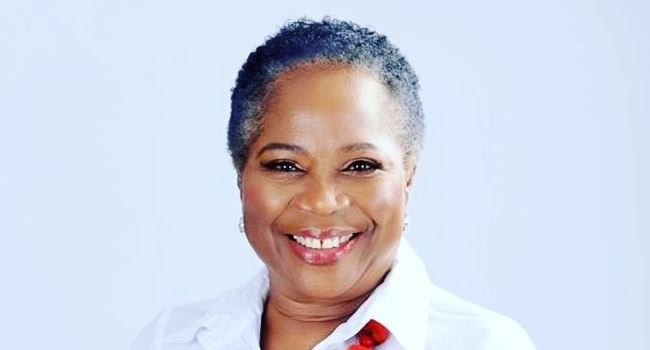
Among the participants, Ayisha Osori stood out for the kind of intellectual composure that elevates a discussion rather than inflames it – a presence that reminded viewers that it is possible to speak about Nigeria’s problems without either minimising them or weaponising them. A lawyer by training, Osori holds an LL.B from the University of Lagos and a Master of Public Policy from the Harvard Kennedy School, credentials that speak to a mind trained in both the rigour of legal reasoning and the complexities of institutional design. Her professional trajectory has taken her through roles of genuine consequence: she has served as Director at the Open Society Foundations Ideas Workshop and previously led the Open Society Initiative for West Africa, positions from which she has worked for years on the nuts-and-bolts questions of democratic governance, gender equity, and civic participation. In the interview, she spoke with a calm authority that derived not from volume or interruption but from the quiet confidence of someone who has done the work and knows the territory. She grounded her arguments in principles of accountability and institutional strength rather than the partisan rhetoric that passes for political discourse in too many Nigerian settings. It was the voice of someone engaging Nigeria as a serious civic project rather than a political battlefield – someone for whom the country’s future is not a talking point but a vocation.
Aanu Adeoye brought a different but equally impressive presence to the conversation, demonstrating that rigorous journalism and analytical clarity need not sacrifice the humanity that makes political reporting meaningful. He studied at the University of Oxford and the Columbia University Graduate School of Journalism, institutions that have shaped some of the world’s most distinguished voices in political and economic reporting. Currently serving as the Financial Times correspondent covering West Africa, Adeoye has built a body of work that appears in major international publications and focuses on the political and economic forces shaping the region with a precision that avoids both sensationalism and apology. In the interview, he spoke with analytical clarity and remarkable restraint, grounding his contributions in observable realities rather than political messaging. Where others reached for generalisations or deflections, he reached for facts – specific, verifiable, contextualised in ways that made the complexity of Nigeria’s situation intelligible without making it excusable. His calm reliance on evidence made his interventions feel measured, credible, and intellectually disciplined, a reminder that the journalist’s craft, properly practiced, is itself a form of accountability.
Then there was Tunde Doherty of the All Progressives Congress, whose contribution to the discussion offered a study in contrast with the intellectual discipline displayed by Osori and Adeoye. He spoke often and energetically, filling the air with words that seemed, in the moment, like they might be going somewhere. But the substance of his contributions rarely matched the volume they occupied. The discussion would move toward concrete questions about governance and accountability – what is actually being done about insecurity, how the economic reforms are affecting ordinary people, whether the anti-corruption commitments are producing measurable results – and somehow his responses would drift into familiar political talking points that circled the issues without quite confronting them. It was a curious performance in which many words were spoken yet very little was said, a kind of linguistic displacement activity in which the appearance of engagement substituted for the reality of it. The contrast with Osori and Adeoye could not have been starker: where they illuminated, he obscured; where they clarified, he complicated; where they engaged honestly with the difficulties of governance, he retreated into the protective fog of partisan messaging. For viewers hoping to understand the government’s perspective on the challenges facing Nigeria, the performance offered more heat than light.
Daniel Bwala’s part of the interview produced the most uncomfortable moments, not because Hasan was unfair but because the questions were so fundamentally fair and the answers so fundamentally inadequate. Hasan did not only question him about past statements, though that was certainly part of it. He asked clear questions about the present reality of governance in Nigeria: the economic hardship that has made basic staples unaffordable for millions, the credibility of anti-corruption commitments when appointees with questionable histories occupy sensitive positions, the worsening insecurity that has turned once-passable roads into corridors of fear. Those questions were not trivial or peripheral. They spoke directly to the lived reality of millions of Nigerians who go to bed hungry, who cannot afford to send their children to school, who wonder whether they will make it home safely each evening. Yet, instead of acknowledging that reality with humility or even a measure of the remorse that might signal genuine engagement with the suffering of citizens, Bwala’s responses repeatedly drifted toward generalisations, deflections, and the kind of political messaging designed to survive the moment rather than address the substance. Political realignments are not unusual in democratic life; people change sides, change loyalties, change their assessments of leaders and policies. That is the nature of politics in any functioning system. But intellectual honesty requires candour when confronted with the consequences of governance, especially when one has been positioned as the voice explaining those consequences to the world. What viewers saw instead were attempts to reinterpret the past and soften the present, to make the harsh realities of Nigerian life disappear through the alchemy of confident assertion.
In politics, people change sides sometimes. That alone is not remarkable, nor is it inherently disqualifying. What they cannot change is the historical record, and it is the historical record that makes Bwala’s position so untenable. When a public figure begins arguing with his own past words while simultaneously evading the pain of the present, credibility does not merely suffer – it dissolves entirely. The audience watching at home, many of them living the very hardships being minimised on screen, draw their own conclusions. They see not a defender of government policy but a man trapped between what he used to believe and what he now must say, between the record that cannot be erased and the performance that must be maintained. And in that trap, something fundamental is revealed about the relationship between power and truth in Nigeria’s political culture.
If there is any consolation in that exchange, it is that Nigerians like Ayisha Osori and Aanu Adeoye continue to demonstrate that the country possesses extraordinary intellectual capital – minds capable of engaging the nation’s most difficult problems with honesty, clarity, and dignity on a global stage. Their presence in the conversation was a reminder that Nigeria’s intellectual resources are far richer than the moments that sometimes embarrass us on international television. They showed that it is possible to speak about Nigeria’s failures without celebrating them, to acknowledge the severity of the country’s challenges without surrendering to despair, to hold power accountable without descending into the kind of performative outrage that substitutes for genuine analysis. In the end, that is what the conversation was really about, beneath all the specific questions about security and economy and corruption. Governance is not only about policy, though policy matters enormously. It is also about credibility – the slow accumulation of trust that allows citizens to believe that those who speak for power are not merely performing loyalty but are engaged in the honest work of explaining, defending, and where necessary, acknowledging failure. When credibility collapses, as it did in those most uncomfortable moments of the interview, the damage radiates far beyond the individual who suffers the embarrassment. It contaminates the entire project of governance, making it harder for any voice to be believed, any promise to be trusted, any explanation to be accepted. That is the real cost of the Al Jazeera appearance, and it is a cost that Nigerians will continue paying long after the clips stop circulating on social media.
As the clips of the interview circulate on WhatsApp and X, generating those caustic, painful jokes Nigerians use to cope, we must sit with the bitter aftertaste of what this means. Bwala on Al Jazeera is the mirror the Nigerian political class refuses to look into. It shows a government that is out of its depth, relying on converted critics to sell an unsellable reality. The tragedy for Nigeria is that Bwala’s performance, for all its individual absurdity, is not an aberration. It is the logical extension of a political culture that treats communication as warfare, truth as optional, and public memory as an inconvenience to be overcome rather than a fact to be respected. Until that culture changes, there will be more Bwalas, more humiliations, more moments when Nigerian officials stand before the world and discover that denying reality does not make it disappear. It was a PR stunt gone horribly wrong because truth, eventually, demands its toll. The world sees Nigeria exactly as it is: a nation of immense potential, pinned to the floor by leaders who are more obsessed with defending their image than defending the lives, the lights, and the livelihoods of the people they claim to serve.