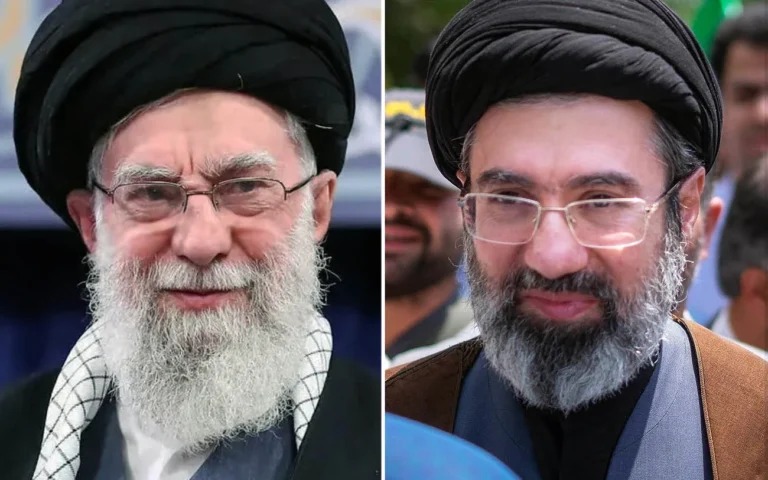
The Assembly of Experts confirms the son of Iran’s late leader as the new head of the Islamic Republic.
Tehran — March 8, 2026: Iran’s clerical leadership has named Mojtaba Khamenei, the son of the late Ali Khamenei, as the country’s new supreme leader, marking one of the most dramatic political transitions in the Islamic Republic since its founding in 1979.
The decision was approved by the Assembly of Experts, the clerical council responsible for selecting Iran’s top authority. Mojtaba, 56, now holds ultimate power over Iran’s political system, armed forces, and nuclear program.
Background: Death of the previous leader
The leadership transition followed the death of Ali Khamenei during the early stages of a widening regional conflict involving the United States and Israel. According to reports, he was killed in a major strike on Tehran at the beginning of the war, triggering an urgent succession process inside Iran’s leadership.
In the immediate aftermath, Iran briefly operated under an interim leadership arrangement until the Assembly of Experts finalised Mojtaba Khamenei as the new supreme leader.
Who is Mojtaba Khamenei?
Mojtaba Khamenei is a cleric educated at the Qom seminary and has long been viewed as a powerful figure behind the scenes in Iran’s political and security establishment.
Key points about the new leader:
- Born in 1969 in Mashhad, Iran.
- Previously worked closely with his father’s office and reportedly influenced security policy.
- Has strong ties to the Islamic Revolutionary Guard Corps, which supported his elevation.
- Known as a hardline political figure within Iran’s conservative establishment.
Before assuming power, Mojtaba held no formal elected office but was widely regarded as a key power broker within Iran’s ruling circles.
Controversy over a “dynastic” transition
The appointment has generated controversy both inside and outside Iran because it represents the first time leadership has passed from father to son in the Islamic Republic. Critics say the move resembles dynastic succession — something Iran’s 1979 revolution originally sought to eliminate when it overthrew the monarchy.
Some Iranian political factions had reportedly resisted the move, arguing that the constitution requires a highly senior religious scholar to become supreme leader.
International reaction
The development has drawn strong international reactions.
- Donald Trump condemned the appointment and suggested Washington should have influence over Iran’s leadership transition.
- Israeli officials also criticized the move, warning it could deepen confrontation in the region.
- Iran’s military leadership and allied groups such as Hezbollah pledged support for the new leader.
Regional tensions rising
The leadership change comes amid a rapidly escalating conflict involving Iran, Israel, and U.S. forces. Airstrikes, drone attacks, and retaliatory strikes have targeted infrastructure across the region, raising fears of a broader Middle East war and disruptions to global energy supplies.
What it means for Iran
Analysts say Mojtaba Khamenei’s rise could shape Iran’s future in several ways:
- Hardline continuity – His leadership is expected to maintain or intensify his father’s ideological policies.
- Greater military influence – Close ties with the Revolutionary Guards could strengthen their political role.
- Potential escalation abroad – The leadership change occurs during an active regional conflict, raising geopolitical stakes.
How Iran chooses its Supreme Leader
In the political system of the Iran, the Supreme Leader is the highest authority. The position was created after the Iranian Revolution of 1979, which overthrew the monarchy of Mohammad Reza Pahlavi.
1. Selection by the Assembly of Experts
The leader is chosen by the Assembly of Experts, a body of senior Islamic clerics.
The assembly has 88 members.
Members are elected by the public every eight years.
Their main role is to appoint and supervise the Supreme Leader.
When a leader dies or resigns, the assembly meets to select a successor.
2. Religious qualifications
Iran’s constitution originally required the Supreme Leader to be a high-ranking Shia cleric capable of issuing religious rulings.
For example:
Iran’s first leader was Ruhollah Khomeini (1979–1989).
After his death, the Assembly chose Ali Khamenei (1989–2026).
The constitution was amended in 1989 to allow less senior clerics to become leader if they are politically capable.
3. Powers of the Supreme Leader
The position is extremely powerful. The leader:
- Commands the armed forces and the Islamic Revolutionary Guard Corps
- Appoints the head of the judiciary
- Controls state broadcasting
- Influences foreign policy and nuclear decisions
- Can dismiss the president
This means the Supreme Leader has more authority than the elected president.
Why Mojtaba Khamenei’s appointment is controversial
The reported appointment of Mojtaba Khamenei, son of Ali Khamenei, is controversial for several reasons.
1. First father-to-son succession
Since the revolution, Iran has had only two leaders:
- Ruhollah Khomeini
- Ali Khamenei
- If Mojtaba succeeds his father, it would be the first hereditary-style transfer of power in the Islamic Republic.
Ironically, the revolution itself overthrew a hereditary monarchy led by Mohammad Reza Pahlavi.
2. Limited religious status
Many clerics argue that Mojtaba does not yet hold the highest clerical rank, which traditionally strengthens a leader’s legitimacy.
3. Behind-the-scenes power
For years, Mojtaba was believed to have influence through:
- Close links to the Islamic Revolutionary Guard Corps
- Influence inside his father’s office
- Support among hardline political factions
However, he held no major elected office, making the transition politically sensitive.
Why the decision matters globally
Iran’s Supreme Leader influences:
- Middle East conflicts
- Iran’s nuclear program
- Relations with the United States and Israel
- Regional allies such as Hezbollah
Because of this, any leadership change in Tehran has major global implications.