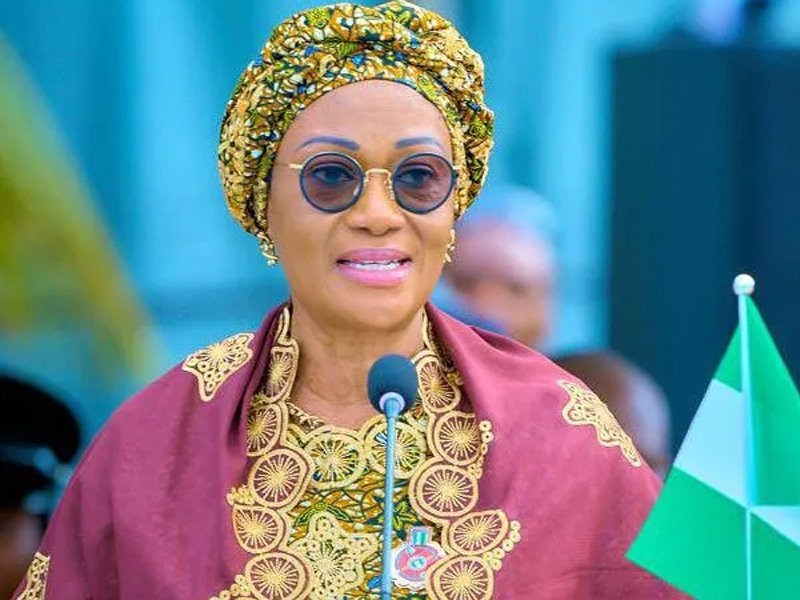
The Mrs. Oluremi Tinubu–Governor Adeleke Encounter and the Shadow of Elena Ceaușescu
As I watched the exchange between Nigeria’s First Lady, Mrs. Oluremi Tinubu, and the Governor of Osun State, Senator Ademola Adeleke, an encounter in which she reportedly declared, “Stop singing or I will switch off the microphone,” even limiting him to five minutes for his remarks, I found myself struggling to understand what our so-called democracy has become. The image was jarring: a First Lady addressing a sitting governor with the tone of a senior prefect correcting a newly admitted junior student.
The Book I read says, “By your words you are justified, and by your words you are condemned.” By the public posture of the political class to which both Adeleke and Mrs. Tinubu belong, Nigeria claims to be running a constitutional democracy, a system built on protocol, institutional order, and a moral architecture of leadership. Within that framework, the governor is: the elected representative of the people, the chief security officer of his state, and in this case, the chief host at an event on his own soil.
The First Lady, by contrast, is not an elected official. Her office is not created by the Constitution. Whatever influence she possesses is social or political, not legal or electoral. So how does a guest at an event publicly warn the host, the elected governor, that she will “switch off the mic” if he continues singing, and interrupt him while he exercises the discretion of his office to address his own people? What do we call that? What democratic dictionary contains such an entry? Why is it so difficult for the political class, including its most visible figures, to live up to the script of democratic governance they want Nigerians to believe exists?
And how do I explain such a moment to my child, in a world where leaders are supposed to be servants? As I watched, one historical image returned with startling clarity: Elena Ceaușescu, wife of Romanian dictator Nicolae Ceaușescu and Deputy Prime Minister of Romania, whose 24-year regime crashed under the weight of its own arrogance. The comparison is not about identical circumstances, but about a familiar posture, arrogance that grows when power loses all sense of humility.
Elena Ceaușescu: When Arrogance Becomes a National Spirit In December 1989, as the Ceaușescu regime collapsed, Nicolae and Elena attempted to flee Bucharest. Their helicopter landed under pressure, and soldiers moved in to arrest them. Elena did not show fear. She showed fury, the fury of someone who believed the country belonged to her. As the soldiers approached, she snapped repeatedly at her husband: “Tell them you are the President! Tell them you are the President! Tell them who you are!” It was a moment of breathtaking delusion, the blindness that absolute power produces.
She believed that shouting his title loudly enough could stop the march of history. When soldiers insisted they were under arrest, she berated them: “This is a mistake! You will pay for this! All of you will pay!” She did not see the guns. She did not see the revolution. She did not see the millions who had rejected them. She only saw herself, above accountability. During their trial, her arrogance sharpened further.
When judges listed her possessions, including 365 pairs of shoes, she interrupted angrily: “No! Not 365, 364 pairs!” Her quarrel was not with the truth; it was with the optics of indulgence. Even on the brink of execution, she corrected the judges with disdain, as though the courtroom were beneath her and the proceedings an affront to her status. She berated the judges. She dismissed the charges. She acted as though she were still untouchable. Arrogance had become her final language.
What Came to Mind Watching Nigeria When I watched Nigeria’s First Lady publicly threaten to silence a governor in his own state, Elena Ceaușescu came to mind, not because the contexts are identical, but because the attitude is identical: a belief that power confers ownership, a disregard for institutional boundaries, a sense of entitlement that tramples protocol, a posture that suggests the nation belongs to a family, not a people. In that moment, it felt as though history had returned, not in form, but in spirit. Where are the servant-leaders? Where is the humility that undergirds true democracy?
How do we raise children in a society where those who should model service instead model domination? Is this democracy, or something drifting quietly toward family monarchy? When protocol is ignored in public and no one blinks, we must ask whether governance has been replaced by personal fiefdom. When leaders cannot model humility, how do we teach our children that leadership is service, not domination? This was more than a breach of protocol.
It was a revelation, a window into how power in Nigeria is increasingly performed, rather than constrained. A democracy without boundaries becomes a dictatorship in slow motion. A nation without servant-leaders becomes a society where the people serve leadership, rather than leadership serving the people. In the Full Glare of History Elena Ceaușescu could not imagine a Romania where people no longer bowed to her. She believed titles were permanent. She believed power was personal property. She believed shouting, “Tell them you are the President!” could restore a collapsing world.
But history has no patience for arrogance. And nations, when pushed long enough, reclaim their voice. What we saw in Osun State may appear small to some. It is not. It is a symbol. A warning. A symptom. Power that disrespects protocol eventually disrespects the people. And power that disrespects the people does not remain democratic for long.
Follow us on all social media platforms @dailyquery for news and analyses around the globe.