This is not a story about terrorism. It is a story about the men who profit from it — and a president who has chosen, deliberately, to protect them.
By Kio Amachree
Nigeria is not losing its war against terrorism and banditry because the enemy is too strong. It is losing because the men charged with fighting that war have calculated, correctly, that losing is more profitable than winning. What follows is an accounting — not of abstract institutional failure, but of identifiable individuals, documented crimes, and a presidency that has chosen complicity over accountability.
The blood on the ground in Borno, Sokoto, Kaduna, and Benue has a return address.
The Architecture of Plunder
To understand how Nigeria’s security apparatus was captured, you must begin with what Transparency International now formally describes as a system of deeply embedded corruption risks across Nigeria’s defence sector, underpinned by weak oversight, significant gaps in defence spending transparency, secret expenditures, and military-owned enterprises — with enforcement of anti-bribery laws described as inconsistent and procurement practices as persistently weak. 
That is the diplomatic language of international assessors. The undiplomatic language is simpler: Nigeria’s military has been converted into a private extraction machine, and it has been this way, with varying degrees of brazenness, for decades.
Former military chiefs have stolen as much as $15 billion — a sum equivalent to half of Nigeria’s foreign currency reserves — through fraudulent arms procurement deals. Defence sector corruption has enabled the political elite to accumulate and distribute political patronage, while military exceptionalism has justified weak and compromised oversight of security-related spending and excessive secrecy. 
These are not statistics. They are body counts expressed in dollars.
The Architects: Those Who Built the Machine
The template for Nigeria’s defence corruption was institutionalised under Colonel Sambo Dasuki, who served as National Security Adviser to President Goodluck Jonathan from 2012 to 2015. What Dasuki constructed was not merely a scandal — it was a system.
Dasuki effectively controlled military procurement during his period in office with no supervision and virtually no input from the Ministry of Defence. He awarded fictitious and phantom contracts worth $1.7 billion for the procurement of four Alpha jets and twelve helicopters, as well as bombs and ammunition that were never delivered.  The soldiers sent to fight Boko Haram had no jets, no helicopters, and no ammunition — because the money for those weapons had been shared among politicians, businessmen, and loyalists.
Among those who received proceeds were Attahiru Bafarawa, former Governor of Sokoto State, who received ₦4.6 billion from the Office of the National Security Adviser with no clear basis for the transaction  — and who claimed, with a straight face, the money was received for “spiritual purposes.” Also implicated was Bashir Yuguda, former Minister of State for Finance, charged with 19 counts of fraud, money laundering, and criminal breach of trust.
The arms broker at the centre of the foreign contracting web was Aboubakar Hima, known as “Petit Boubé,” a Nigerien businessman who set up the shell company Société d’Équipements Internationaux Nigeria Ltd specifically to exploit Nigeria’s security emergency. Between 2014 and 2015, Hima netted over $400 million in fraudulent arms contracts, receiving government money for military equipment that was never fully supplied.  He remains wanted by Nigeria’s Economic and Financial Crimes Commission. He continues to operate.
Air Chief Marshal Alex Badeh, former Chief of Defence Staff, was arrested in February 2016 in connection with the same procurement fraud. He was assassinated in December 2018 before his trial concluded — a fact that tells you as much about the depths of this system as any court judgment could.
Another contractor, unnamed in official records but documented by ICPC, received a cumulative sum of approximately ₦6 billion from the Nigerian Army over less than ten years in suspicious circumstances. ICPC’s recovery from the contractor’s premises included large cash sums in local and foreign currencies, luxury cars, customised mobile phones, designer watches including three Rolexes, and property documents. 
In a particularly chilling dimension of the same corrupt ecosystem, a former head of one of the arms of the military deposited ₦4 billion from the military budget into the accounts of two companies where he was the beneficial owner and sole signatory.  He was not named publicly. He was not charged publicly. The system protects its own.
The Ghost Army: A War That Was Never Fought
Leaked UK diplomatic cables found that of the 20,000 troops Nigeria claims to deploy in the northeast, the real number is significantly lower, with thousands of ghost soldiers generating salaries collected by officers.  Every phantom private on the payroll represents a salary diverted to a commanding officer’s pocket. Every empty bunk in a forward operating base represents a position that will not be filled when ISWAP attacks.
Soldiers earn $31 a month while generals oversee billions in unchecked spending.  The men who are actually present — hungry, unrotated, communicating via WhatsApp on commercial networks that ISWAP monitors — are sent to fight a war that their commanders have quietly decided not to win.
Major General Hakeem Otiki, former General Officer Commanding (GOC) 7 Division in Sokoto, was court-martialled by the Nigerian Army over the alleged theft of ₦400 million. The charges against a divisional commander responsible for the northwest theatre — one of the most volatile in the country — tells you everything about the calibre of officers commanding Nigeria’s frontline positions.
In recent years, many Army, Air Force, and Navy generals have faced prosecutions by the EFCC for large-scale theft of public funds meant for procurement of weapons to prosecute the war on terror. Procurement corruption in the military is the same as terrorism, given the consequences of not buying the right kind of weapons — consequences that enabled Boko Haram and other armed bandits to continue attacking Nigerians. 
The Present Crisis: Tinubu’s Watch, Tinubu’s Failure
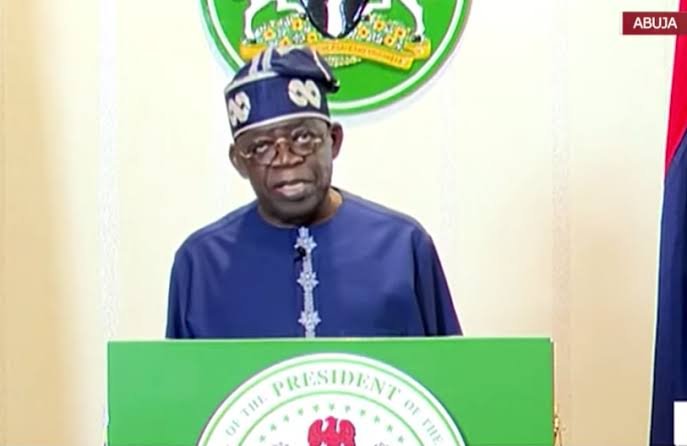
President Bola Tinubu inherited a broken system. He has not merely failed to fix it — he has presided over its acceleration.
Of the ₦20.56 billion budgeted by the Nigerian Army for the purchase of security equipment in 2025, only ₦1.46 billion — representing 7.11 percent — was actually disbursed by December 31, 2025.  Seven percent. In the middle of a declared security emergency. While ISWAP was conducting its most successful campaign in its operational history.
The 2026 defence budget sets aside 5.41 trillion naira — approximately $3.9 billion — but 62 percent goes to personnel costs, and the naira’s collapse has cut real spending power by two-thirds since 2023.  The headline number is propaganda. The operational reality is destitution.
Tinubu’s response to the cascading crisis has been characteristically theatrical. He declared a security emergency. It did not change the picture: at least 316 civilians were killed across 15 states in the 71 days that followed. He announced procurement of mine-resistant ambush-protected vehicles. The 7 percent disbursement rate tells you what those announcements are worth. He sacked military chiefs. When President Tinubu removed General Christopher Musa as Chief of Defence Staff in October 2025, public speculation immediately linked the change to an alleged failed coup attempt, though the Presidency framed it as a routine leadership refresh.
He then appointed the same General Musa as Minister of Defence in December 2025 — a man who, within months of taking office, was defending rising soldier death tolls and claiming that worsening insecurity in political years is driven by individuals who want to make the government look weak. This is not strategic analysis. It is the language of a ministry that has given up on winning and is managing perception instead.
Northern youth group Arewa Youths formally called on Tinubu to sack Musa, alleging that more soldiers have died under his watch than under any previous Defence Minister — with over 100 soldiers reportedly killed by terrorists in a single week and more than 250 abducted in the same period. The group accused Musa of behaving more like a “social media content creator” than an effective leader of Nigeria’s defence apparatus.
Musa’s own admission before a national audience has been the most damning official statement to emerge from this government’s entire security posture. He publicly acknowledged that military action addresses only 30 percent of the conflict, with 70 percent depending on good governance and addressing poor state capacity in the north.  The minister of defence of a country at war has announced, in effect, that the military cannot solve 70 percent of the problem — and then done nothing discernible about the 70 percent.
The Enemy Is Winning Because the System Lets It
While Nigeria’s generals were managing their portfolios, their adversaries were studying Sun Tzu.
ISWAP’s 2025 “Camp Holocaust” campaign was the most successful in the group’s history, systematically destroying forward operating bases across the Lake Chad Basin using drones, night-vision gear, and coordinated swarm attacks. The capture and execution of Brigadier General Musa Uba in November 2025 was not simply a battlefield loss — ISWAP intercepted his communications and tracked his position after his convoy was ambushed 88 kilometres from regional military headquarters in Maiduguri. 
A force with 230,000 troops and a multibillion-dollar budget could not locate its own brigade commander. ISWAP could. That asymmetry is not about firepower. It is about institutional integrity.
Following the 2023 coup in Niger, the two countries called off formal defence cooperation after Abuja threatened to lead ECOWAS into a military intervention to restore civilian rule. Niger, Mali, and Burkina Faso subsequently withdrew from ECOWAS entirely to form the Alliance of Sahel States. Niger’s withdrawal from the Multinational Joint Task Force in March 2025 ended joint border patrols along a vast open frontier. Tinubu’s diplomatic belligerence, driven by domestic political calculation, cost Nigeria its northern shield.
Into that vacuum moved Lakurawa — an Islamic State affiliate armed with surveillance drones and territorial ambitions across Sokoto and Kebbi. Al-Qaeda’s West African affiliate JNIM launched its first recorded attack on Nigerian soil in 2025. ISWAP now brings in an estimated $191 million per year by taxing trade across the Lake Chad Basin — ten times what the Borno State government collects. Northwest bandit networks took in an estimated $1.42 billion in ransom in a single year.
The insurgency is not just a military threat. It is an alternative state — with revenue, governance, and growing legitimacy among populations who receive nothing from Abuja but broken promises and errant airstrikes. SBM Intelligence estimates over 400 Nigerian civilians killed in erroneous military airstrikes between 2017 and 2025.
The Christmas Day Tomahawk strikes — 16 American missiles on Nigerian soil, authorised by Tinubu and celebrated by Donald Trump as an “amazing Christmas present” — were not a security strategy. Chatham House observed that Nigerian elites have a recurring practice of leveraging insecurity and humanitarian crises for political and financial gain, and that this episode reflected exactly that pattern. Tinubu used the crisis to extract military aid and political capital from Washington. The Nigerians dying in the north got neither.
What Reform Actually Requires
Let us be precise, because precision is what vested interests fear most.
Biometric verification of every soldier on the national payroll. Not a committee. Not a presidential directive. Actual fingerprint-based headcounts of every uniformed officer drawing a salary, conducted by an independent body with no connection to the Ministry of Defence. The International Crisis Group called for this in 2016. Iraq implemented it after Mosul. Nigeria has ignored it for a decade. Every month of continued delay is a month of salaries diverted from phantom soldiers to real generals.
Full public audit of defence procurement for the Tinubu years. Every contract. Every supplier. Every delivery certificate. Independent technical assessors — not Defence Ministry officials — should certify that what was ordered was actually delivered and actually functions. Three JF-17 fighters purchased from Pakistan in 2021; by May 2023, only one could still fly. Who certified delivery? Who approved payment? Those individuals should be named and prosecuted.
Prosecution of named individuals — not institutional reform theatre. The EFCC and ICPC have files. They have the contractor with the Rolexes. They have the general with the ₦4 billion in his companies. They have the disbursement records showing 7 percent release on a combat equipment budget. The question is not whether the evidence exists. The question is whether Tinubu will allow his own anti-corruption agencies the independence to act on it. Nothing in his record suggests he will.
Restoration of regional security architecture. The ECOWAS confrontation with Niger was a strategic catastrophe dressed up as democratic principle.
Pragmatic bilateral security arrangements — beginning with Niamey — must be pursued, regardless of ideological discomfort. Security does not respect political grievance.
A new theory of the north. Nigeria’s own Defence Minister has conceded that 70 percent of the conflict’s resolution depends on governance, not guns. That means schools, infrastructure, economic inclusion, and an end to the predatory relationship between the Nigerian state and its northern population. It means confronting the fact that ISWAP’s tax revenues dwarf those of the states it operates in because it provides what those states will not. No military solution survives that comparison.
The Verdict
The Boko Haram insurgency is now in its fifteenth year, fed by the notorious levels of public sector corruption that have eroded the Nigerian state’s legitimacy. Politicians compete for private control of national coffers, rather than delivering public goods — and their predation validates extremist narratives about the immorality of secular governance.
Sambo Dasuki stole $2 billion. Aboubakar Hima stole $400 million. Alex Badeh was arrested and then murdered. Hakeem Otiki stole ₦400 million as a divisional commander. Unknown contractors stole billions more. And today, under Bola Tinubu, the 2026 defence procurement risk score from Transparency International sits at 23 out of 100 — a rating of “Very High” corruption risk — while Nigerians are buried in mass graves in Borno and Sokoto.
The president has not prosecuted a single senior military officer for procurement fraud since taking office. He has not published a line-item audit of defence spending. He has not convened an independent inquiry into the ghost soldier payroll. He has, instead, signed a ₦68.32 trillion appropriations bill, extended the 2025 budget implementation to avoid accountability for its catastrophic underspend, and posed for photographs at the Chief of Army Staff Annual Conference praising the military’s “resilience and professionalism.”
The longer reform is delayed, the more these groups entrench themselves as alternative governments with independent revenue. Once that happens, as Sudan’s civil war has shown, the window for reversing the trend narrows sharply.
Nigeria is not yet Sudan. But it has generals who profit from war, a president who protects them, and a population that is running out of time. The men responsible have names. Some of them are in this article. The rest are in files that the EFCC is not permitted to open.
That is the indictment — of the dead, by the living, against those who should be in a courtroom.
Kio Amachree | Stockholm, Sweden | President, Worldview International