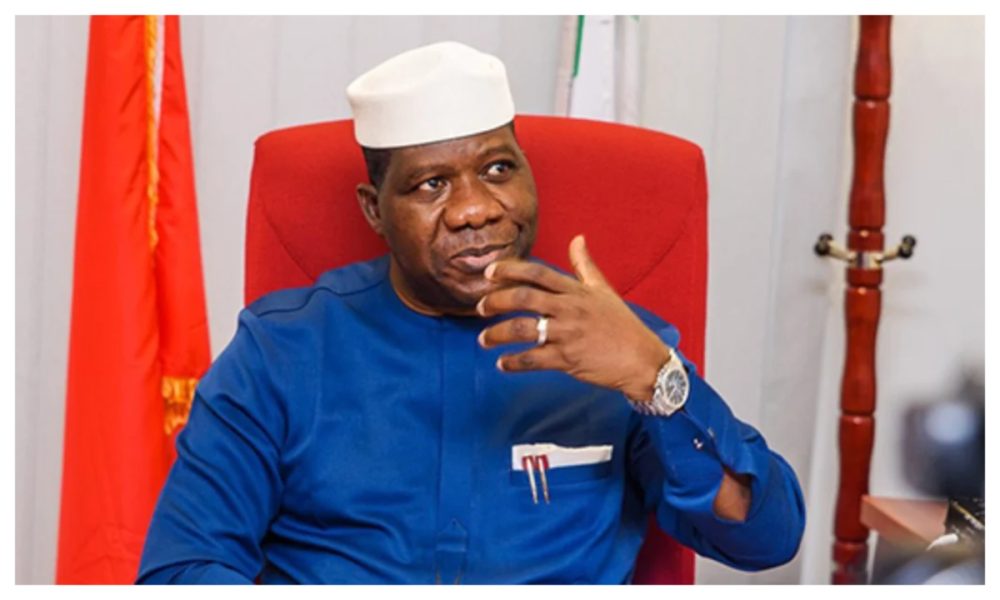
Senate Leader, Opeyemi Bamidele, has disclosed plans to sponsor a constitutional amendment bill seeking to introduce a single six-year tenure for presidents and governors in Nigeria after the 2027 general elections.
Bamidele said the proposed legislation would rank among the first set of bills he intends to present when the next National Assembly is inaugurated, stressing that the current two-term arrangement often distracts elected leaders from governance and development.
The lawmaker made the disclosure while speaking with journalists in his office on Tuesday, where he explained that a single tenure system would allow political office holders to focus entirely on delivering good governance without the pressure of re-election campaigns.
According to him, the existing constitutional structure, which allows presidents and governors to seek a second four-year term, has created a political culture where incumbents begin strategising for re-election almost immediately after assuming office.
“One of the first set of bills that I look forward to moving, by God’s grace, when we come back for the 11th Senate, God willing, is for a bill that will only make it possible for anyone who wants to be president of this country, or governor in any part of this country, to spend only one term of six years,” Bamidele stated.
He argued that a six-year single tenure would eliminate the distractions associated with political calculations and endless campaigns for a second term.
“So that you don’t even have to worry about wasting almost one and a half years of your first term thinking and struggling and looking forward to how you’ll be re-elected,” he said.
“If you know you are there for six years, only one tenure, you put in your best from day one. You know this is the only chance that you have.”
The proposal is expected to reignite national debate over Nigeria’s presidential and governorship tenure system, which has remained a recurring issue in the country’s constitutional and political discourse for decades.
Under the current 1999 Constitution, presidents and governors are elected for a four-year term and may seek re-election for one additional term, making a maximum of eight years in office.
However, supporters of a single tenure system have long argued that the arrangement could reduce political tension, minimise abuse of incumbency powers, and allow leaders to devote more attention to governance rather than electoral survival.
Advocates also believe the system could curb excessive spending on re-election campaigns and reduce the political instability that often accompanies second-term ambitions.
Critics, however, have raised concerns that a single tenure could weaken accountability, arguing that the possibility of re-election serves as an incentive for elected officials to remain responsive to the people.
Some political analysts also fear that a one-term system may encourage leaders to act without restraint since they would no longer need public approval for another mandate.
Although similar proposals have surfaced in previous constitutional amendment efforts, none has successfully scaled through the rigorous legislative process required to alter the Constitution.
For the proposal to become law, it would require the approval of at least two-thirds of both chambers of the National Assembly as well as endorsement by no fewer than 24 state Houses of Assembly.
Bamidele’s latest remarks have already begun generating reactions across political circles, with observers predicting intense debates among lawmakers, political parties, constitutional experts, and civil society groups in the coming months.
The proposed amendment, if eventually passed, would significantly reshape Nigeria’s political landscape and alter the structure of executive leadership at both federal and state levels.
Political watchers say discussions around tenure reform are likely to intensify as the country gradually approaches the 2027 general elections, with many stakeholders expected to weigh the potential advantages and drawbacks of the proposed system.
For now, Bamidele maintains that the reform is necessary to strengthen governance and ensure that elected leaders dedicate their entire time in office to national and state development rather than political survival.