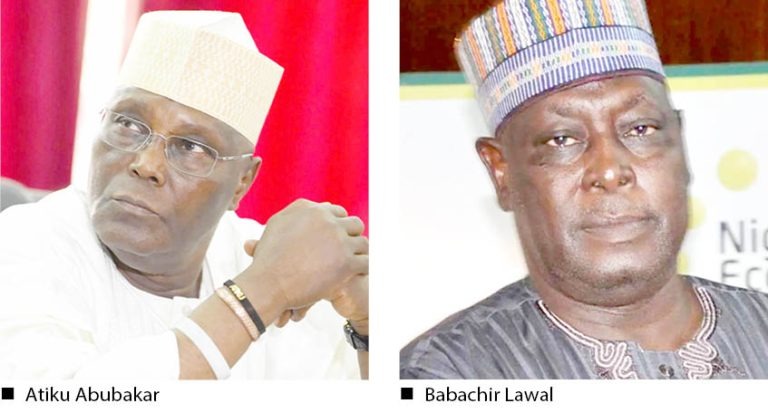
A fresh crisis appears to be brewing within the opposition coalition ahead of the 2027 general elections as former Vice President Atiku Abubakar and former Secretary to the Government of the Federation, Babachir Lawal, on Monday exchanged harsh words over the conduct of the presidential primaries of the African Democratic Congress.
The disagreement followed Lawal’s dramatic resignation from the ADC and his allegations that the party’s primary elections were manipulated in favour of Atiku.
Atiku had emerged as the presidential candidate of the party after polling a total of 1,846,370 votes in the primaries conducted across the country last week.
He defeated former Rotimi Amaechi, who secured 504,117 votes, and businessman-politician Mohammed Hayatu-Deen, who garnered 177,120 votes.
The outcome of the exercise was initially celebrated by many supporters of the opposition coalition who viewed the ADC as a major platform for challenging President Bola Tinubu in the 2027 presidential election.
However, the controversy surrounding the conduct of the primaries has now exposed deep cracks within the coalition.
Lawal, who until recently was regarded as one of the prominent figures in the anti-Tinubu opposition alliance, publicly announced his resignation from the ADC on Monday through a strongly worded statement posted on his social media platforms.
In the statement, the former SGF accused Atiku and his allies of allegedly manipulating the primary election process to guarantee victory for the former vice president.
“I am exiting the ADC because its just concluded primaries were at all levels massively rigged in favour of Kachalla Abubakar Atiku,” Lawal declared.
“Results were just written or rewritten to favour him and his coven. Even where they allowed some semblance of an election to be held, the winners were simply replaced with members of his syndicate. In the real sense, it was a disgraceful charade.”
The former SGF further stated that he could no longer remain silent in the face of what he described as widespread irregularities and injustice within the party.
According to him, the silence that followed the conduct of the primaries compelled him to speak out and “set the record straight.”
Lawal’s resignation and allegations immediately triggered reactions within political circles, with supporters of both camps engaging in heated exchanges online and across media platforms.
Sources within the ADC indicated that some party members were shocked by the intensity of the accusations, especially given Lawal’s previous role as one of the leading architects of opposition unity talks.
Political observers say the development could complicate ongoing efforts by opposition leaders to build a united front capable of challenging the ruling party in 2027.
Although Atiku himself had yet to issue a detailed personal response as of Monday evening, some of his loyalists reportedly dismissed the allegations as baseless and politically motivated.
Supporters of the former vice president argued that the primaries reflected the will of party members across the country and that Atiku’s overwhelming victory margin demonstrated his popularity within the ADC.
They also accused Lawal of attempting to discredit the process after failing to secure the outcome he desired.
The controversy has further reignited debates about internal democracy within political parties in Nigeria, an issue that has repeatedly surfaced during party congresses and primary elections.
Analysts note that allegations of manipulated primaries, imposition of candidates and rewriting of results have historically weakened opposition movements and contributed to divisions within parties.
The latest clash between Atiku and Lawal is also seen as a significant setback for the broader coalition negotiations that had brought together several opposition figures seeking to challenge the dominance of the ruling All Progressives Congress.
In recent months, discussions among opposition politicians had centred on building a united platform capable of presenting a formidable challenge to Tinubu’s administration in the next election cycle.
Lawal had been considered one of the influential northern political figures supporting the coalition project before his sudden exit from the ADC.
Political analysts say his departure may influence the calculations of other opposition stakeholders who are still undecided about their future within the party.
The development may also intensify scrutiny on the ADC leadership regarding the credibility and transparency of its internal electoral processes.
As the political drama continues to unfold, Nigerians are expected to watch closely how the ADC manages the fallout from the dispute and whether the opposition coalition can survive the growing internal tensions ahead of the 2027 elections.
For now, the public exchange between two major opposition figures has highlighted the fragile nature of political alliances and the fierce battle for control of emerging political platforms in Nigeria’s evolving political landscape.