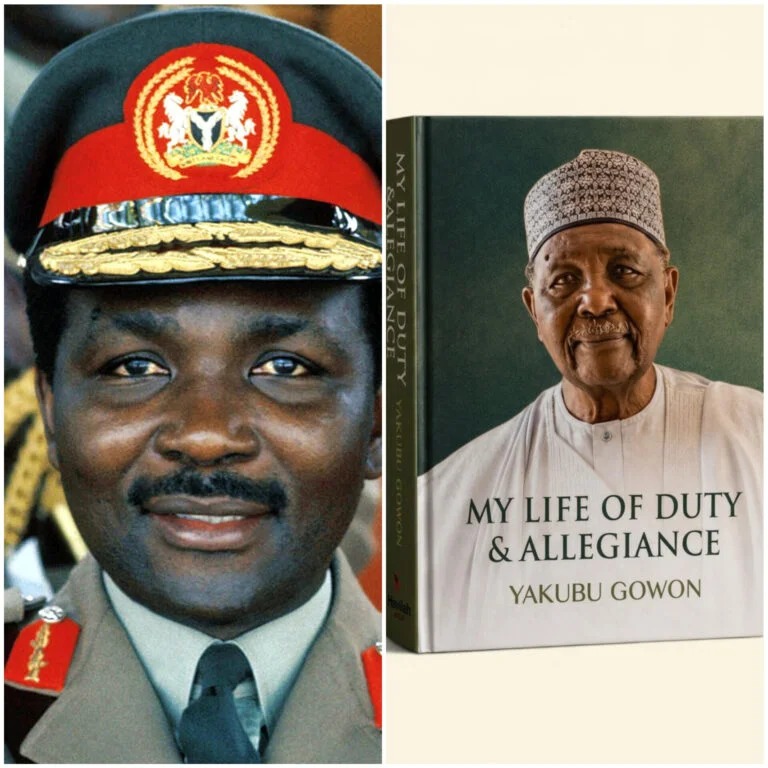
After 56 long years, General Yakubu Gowon — Nigeria’s wartime Head of State and Commander-in-Chief during the Civil War — has finally offered his own account of the events that plunged the country into catastrophe between 1966 and 1970.
The publication of his memoir is, in itself, a significant historical moment. Whatever one’s political sympathies, Gowon remains a central figure in Nigeria’s most traumatic national experience. His testimony matters because history is rarely complete until every principal actor has spoken.
This is not a review of the book itself, as I have not yet read it. Rather, it is a reflection on the excerpts and summaries already circulating in the media from early reviewers and commentators. Even from those fragments, however, certain troubling questions arise.
To begin with, Gowon waited until virtually every major co-actor in the tragedy was dead before publicly presenting his version of events. Chukwuemeka Odumegwu Ojukwu, his Biafran opposite number, is gone. Murtala Mohammed, his tempestuous co-conspirator and later adversary, is gone. Most of the senior military officers and political figures of that era are no longer alive to challenge, clarify, or contextualize his claims.
That timing inevitably invites scrutiny.
In public life, timing is often inseparable from credibility. Trial lawyers understand this. Historians understand it. So do ordinary people. When testimony arrives only after every possible contradiction has been permanently silenced, suspicion naturally follows. Fair or unfair, Gowon’s long silence weakens the persuasive power of his account.
More importantly, Nigeria has paid a heavy price for decades of unresolved truth, nurtured in part by Gowon’s unusually protracted silence. Since the Civil War ended in 1970, the country has struggled with recurring cycles of distrust, ethnic suspicion, separatist agitation, and political instability. Genuine reconciliation was never fully pursued.
Pain was buried instead of confronted. Hard questions were postponed rather than answered. No comprehensive national process of truth-telling, accountability, apology, or healing ever truly occurred.
The consequence is that the war never completely ended psychologically, even if it ended militarily. Gowon must take a large part of the responsibility for that. Now, his long-awaited autobiography seems to offer neither relief nor hope for a brighter future.
Some of the claims attributed to Gowon in early reviews also appear difficult to reconcile with other widely known accounts of the period.
For instance, Gowon reportedly suggests that many Northern officers and politicians believed Ojukwu had prior knowledge of — or sympathy for — the January 1966 coup led by Major Chukwuma Kaduna Nzeogwu. Yet historical accounts also show that Ojukwu, then commanding the Army’s Fourth Battalion in Kano, moved quickly to suppress the coup in the North.
That contradiction does not automatically exonerate Ojukwu, but it complicates the simplistic narrative that later became politically convenient. With the benefit of his position, once as Head of State and now as elder statesman, Gowon offers no fresh insights in search of truth on this matter.
The same tension appears in discussions surrounding the collapse of the Aburi Accord. Gowon reportedly places substantial responsibility on Ojukwu’s alleged intransigence. Yet several historical accounts have long maintained that influential Northern officers, senior federal bureaucrats, and even British interests became uncomfortable with concessions Gowon made during the talks in Ghana and pressured the Federal Government to retreat from aspects of the agreement reached in the presence of General Joseph Arthur Ankrah and other Ghanaian mediators.
If that interpretation is accurate, then the collapse of Aburi was not merely the product of one man’s stubbornness, but of a broader struggle over power, trust, and political survival inside the Nigerian federation itself. And Gowon was at the epicenter of that power struggle and repudiation — not Ojukwu.
Perhaps the most revealing aspect of Gowon’s account concerns Colonel Murtala Mohammed.
According to some early reviews, Gowon alleges that Murtala ignored instructions from Army Headquarters not to cross the River Niger at a particular point, resulting in devastating federal casualties. He also reportedly suggests that rivalry between Murtala and Colonel Mohammed Shuwa influenced operational decisions during the war.
If true, those are extraordinary admissions.
But they also raise unavoidable questions about Gowon’s own leadership. If a subordinate commander repeatedly acted recklessly, disobeyed instructions, and endangered military operations, why was he retained in command for so long? Why were there no decisive disciplinary consequences?
History records that both before and after the disastrous initial attempt to cross into Onitsha, federal forces suffered additional major losses. First, Murtala ordered the mass killing of an estimated 700 – 1000 boys and men in Asaba. Their only crime was being Igbo. The goal was ethnic cleansing. The Asaba Massacre was a PR disaster for Gowon’s regine. It remains a blight on Nigeria’s conscience to this day. Then there was the famous Battle of Abagana, one of the Nigerian Army’s worst battlefield defeats during the war. Only later was Murtala redeployed.
This does not merely cast doubt on Murtala’s judgment. It also raises difficult questions about Gowon’s authority over the officers beneath him, his principles as a man, and his capacity as Head of State.
Indeed, one interpretation that has circulated for decades is that Gowon governed under immense pressure from the powerful Northern military bloc that emerged after the July 1966 counter-coup, and that he always sought to please them.
Whether fully true or not, his own narrative seems, unintentionally perhaps, to reinforce the image of a weak leader constrained by forces around him rather than fully in command of them.
That, ultimately, may become the lasting impression left by the memoir: not of a ruthless dictator, but of a hesitant and overwhelmed ruler navigating events far larger than himself.
And perhaps that is the tragedy.
Gowon was extraordinarily young when power was thrust upon him. He inherited a fractured nation already descending into chaos and collapsing trust between regions. He was trying to manage an exploding federation under pressures from the military, foreign governments, ethnic interests, and Cold War geopolitics all at once.
Yet leadership is measured precisely in moments such as those. Gowon did not rise creditably to these leadership challenges. His belated autobiography probably confirms this.
Millions died during the war and the humanitarian catastrophe surrounding it. Whether one accepts the language of genocide or not, the scale of civilian suffering remains one of the darkest chapters in African history. A generation was scarred. Entire communities were devastated. The emotional wounds remain visible even now.
If he had acted differently at one or two critical points, the outcome might have been completely different. The war might have been unnecessary.
The deeper disappointment is that Nigeria never truly confronted that pain honestly after the guns fell silent.
In the end, Gowon’s memoir may succeed as an important historical document, but fail as moral closure. Too many questions remain unresolved. Too many contradictions endure. Too much time has passed.
One admission, however, might still alter how history remembers him: a candid acknowledgement that he was too young, too inexperienced, and too overwhelmed for the burden suddenly placed upon him in 1966 — and that, with wisdom gained over time, he might have acted differently.
Such humility would not erase history.
But it might finally humanize it.
And perhaps, after more than half a century, that is what Nigeria still awaits. Not an autobiography that portrays only the author as a saint and all others, especially the departed, as villains.