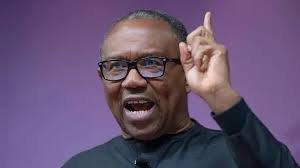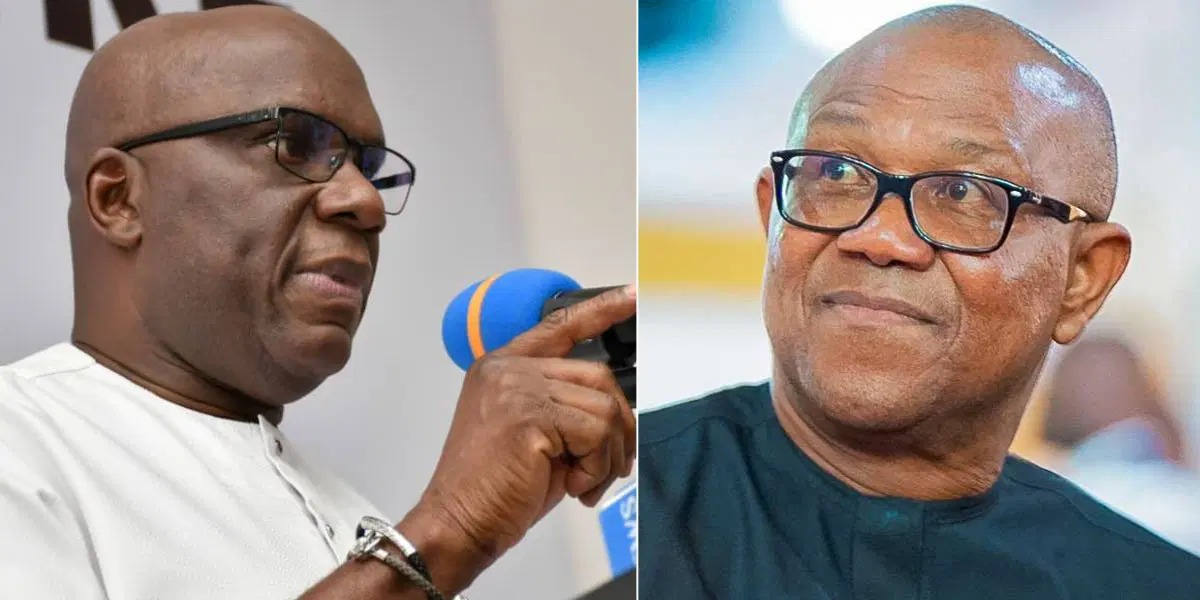
The National Publicity Secretary of the All Progressives Congress, Felix Morka, has launched a sharp critique of former Labour Party presidential candidate, Peter Obi, following his reported resignation from the African Democratic Congress.
In a post shared on X (formerly Twitter) on Sunday, Morka described Obi as a “political rolling stone,” accusing him of frequently moving between political parties in pursuit of what he termed an easier path to securing a presidential ticket.
“Peter Obi, a political rolling stone that gathers no moss… roaming again in search of free, uncontested, unchallenged presidential ticket… never willing to remain to build any party,” Morka wrote, in a statement that has since stirred fresh debate across Nigeria’s political landscape.
The comments mark one of the most direct attacks from a senior APC official on Obi’s political trajectory, reigniting discussions about party loyalty, internal democracy, and the evolving dynamics of Nigeria’s multi-party system.
Morka further alleged that Obi tends to avoid internal party contests, preferring instead political environments where he can emerge as a consensus candidate without facing significant opposition.
According to him, such an approach undermines the principles of party development and competitive democracy, which rely on robust internal processes to produce credible candidates.
“Leadership requires patience, commitment, and the willingness to build structures over time,” Morka implied, suggesting that frequent party changes weaken both individual credibility and institutional stability.
While Obi has yet to respond directly to the latest remarks, his political journey has often been the subject of scrutiny and debate. Supporters argue that his decisions to move across platforms have been driven by ideological alignment and strategic considerations rather than opportunism.
They also maintain that Obi’s growing popularity, particularly among young voters and urban constituencies, reflects a broader shift in Nigerian politics, one that prioritizes competence, accountability, and reform over traditional party structures.
Critics, however, have continued to question his party-switching history, framing it as evidence of inconsistency and a lack of long-term commitment to building political institutions.
Political analysts note that Morka’s comments may also be part of a broader effort by the APC to shape the narrative ahead of future electoral contests, especially as opposition figures like Obi remain influential voices in national discourse.
“The rhetoric is not surprising,” a political commentator observed. “As the political space begins to realign ahead of the next election cycle, we are likely to see more of these exchanges as parties and individuals position themselves.”
The controversy also highlights ongoing tensions between established political parties and emerging movements seeking to redefine the electoral landscape.
For many observers, the debate goes beyond individual personalities, touching on deeper questions about how political parties in Nigeria can balance internal democracy with the need to remain competitive in a rapidly changing environment.
As reactions continue to trail Morka’s statement, it remains to be seen whether the exchange will escalate into a broader political confrontation or fade as part of the routine back-and-forth that characterizes Nigeria’s vibrant, and often contentious, political arena.
What is clear, however, is that with political actors already staking positions, the road to the next general elections is gradually taking shape, marked by sharp rhetoric, strategic realignments, and an intensifying battle for public perception.