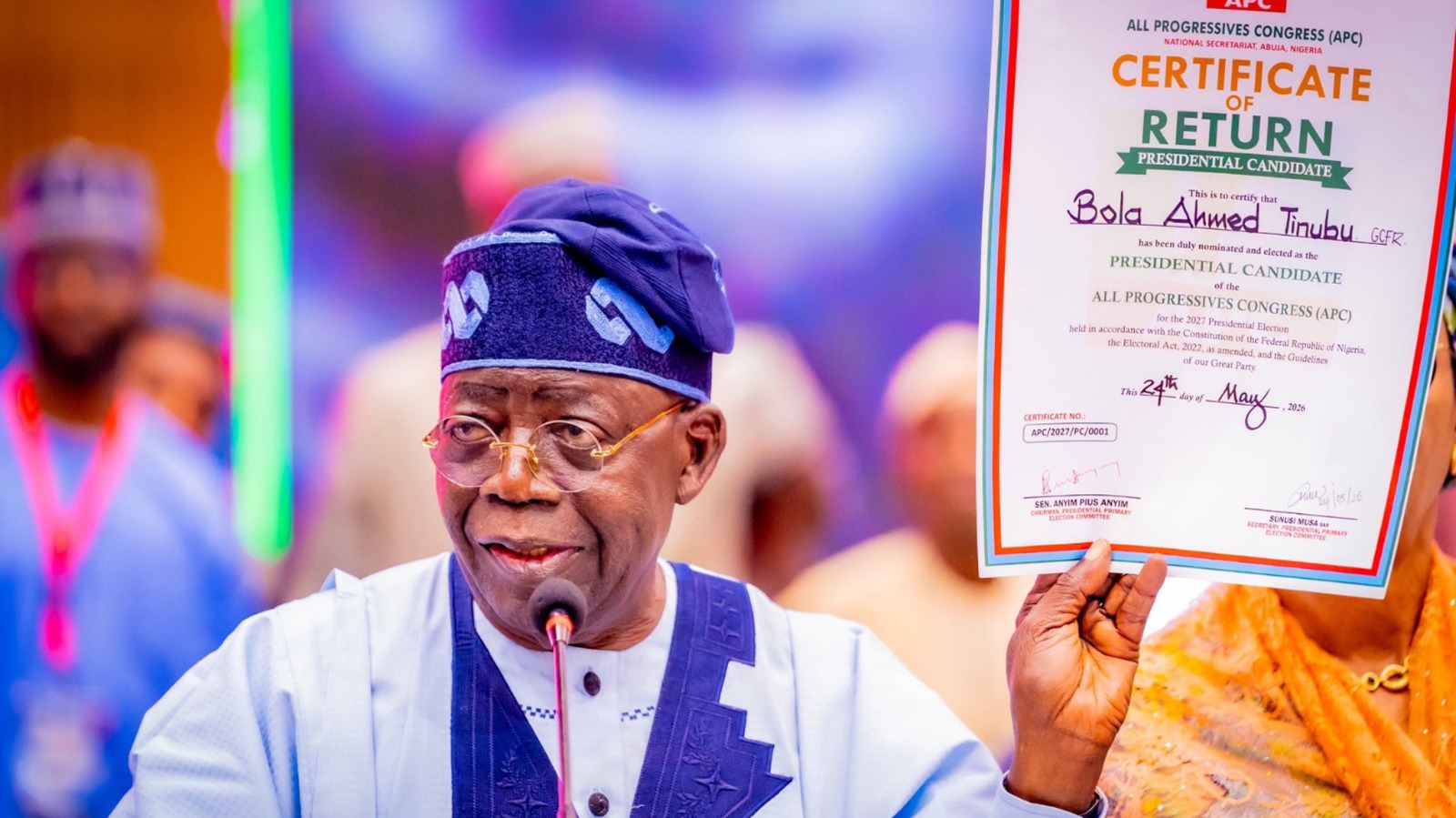
The All Progressives Congress (APC) presidential primary election, held ahead of the 2027 general elections, culminated in the declaration of President Bola Ahmed Tinubu as the party’s candidate, with an overwhelming 10,999,162 votes. His sole challenger, Stanley Osifo, managed a mere 16,503 votes. On paper, this result signals Tinubu’s unchallenged dominance within the ruling party.
However, the process was marred by widespread reports of miscounting, inflated vote tallies, and procedural irregularities, particularly in parts of the Southeast. This has now been copied by the African Democratic Congress (ADC). While Tinubu’s political machinery and incumbency likely secured a genuine majority, these manipulations were a profound disservice to him. They undermine the credibility of his mandate. They fuel suspicion and erode the very legitimacy that Tinubu would have earned through a cleaner, transparent process. Tinubu, a seasoned strategist with deep roots in Nigerian politics, did not need such “help” to prevail.
The scale of the reported figures alone invites scrutiny. With APC claiming over 11 million accredited voters and nearly 11 million votes cast in a party primary, the numbers dwarf the party’s performance in past general elections. Critics have pointed out the improbability of the numbers against the 2023 general election figures, where Tinubu secured approximately 8.8 million votes nationwide amid intense competition. This arithmetic defies logic and invites accusations of overreach. Videos circulating on social media captured blatant discrepancies, such as in Abia State’s Bende ward, where vote counts allegedly ballooned from double digits to thousands in moments. Such visuals, whether isolated or systemic, paint a picture of deliberate inflation rather than organic support.
This is with particular attention on the Southeast, a region where APC has historically struggled to gain traction. The zone’s political landscape remains complex, marked by lingering sentiments around marginalisation and strong opposition leanings toward figures like Peter Obi in recent cycles. Yet, reports from the primary suggested unusually high participation and near-unanimous support for Tinubu in certain areas.
In a region where APC ward-level structures are often modest, the sudden surge in accredited voters and cast ballots raised eyebrows among analysts and opposition voices. This is not to dismiss genuine support because incumbency brings resources, patronage networks, and the allure of federal power, but the optics of rapid, inflated tallies in areas with documented low APC membership density, like Abia State, fuel scepticism.
Critics argue that this reflects a pattern where governors and party executives, eager to demonstrate loyalty and secure favour, may have padded figures to outdo one another. In direct primaries, where voting supposedly occurs at ward levels, the temptation for local actors to “overperform” is high. The result is that the Southeast appears more APC-friendly on paper than ground realities suggest. This does Tinubu no favours. A leader with his profile commands respect across many quarters through sheer political sagacity such that artificial boosts in resistant zones portray him as reliant on sleight-of-hand rather than organic consolidation. This weakens his narrative as a unifying national figure capable of bridging divides without coercion or fabrication.
President Tinubu would have secured victory irrespective of these controversies. His achievements, incumbency advantages, and strategic positioning within APC provided ample grounds for a legitimate win. As the party’s dominant force post-2023, he controls extensive patronage networks, has governors largely aligned, and benefits from the absence of formidable internal challengers. Rotimi Amaechi, Yemi Osinbajo, and others who posed threats in 2022 are no longer in the fray. The primary’s structure, which favours the establishment, naturally tilted toward the president. Even conservative estimates of delegate or member enthusiasm in core strongholds like the Southwest, Northwest, and parts of the North Central would have delivered a comfortable majority.
Tinubu’s governance record, despite economic headwinds like fuel subsidy removal and naira reforms, includes visible infrastructure pushes, diplomatic engagements, and efforts at repositioning Nigeria globally. Renewed hope in sectors like technology, security stabilisation in troubled areas, education, agriculture, blue economy and private sector partnerships all count as positives for him.
Within APC, his influence as a unifier remains unmatched. A transparent count reflecting actual mobilised support would have affirmed this without the taint of excess. Instead, the joke of the count, which led to exaggerated tallies and viral miscount videos, shifts focus from merit to malpractice. It hands ammunition to opposition parties and civil society, who now frame the 2027 contest as predetermined rather than competitive. This diminishes the president’s acceptability across Nigeria and may instigate doubts and questions over his mandate.
The disservice extends beyond Tinubu personally to the health of Nigeria’s democracy. Political parties are the bedrock of representative governance. When their internal processes mimic a farce, public trust erodes. Nigerians already harbour deep scepticism toward electoral integrity, stemming from past cycles underpinned by inflated primaries which now exacerbate argument that party affairs prioritise optics and sycophancy over accountability. In the Southeast particularly, where genuine reconciliation efforts could build APC bridges, manufactured majorities will likely breed resentment. It could also alienate potential converts who might have warmed to Tinubu’s leadership on its merit.
Besides, such practices risk internal party fractures. Loyalists who delivered real votes in core areas may feel their efforts cheapened by overzealous counterparts elsewhere. Ambitious younger politicians or technocrats within APC might question the value of merit when numbers can be conjured. For a president positioning himself as a reformer that is tackling corruption and improving governance efficiency, this primary outcome sends a contradictory message. It undercuts the “renewed hope” mantra by suggesting reliance on the old playbook of ballot stuffing and result writing.
President Tinubu deserved better. Not this certainly. His political journey, from exile under General Sani Abacha to steering APC to power, speaks of resilience and vision. He has survived political battles, including intra-party ‘wars’, and national crises. A primary that showcased disciplined, verifiable support, perhaps through better-monitored direct voting with independent observers, would have strengthened his appeal heading into 2027. It would have signalled confidence, indicating that he won because the party stands with him and his record, not because the margins were manipulated. Instead, the controversies created by the counts now invite comparisons to authoritarian strongholds where elections are rituals of affirmation rather than choice.
Critics may counter that all parties engage in similar games, citing past PDP or opposition primaries. However, this misses the point. As the ruling party with state resources at hand, APC bears greater responsibility for setting standards. The scale here, with millions of purported votes amid documented inflation, elevates it beyond typical Nigerian political excess into something more damaging.
While President Tinubu’s declaration as APC candidate was inevitable given his grip on the party apparatus, the manner of victory through observed miscounting and deliberate vote increases constitutes a self-inflicted wound. It robs him of the clean narrative of popular acclamation he could have claimed. For a politician of his calibre, this was unnecessary. True leadership thrives on authenticity.
Padding results only breeds doubt where confidence should reign. As Nigeria approaches another general election cycle, the APC must reflect on this. Sustainable power stems from earned trust, not engineered numbers. The joke made of the counting may deliver short-term headlines but risks long-term legitimacy deficits that no number of inflated votes can erase. Nigeria’s democracy, and Tinubu’s legacy, deserve far more.