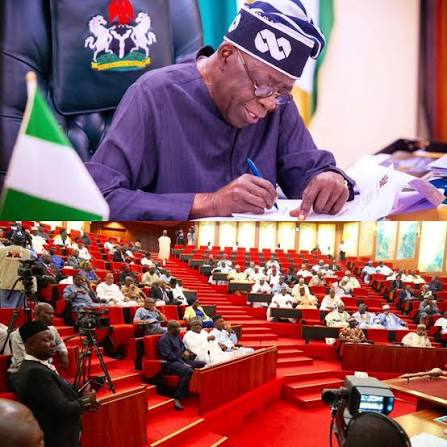
The Nigerian Senate has approved President Bola Tinubu’s request for a supplementary external borrowing plan of $20.517 billion and €1.45 billion to finance critical government projects and fiscal commitments across the 2026 and 2027 fiscal years.
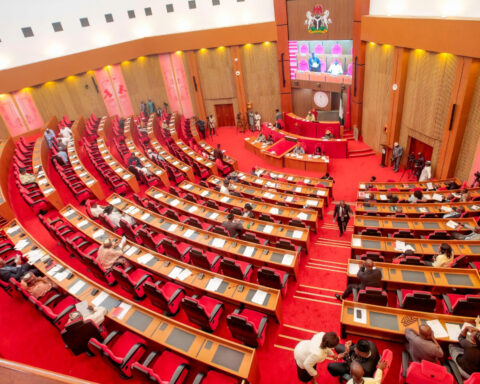
The upper chamber granted the approval during its plenary session on Tuesday, November 24, 2026, at the National Assembly Complex in Abuja, following the consideration and adoption of a report presented by the Senate Committee on Local and Foreign Loans.
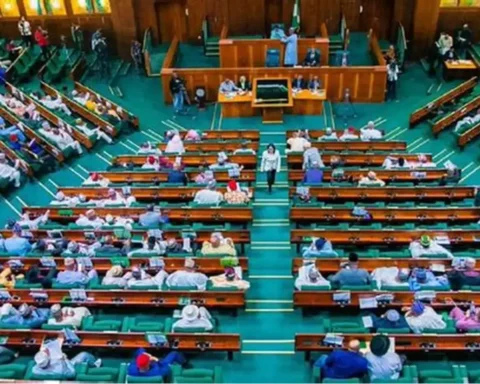
The Senate’s concurrence came hours after an earlier endorsement on Tuesday afternoon by the House of Representatives, where lawmakers passed a parallel resolution after considering a report presented by Sada Soli on behalf of the Chairman of the House Committee on Aids, Loans and Debt Management, Abubakar Nalaraba.
Under the approved framework, calculated at an official exchange rate benchmark of ₦1,400 to the dollar, the Federal Government is authorized to raise the funds through a diverse mix of external financing instruments.
These channels include concessional and commercial loans from multilateral and bilateral institutions, facilities from the International Monetary Fund (IMF), bridge financing and loan syndication, as well as international capital market issuances such as Eurobonds.
To ensure transparency and fiscal discipline throughout the borrowing process, the National Assembly mandated the Federal Government, acting through the Debt Management Office (DMO), to prioritize loan offers with the most favorable terms and submit periodic reports on all closed loan agreements.
Lawmakers directed that each submission must detail the exact amounts borrowed, funding sources, interest rates, repayment timelines, fees, and associated conditions, while tasking relevant legislative debt committees with strict oversight of drawdowns and project execution.
The loan approval coincided with a separate legislative proceeding on Tuesday in which Senate President Godswill Akpabio read a formal communication from President Tinubu seeking approval to repeal and re-enact the 2026 Appropriation Act. Akpabio subsequently referred the correspondence, titled Transmission of FGN 2026 Appropriation Repeal and Re-enactment Bill and Revised 2026 Federal Government Fiscal Framework, to the Senate Committee on Rules and Business for immediate legislative action.
Within the proposed revised 2026 fiscal framework, total expenditure has been reduced by approximately ₦3.15 trillion, dropping from ₦68.323 trillion to ₦65.176 trillion, while projected revenue is estimated at ₦33.720 trillion, inclusive of receipts from government-owned enterprises.
Capital expenditure under the revised proposal is pegged at ₦26.232 trillion, whereas the overall fiscal deficit and new borrowing remain unchanged at ₦31.457 trillion, representing 5.64 percent of Nigeria’s Gross Domestic Product, and ₦29.218 trillion respectively, comprising ₦18.428 trillion in domestic borrowing and ₦10.790 trillion in external borrowing.
In earlier correspondence transmitted to the National Assembly on November 4, 2026, President Tinubu explained that the external financing facilities, alongside a separate $7.707 billion (₦10.790 trillion) external loan component, are designed to part-finance the 2026 budget deficit without breaching existing statutory borrowing ceilings.
The Presidency has consistently maintained that securing these external facilities is vital to bridging Nigeria’s infrastructure deficit and funding key investments in transportation, energy, agriculture, healthcare, education, and national security.
Tuesday’s legislative approvals clear a major fiscal hurdle for the executive arm ahead of President Tinubu’s expected presentation of the 2027 Appropriation Bill to a joint session of the National Assembly before the end of December 2026.