The Independent National Electoral Commission (INEC) has unveiled strict technological safeguards designed to automatically detect over-voting and mathematical discrepancies at polling units, blocking inaccurate results from being uploaded to the INEC Result Viewing Portal (IReV) during the 2027 general elections.
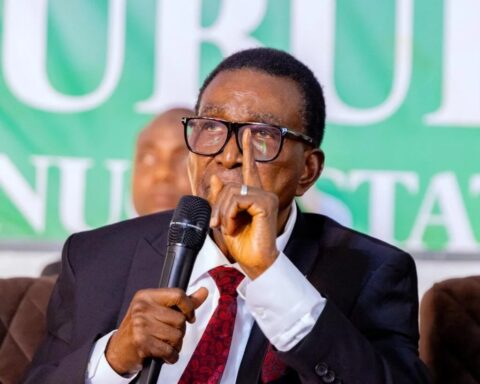
The announcement was made by INEC Chairman Prof. Joash Amupitan, SAN, on Thursday, November 12, 2026, during a high-level policy dialogue held between 2:00 p.m. and 3:30 p.m. (3:00 p.m. to 4:30 p.m. WAT) at The Royal Institute of International Affairs (Chatham House), 10 St James’s Square, London, United Kingdom.
Organised in partnership with the Kimpact Development Initiative (KDI), the forum convened diplomats, policy experts, and international observers under the theme “Nigeria’s 2027 Elections: Democratic Trajectory and Regional Stability Beyond the Ballot.”
Addressing participants at the London venue, Prof. Amupitan acknowledged that controversies surrounding the upload of inconsistent result sheets during the 2023 elections severely dented public trust in the electoral umpire.
To prevent a recurrence, he explained that INEC has embedded automated validation checks directly into its result-management architecture so that flawed figures are rejected before transmission.
”In 2023, there were instances of inaccurate results or results with over-voting being uploaded onto IReV,” Prof. Amupitan said. “We have now devised a technical safeguard: if a result is not accurate at the polling unit, it will not go to IReV at all. The moment a result appears on IReV, citizens can trust what they see. By eliminating inconsistencies at the source, collation will become a transparent formality.”
Beyond the automated IReV validation protocol, the Commission has rolled out comprehensive operational upgrades and fixed key milestones to strengthen credibility ahead of the polls.
To eliminate congestion at polling units and ensure faster voter accreditation alongside smoother data transmission, INEC has procured additional Bimodal Voter Accreditation System (BVAS) machines and reduced the maximum number of registered voters assigned to a single device from 1,250 to 850.
To stress-test both the upgraded BVAS devices and the new anti-discrepancy filters under real-world conditions, the Commission has scheduled a nationwide mock accreditation and voting exercise for Saturday, November 28, 2026.
Following ongoing clean-up exercises across the country, INEC will publish the final voters’ register on December 15, 2026, setting the stage for the Presidential and National Assembly elections on Saturday, January 16, 2027, and the Governorship and State Houses of Assembly elections on Saturday, February 6, 2027.
Meanwhile, in Abuja, INEC’s National Commissioner and Chairman of the Information and Voter Education Committee, Mohammed Kudu Haruna, alongside Chief Press Secretary to the INEC Chairman, Rotimi Oyekanmi, have reiterated the Commission’s commitment to transparency as political parties scrutinize the new digital rollout.
Although opposition figures, including leaders of the African Democratic Congress (ADC) and the Nigeria Democratic Congress (NDC), have called for an independent audit of INEC’s upgraded systems prior to the November 28 mock exercise, Prof. Amupitan maintained that the Commission’s loyalty rests solely with the 1999 Constitution and the Electoral Act.
He concluded by urging Nigerian youths and the broader electorate to verify information before sharing in order to counter election-related misinformation.