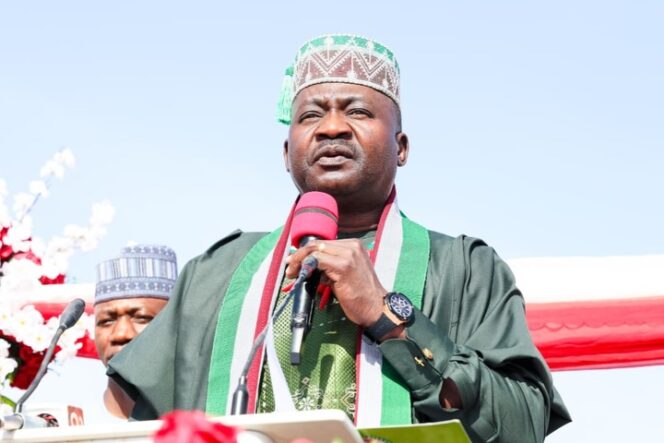
Nigeria’s Minister of Defence, General Christopher Musa (retd.), has confirmed that the United States is supplying the Nigerian military with real-time intelligence, satellite imagery, and specialized training to track and neutralize terrorist and bandit leaders ahead of the January 2027 general elections.
Speaking to journalists during a press briefing in Abuja on Monday, November 16, 2026, held on the sidelines of the 2026 Chief of Defence Intelligence (CDI) Annual Conference at the Armed Forces Officers’ Mess in Asokoro, General Musa disclosed that the expanded intelligence partnership has significantly degraded militant networks across northern Nigeria.
The afternoon briefing, which followed the 1:15 PM. opening session of the conference, highlighted how intelligence-led operations in the North-West and North-East have led to the elimination of several high-profile terrorist and bandit commanders.
”We took out a lot of the bandit leaders and the terrorists themselves,” General Musa told reporters. “We don’t want them to develop that capacity. We’re blocking the logistics and taking them out from within Nigeria.”
He noted that while armed groups have historically exploited dense forests and porous borders with Niger and Benin to evade security forces after launching attacks, advanced surveillance capabilities and satellite imagery provided by Washington have severely restricted their freedom of movement.
These intelligence assets are being complemented by newly commissioned Nigerian air platforms and expected helicopter deliveries from the United States and Italy.
With presidential and National Assembly elections scheduled for January 16, 2027, in which President Bola Tinubu is seeking a second four-year term, Musa emphasized that security agencies are intensifying preemptive operations to prevent violence before, during, and after the polls.
To prevent fleeing insurgents from using neighbouring territories as safe havens, Nigeria has formalised a five-kilometre (three-mile) cross-border “right of pursuit” agreement with Cameroon, Niger, and Chad, enabling Nigerian troops to pursue militants across shared frontiers.
At the same time, the Defence Minister warned of an evolving ideological threat in the region, noting that the Islamic State Sahel Province is actively attempting to recruit profit-driven criminal bandit gangs in northwestern Nigeria.
Such an alliance, he cautioned, threatens to transform localized criminal networks into ideologically driven insurgents akin to Boko Haram and the Islamic State West Africa Province (ISWAP) in the North-East.
To counter this convergence, Nigerian authorities are working closely with US counterparts to disrupt militant financing and logistics channels, including tracking the illicit use of Starlink satellite internet services, cryptocurrencies, and commercial drones.
The deepening military rapprochement between Abuja and Washington builds on a bilateral defence cooperation roadmap established in January 2026 and subsequent high-level engagements with the US Africa Command (AFRICOM) in February 2026.
Joint intelligence efforts have already yielded major operational successes, including a May 2026 strike in northeastern Nigeria that killed senior ISIS figure Abu-Bilal al-Minuki. When contacted regarding the latest briefing, a spokesperson for the US Embassy in Abuja did not immediately respond to a request for comment.
The push for intelligence-driven warfare echoed directives issued earlier during the Monday conference, which was themed “Optimising Intelligence Through Technological Innovations and Strategic Partnerships in a Complex Security Environment.”
Delivering President Bola Tinubu’s address, National Security Adviser Mallam Nuhu Ribadu urged Nigerian Defence Advisers stationed abroad to leverage bilateral and multilateral partnerships to bolster domestic intelligence gathering.
Chief of Defence Staff General Olufemi Oluyede similarly called for sustained investment in artificial intelligence, geospatial intelligence, and unmanned systems to shift the Armed Forces from reactive responses to proactive, predictive operations, while Chief of Defence Intelligence Lieutenant General Emmanuel Undiandeye unveiled plans for joint mission centers and private-sector technology alliances to counter encrypted terror networks.
Alongside international intelligence sharing, the federal government is rolling out domestic security reforms to fortify national stability ahead of the 2027 vote.
These measures include expanding Nigerian Army divisions from eight to 12, establishing a dedicated “forest guards” service to secure ungoverned spaces, and advancing legislative frameworks for state policing.