Global public relations and communication leaders have issued a stern warning to governments and corporate organisations against weaponising public relations, propaganda, and strategic messaging to conceal poor governance and leadership failures.
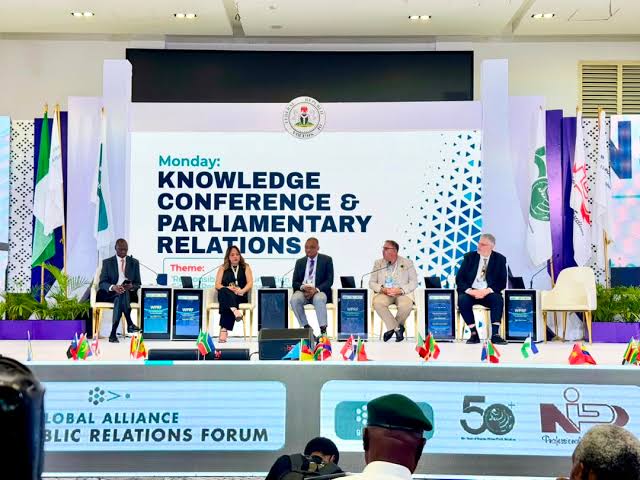
The warning was delivered on Tuesday, November 17, 2026, during a morning plenary session titled “Ethical Leadership and Trust in a Divided World,” held between 9:15 a.m. and 10:25 a.m. at the Transcorp Hilton Event Centre in Abuja.
The session formed part of the ongoing 2026 World Public Relations Forum (WPRF), running from November 15 to November 22, 2026, under the theme “Responsible Communication: The Voice of the World”, co-organised by the Global Alliance for Public Relations and Communication Management and the Nigerian Institute of Public Relations (NIPR).
Addressing delegates from across the globe, the panellists, comprising the Global Alliance’s regional council chairs for Europe, North America, Africa, Asia-Pacific, and the Middle East and South Asia, emphasized that public trust cannot be manufactured through publicity campaigns.
Instead, they insisted that credibility must be earned through transparency, accountability, and actions that align with public promises.
Silvia Arto, Global Alliance Vice President and Chair of its European Regional Council (and a senior executive at BNP Paribas in France), stated that genuine ethical leadership is demonstrated through personal conduct rather than polished public declarations.
“To me, ethical leadership is lead by example. It’s walk the talk. It’s integrity,” Arto said, defining integrity as doing what is right even when nobody is watching. She cautioned leaders that while public trust takes years to cultivate, it can be eroded within seconds in the age of social media.
Speaking from the private-sector perspective, Bonnie Caver, Chair of the Global Alliance’s North American Regional Council and CEO of Reputation Lighthouse, warned that businesses face severe reputational damage when their public commitments fail to match operational reality.
Caver noted that many corporations announce ambitious community engagement initiatives without following through, creating a credibility gap between corporate rhetoric and lived stakeholder experience. She urged executives to look beyond routine surveys and engage directly with employees, customers, and host communities to address genuine concerns.
She also called for stricter professionalisation within the communications industry to distinguish trained, ethical practitioners from casual users of digital platforms:
“Everybody in the world is a communicator. My son, who’s an engineer, is a communicator. My son, who’s a scientist, is a communicator. In today’s world, everyone is a communicator. We are not communicators. We’re communication professionals,” Caver said.
Moderating the session, Chimdi Neliaku, Chair of the NIPR Young Professionals Hub, concluded that sound leadership must always come before communication. She noted that lasting institutional credibility is built on strong governance structures, emotional intelligence, and authentic stakeholder relationships rather than reactive damage control.
Neliaku further challenged emerging communication professionals to uphold the same standards of accountability they demand from political and corporate executives. “We must also start to build a record of conduct that our own generation will be trusted on and judged on,” she said.