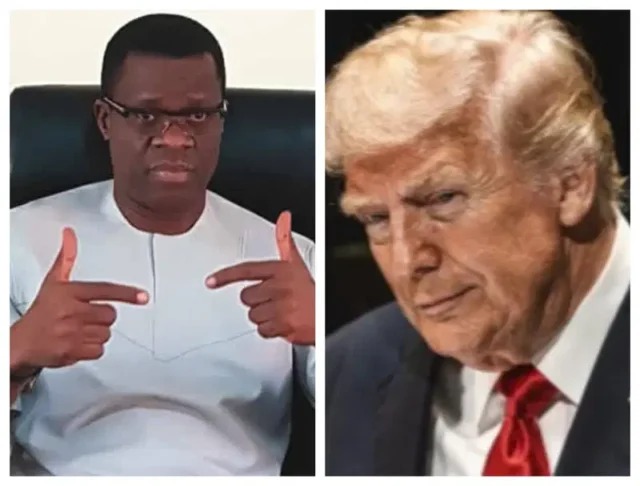
A former Resident Electoral Commissioner (REC) of the Independent National Electoral Commission (INEC), Barrister Mike Igini, has formally urged United States President Donald Trump to tie America’s immigration policy, diplomatic engagement, and bilateral cooperation with Nigeria to the credible conduct of the country’s 2027 general elections.
In an open letter dated November 13, 2026, and made public over the weekend of November 15 to 16 in Abuja under the title “No Mandate from Fraud: Election 2027,” Igini argued that Washington must adopt a proactive, deterrent posture ahead of the polls rather than waiting for post-election disputes or political crises to erupt.
Rather than relying on post-crisis mediation, Igini called on President Trump to dispatch a high-level United States delegation to Abuja well ahead of the elections to engage President Bola Tinubu, political parties, presidential and governorship candidates, INEC leadership, and key democratic institutions.
According to Igini, such a delegation should clearly communicate Washington’s position that transparent elections, peaceful competition, and respect for constitutional rights remain central pillars of US-Nigeria bilateral relations.
Expanding on his call for preventive accountability, the former Akwa Ibom State REC proposed strict visa restrictions, financial sanctions, and asset freezes, where supported by credible evidence, against culpable INEC officials who manipulate results or falsify electoral records.
He further urged the Trump administration to extend those punitive measures to judicial officers found culpable of misconduct in election-related litigation, as well as security personnel implicated in voter intimidation, electoral violence, or the unlawful suppression of opposition parties.
In his correspondence, Igini specifically named the Nigeria Police Force, the Department of State Services (DSS), the Armed Forces, and the Nigeria Security and Civil Defence Corps (NSCDC) as critical state institutions obligated to enforce the law impartially throughout the voting process.
Alongside targeted sanctions, he appealed to the US government to back credible domestic and international election observers to monitor the entire electoral cycle, spanning pre-election preparations, polling-unit result publication, transparent collation, and post-election dispute resolution.
Framing his appeal around shared strategic priorities, Igini contended in his letter that conditioning bilateral ties on electoral integrity directly advances President Trump’s “America-First” policy.
He argued that credible elections produce accountable leaders capable of revitalizing Nigeria’s domestic economy, which in turn reduces irregular migration pressures on United States borders. “Credible elections produce good leaders. Good leaders fix the economy. When Nigeria works, Nigerians will stay home and build their country. Many in the US diaspora will return,” Igini wrote.
Beyond migration control, he noted that linking diplomatic recognition to democratic legitimacy protects American taxpayers by ensuring Washington stops legitimising or committing financial resources to governments lacking the genuine consent of their citizens.
He added that a stable, democratically legitimate Nigerian government would serve as a far stronger partner for the United States in combating terrorism, organised crime, regional instability, and adversarial foreign influence across Africa, while unlocking transparent economic partnerships in Nigeria’s energy and electricity sectors for American technology transfer and private-sector investment.
Concluding his correspondence, which was issued directly to the press without a physical press conference venue or specific time of release attached, Igini reiterated that early deterrence is far more effective than post-election intervention.
“Mr. President, strength and clarity work. The time to act is before the election, not after a crisis has occurred,” he stated, warning that a clear message from Washington is urgently needed to demonstrate that the United States will not conduct business as usual with any government produced through electoral fraud.
As of Monday morning, November 16, 2026, neither the White House, the US Embassy in Abuja, nor official spokespersons for the Nigerian Presidency and INEC had issued a formal response to Igini’s open letter.