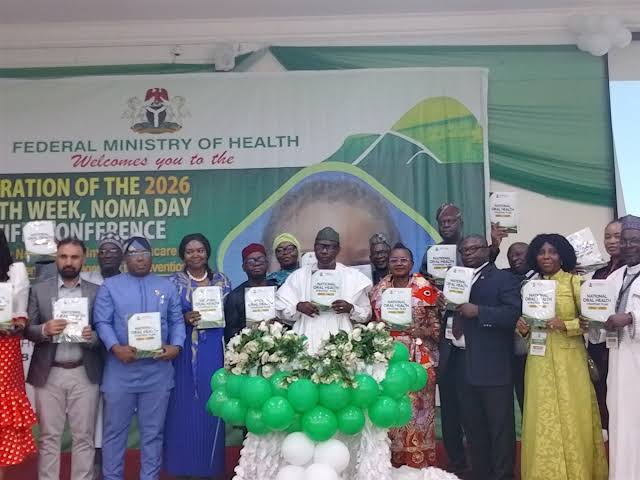
The Federal Government of Nigeria officially unveiled its ₦70 billion National Oral Health Strategic Plan (2026–2030) during a high-level commemoration ceremony held in Abuja on Monday, November 9, 2026.
Timed to coincide with National Noma Day and National Oral Health Day, the comprehensive policy sets out an ambitious roadmap to eliminate Noma as a public health threat, drastically improve access to dental services, and integrate specialised care into primary healthcare centers across all 774 Local Government Areas.
Delivering the keynote address, the Minister of State for Health and Social Welfare, Dr. Iziaq Adekunle Salako, described oral health as a critical yet historically neglected component of Universal Health Coverage.
He revealed that Nigeria faces a acute human resource deficit, operating with a ratio of approximately one dentist per 38,000 citizens, a stark contrast to the World Health Organization’s recommended benchmark of 1 per 7,500.
Dr. Salako emphasized that the five-year blueprint directly advances President Bola Ahmed Tinubu’s Renewed Hope Agenda by tackling structural health inequities nationwide.
Supporting the unveiling, Ado Bako, Assistant Director of Information and Public Relations at the Federal Ministry of Health, issued a statement detailing the government’s commitment to prioritising both preventive and curative dental interventions across the country.
Development partners also voiced strong support, with Dr. Ahmed, representing Médecins Sans Frontières (Doctors Without Borders), revealing that their team performed 114 surgical operations on 96 Noma patients in 2026 alone at the Sokoto Noma Children’s Hospital.
He called for sustained funding and the immediate integration of early Noma screening into routine primary healthcare to save vulnerable children. The strategic plan addresses the crisis through four primary pillars over the next five years.
First, it targets Noma (Cancrum Oris) by deploying concentrated resources toward early detection, community surveillance, and immediate surgical intervention, particularly in heavily burdened northern communities.
Second, it embeds oral health checks into routine maternal, child health, and nutrition programs, financing the initiative through the Basic Health Care Provision Fund (BHCPF) and Sector-Wide Approaches (SWAp).
Furthermore, the strategy drives aggressive preventive initiatives by expanding school-based oral hygiene education, broadening public access to affordable fluoridated toothpaste, and launching national sugar-reduction health campaigns.
Finally, the plan prioritises workforce capacity building by upskilling frontline health workers and surgical teams to bridge the critical shortage of specialised dental personnel in underserved rural communities.