By Okoh Aihe
Dr Chimezie Amadi called on October 20, 2026. Very early in the morning. I don’t take calls that will distract me from following AM programmes on television.
But I had to pick and listened to the man on the other side. There was so much excitement in his voice.
Those of the Christian faith have a song, “name your blessings one by one.” Amadi was not only naming them this beautiful morning, he was counting his blessings one by one, and they come in encouraging numbers.
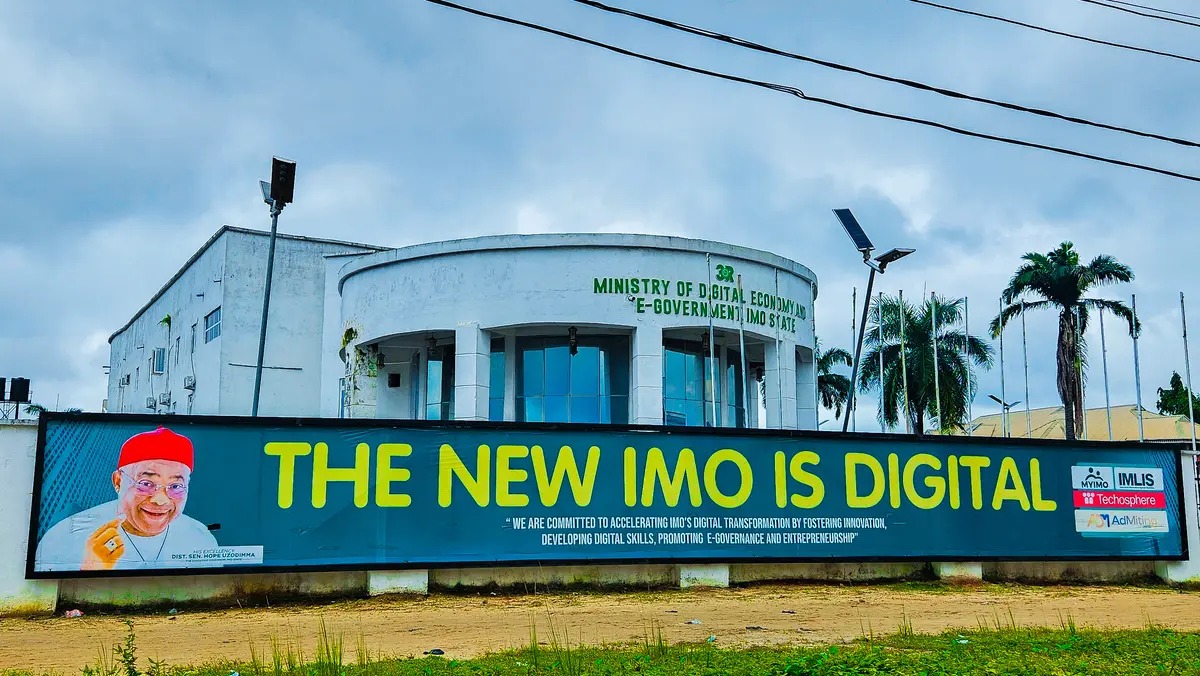
The Imo State Ministry of Digital Economy and E-Government is four years old. Amadi had a basketful of testimonies. Besides, he wanted to express gratitude for the support received from this column.
There is virtue in listening, dear friend. This very morning I had so much of it while replaying that very conversation we had four years ago when he called to inform that he had been appointed Commissioner in his home state Imo.
He would be on secondment from the Nigerian Communications Commission (NCC), where he had firmly cut his teeth as they would put it in the local parlance.
What will you be doing, I asked. That was when he tried to introduce the Imo Digital Economy Agenda (IDEA), which would mop up the young unemployed from the streets of Imo and train them in modern technology, build innovation hubs and promote e-governance, among other things.
Embedded in IDEA is the SkillUpImo programme which would train the youths in cohorts. The immediate target was to train as many as 300,000 within four years and assist them to be gainfully employed or be more useful to the society. The figure was an ambitious projection.
His proposition wasn’t strange to me. Besides, our environment was ripe for this kind of development. There was hunger. Unemployment has reached a worrying concern. And desperation was even more. Even the educated were looking for the opportunity to acquire some new skills that would adapt them to the needs of the society. This is an opportunity that has been waiting for perfect deployment.
Based on history of relationship, we did a character and competence analysis and came to the inevitable conclusion that Amadi was the right man for the job.
This was our position on October 5, 2022: “In Amadi the Governor of Imo State has made a good appointment. He will earn good returns from such a valuable choice. Imo State has scored a good goal.”
However, I had cautioned at the time, too, based on my very humble background and even more humble expectations, that if Imo State could just get only about 10 percent of the projected figure to perform, the programme would have succeeded as that small percentage could positively affect the lives of so many people and create a strong impact on the state.
When Amadi called, it was to confirm that we took a gamble on him and that he has delivered as expected. What the Imo State Government, under Senator Hope Uzodimma has done with IDEA, has exceeded the expectations of even the most stubborn optimist.
“Under SkillUpImo,” Amadi enthused, “more than 65,000 Imolites have been trained in AI, coding, cybersecurity, UI/UX design and blockchain; and Cohort 4, targeting a further 10,000 puts the programme on course to exceed 75,000. Digital skills centres operate in all 27 Local Government Areas. Graduates receive startup kits for remote work, freelancing and entrepreneurship, and more than 30 startups have emerged, including WritersGig.com, SMFEST, City Bus Initiative, Diskox.com and Basetech Hub.”
Breaking down the foregoing to some tiny details even makes more sense. Some of their trainees, Amadi explained, are working as clinical data analysts with National Health Service (NHS) in the UK, Konga, Cisco, Federal Medical Centre, some directly employed by the Imo State Government, while some of them have created their own startups.
In the past four years, Amadi continued, the state has built a relationship with international bodies and institutions which has boosted its vision to create a digital economy and digital living.
Imo State Digital City Limited, the state’s official tech hub, rests on a $15 million partnership with US-MAC and UC Berkeley’s Sutardja Center for Entrepreneurship and Technology, making Imo the first sub-national government to partner with US-MAC, in the words of Amadi.
For him, Imo Digital City Limited is like the Silicon Valley in California, where ideas are birthed and converted to products and services. In the case of Imo, ideas from young and, sometimes, restless minds, are finding good and much needed expression.
So far, over 20 startups have been incubated. The Founder Dojo programme, whose Cohort One now has nine startups and 30 founders (4FG-Monitor, AlphaWPC, ShopCop, LyfeBlood, OriginTrace, Sneepha, Volkes, WakaBid and Worka), is nurturing home-grown, grassroots startups with the potential to become the tech unicorns of the near future.
The state, according to Amadi, has built a digital ecosystem which incorporates, governance, revenue management system, land information management, healthcare, education and a state digital identity system, among others. For instance, an interested party can search for land information using his mobile phone while with an Imo Social Security Benefit Number (IMSSBN), he can also access a loan from the State Mortgage Bank, health insurance scheme or in the case of a student, even get a student bursary.
The commitment of the state to technology has been honoured by Cisco and the National Information Technology Development Agency (NITDA). Governor Uzodimma was named Digital Governor of the Year at the National Information Technology Merit Awards in 2024.
However, Amadi confessed that the state was still trying to crack the area of broadband penetration because digital economy works best when everybody is connected. We already achieved 65 percent broadband penetration, but we need more in order to accelerate further economic growth especially in rural areas. We want to create rural economies and mitigate rural-urban migration, he explained.
I do not know how much of political considerations went into the appointment of Amadi but I do want to think that his portfolio from the NCC played a significant role. He went through the NCC system, through the trainings – local and international, and has taken all that benefit to his home state Imo. The result is a digital Imo where street boys and girls have been transformed into global citizens.
It is not possible to rule out politics from appointments especially in our kind of world where politicians enjoy more narcissism and nepotism than any consideration for the welfare of the people. But Digital Imo reinforces my belief that technocrats are important in the value-chain but they should be allowed to do the primary assignment given them to the overall benefit of the people.