By Charles Obiajulu Ugwu
In the summer of 427 BC, the Assembly of Athens met in anger. The city of Mytilene, an ally on the island of Lesbos, had revolted and been crushed, and the citizens of Athens, sitting together on the hillside of the Pnyx, voted to put every adult male of Mytilene to death and to sell the women and children into slavery. A trireme was sent across the Aegean with the order.
Then something happened that has never quite stopped happening in democracies. The citizens slept on it. By morning many of them were troubled by what they had done, and the Assembly was called again. The demagogue Cleon told them that pity was a weakness unworthy of an empire.
A man named Diodotus answered him, and the vote went the other way by a narrow margin. A second trireme was launched to overtake the first. Thucydides tells us its crew ate barley kneaded with wine and oil at the oars and slept in shifts so the rowing never stopped. They arrived just as the Athenian commander had read the first decree and was preparing to carry it out. Mytilene was spared.
I keep returning to that story because it holds the whole truth about democracy in a single night. The same body of citizens that could vote for a massacre could also vote to recall it. Democracy did not make Athens wise. It made Athens correctable, barely, and only because a second ship rowed faster than the first.
This essay is an attempt to look honestly at what democracy promised, what it delivered, and what remains. My argument is simply to state the uncomfortable truth about democracy and not to accept it as being showcased globally as the irreducible standard of governance excellence. Democracy came to us carrying a bundle of large promises.
Most of them were never realisable at the scale of the modern state, and some were never coherent even in principle. What survives is narrower and humbler than its admirers like to admit: the ability of a people to remove their rulers without bloodshed, and the restraint of power by rules the ruler did not write. That residue is small. It is also, I will argue, worth defending with some ferocity, precisely because it is all we actually have.
The Seduction
Democracy has never been one idea. It arrived as a cluster of hopes, and its appeal has always depended on our not looking at any one of them too closely.
The first hope was self-rule. In a democracy, the people govern themselves, so that obeying the law becomes a form of obeying one’s own will. This is the idea that thrilled Rousseau and that still animates every speech that begins with “we the people.”
The second was political equality. Each citizen counts as one and no more than one. The farmer’s vote weighs exactly what the banker’s weighs. In societies built for centuries on hereditary rank, this was a moral revolution.
The third was the wisdom of the many. Aristotle observed that a feast to which many people contribute can be better than one provided by a single host, and he suggested that the judgment of a crowd might likewise surpass that of any one expert. Two thousand years later, the Marquis de Condorcet put mathematics behind the intuition: if each voter is even slightly more likely to be right than wrong, a large enough majority becomes almost certain to be right.
The fourth was the common good, the belief that behind the noise of competing interests there exists something we can call the will of the people, and that legitimate government is its faithful expression.
The fifth was moral formation. John Stuart Mill and Alexis de Tocqueville both believed that participation would make citizens better: more informed, more public-spirited, more fully human. Tocqueville saw it in the New England township, where ordinary farmers argued over roads and schools and became, in the arguing, a people capable of governing themselves.
The sixth hope came late and burned brightest. After the Berlin Wall fell, Francis Fukuyama published his famous essay asking whether we had reached the end of history, the point at which liberal democracy stood as the final form of human government, the destination toward which every society was travelling whether it knew it or not.
Measured against these six hopes, the record of the last two and a half thousand years is sobering. Let me take them in turn.
Self-Rule Became the Selection of Rulers
Athens could practise direct rule for a reason its modern admirers tend to skip. Its citizen body was small, and it was small because most of the people who lived in Attica were excluded from it. Women could not vote. Slaves could not vote. Resident foreigners, the metics who ran much of the city’s trade, could not vote. Historians argue over the exact numbers, but on any estimate the adult male citizens who filled the Pnyx were a minority of the population whose lives they governed. The first democracy was a democracy of the few, and its directness depended on that.
Once democracy had to govern nations of millions, direct rule became impossible, and representation took its place. The people would no longer decide; they would choose who decides. Rousseau saw the trap early and named it with contempt. The English, he wrote in The Social Contract, believe themselves free, but they are free only during the election of members of Parliament; once the members are chosen, the people are slaves again.
A century and a half later, the German sociologist Robert Michels went looking for democracy in the place it should have been purest: the socialist parties of Europe, organisations founded explicitly to give power to the working masses. What he found instead was a permanent caste of leaders, officials and party professionals, whose expertise and control of the organisation made them all but impossible to remove. He called it the iron law of oligarchy. Whoever says organisation, he concluded, says oligarchy.
By 1942, the economist Joseph Schumpeter decided to stop pretending. In Capitalism, Socialism and Democracy he redefined democracy not as rule by the people but as a method by which leaders compete for the people’s vote. Citizens do not govern; they choose between teams of would-be governors, and then they go home. It was a deflating definition. It was also the honest one, and it describes how almost every working democracy on earth actually runs.
So the first promise did not survive the move from the hillside to the nation. Self-government became the periodic selection of rulers, and the citizen who was meant to be sovereign became something closer to a customer choosing between two shops.
Equal Votes, Unequal Voices
The second promise fared better on paper and worse in practice. The ballot really is equal. In most democracies, the vote of the poorest citizen is counted exactly as the vote of the richest. But the vote is the last step of a long process, and nearly every step before it is unequal.
Money funds campaigns and buys the attention that decides them. Organised interests employ lawyers and lobbyists to draft legislation while ordinary citizens are at work. Media owners decide what the public sees and what it never hears about. The vote is cast at the end of a pipeline that the voter did not build and cannot inspect.
In 2014, the political scientists Martin Gilens and Benjamin Page tested this against the record of the United States. They examined 1,779 policy questions over two decades and compared what happened with what different groups of Americans had said they wanted. Their finding was stark: the preferences of economic elites and organised business groups had substantial independent influence on policy outcomes, while the preferences of average citizens had little or none once those other groups were accounted for. Other scholars have disputed the size of the effect, and the debate continues. But no serious participant in it claims that the average citizen and the wealthy donor carry equal weight.
The French novelist Anatole France captured this gap more than a century ago with a line that has never lost its sting. The law, he wrote, in its majestic equality, forbids the rich as well as the poor to sleep under bridges, to beg in the streets, and to steal bread. Formal equality of the vote sits in exactly that position. It is real, and it is laid over a pyramid of influence that it does very little to flatten.
The Crowd That Was Not Wise
The third promise, that the many would judge better than the few, was undermined almost at the moment of its first great test. In 399 BC an Athenian jury of five hundred and one citizens tried Socrates on charges of impiety and corrupting the young. They found him guilty and sentenced him to death. Western philosophy has never entirely forgiven democracy for that verdict, and Plato spent the rest of his life designing political systems in which the crowd would never again sit in judgment over the wise.
Condorcet’s theorem is elegant, but it depends on two conditions that real electorates rarely meet. Each voter must be better than chance at judging correctly, and each voter must judge independently of the others. The first condition runs into what Anthony Downs called rational ignorance. Since a single vote almost never decides an election, it is perfectly sensible for a busy person not to spend weeks studying policy. The cost is high and the private return is close to zero. Most people, quite reasonably, do not bother.
The second condition, independence, is destroyed by the way people actually decide. In Democracy for Realists, Christopher Achen and Larry Bartels argue that voters behave much less like deliberating citizens and much more like members of teams. They take their opinions from the groups they belong to, and they reward or punish incumbents for things over which those incumbents had no control. Their most memorable example is the summer of 1916, when a string of shark attacks terrified the beach towns of New Jersey. In the presidential election that autumn, Woodrow Wilson’s support in those towns fell noticeably compared with inland areas. No president commands the sharks. The voters punished him anyway.
Add to this a media environment engineered to sort people into tribes and feed each tribe what it already believes, and Condorcet’s optimism collapses. A crowd of independent, modestly informed judges may be wise. A crowd of loyal, poorly informed partisans, all reading from the same script, simply magnifies the error of the script.
The Will That Is Not There
The fourth promise, the common good expressed as the will of the people, runs into a problem that is not practical but logical.
Condorcet himself discovered the first crack. He showed that a group of perfectly rational voters can produce a collective preference that goes in circles: a majority prefers A to B, another majority prefers B to C, and yet another majority prefers C to A. There is no stable answer to the question of what the group wants. The same man who gave democracy its most hopeful theorem also gave it its most troubling paradox.
In 1951 the economist Kenneth Arrow generalised the problem. He proved that no voting system can turn individual preferences into a consistent collective ranking while satisfying a handful of basic fairness conditions that almost everyone accepts. The result earned him a Nobel Prize, and it has never been overturned. Thirty years later the political scientist William Riker drew out the political lesson. If the outcome of a vote depends on how the options are framed, in what order they are presented and which alternatives are allowed onto the ballot, then whoever controls the agenda controls the result. The people’s will, on this account, is not discovered. It is manufactured by whoever sets the menu.
This is why the phrase “the people have spoken” should always make us slightly nervous. After the British referendum on leaving the European Union in 2016, decided by roughly fifty-two percent to forty-eight, the phrase “the will of the people” was used to describe a choice on which the country had split almost down the middle. Whatever one thinks of the outcome, the language was doing work that the arithmetic could not support. A narrow majority on a single question is the result. It is not a will.
The Citizen as Spectator
The fifth promise, that democracy would form better citizens, has not disappeared entirely. It survives in parent-teacher associations, town meetings, cooperatives and the countless small civic bodies where people still argue face to face about shared things. Tocqueville would recognise them.
But at the level of the nation, participation has thinned into spectatorship. For most people, democratic life now consists of one vote every four or five years, punctuated by long stretches of watching, scrolling and reacting. Politics is consumed rather than practised. Opinion has become a matter of allegiance, worn like the shirt of a football club, and the habits of mind Mill hoped democracy would build, patience, curiosity, the willingness to be persuaded, are precisely the habits the modern attention economy punishes.
Destiny Reversed
The sixth promise, that history was moving inexorably toward liberal democracy, has been tested by events, and events have not been kind to it.
The Varieties of Democracy Institute at the University of Gothenburg, which tracks hundreds of indicators of democratic health across nearly every country on earth, published its tenth annual report in March 2026 under a title ending in a question mark: Unraveling the Democratic Era? Its findings read like an obituary for the optimism of 1989. For the average person on the planet, the level of democracy has fallen back to where it stood in 1978.
The gains of the great wave of democratisation that began with Portugal’s revolution in 1974 have been almost entirely erased. By the end of 2025 the world contained more autocracies than democracies, ninety-two against eighty-seven. Nearly three-quarters of humanity, about six billion people, now live under autocratic rule, and only seven percent live in what the institute classifies as liberal democracies.
What makes the 2026 report different from its predecessors is where the decline is happening. This is no longer a story about fragile states on the periphery. Six of the ten countries newly identified as autocratising are in Europe and North America, and the United States lost its classification as a liberal democracy for the first time in more than half a century. Within a single year, its score on the institute’s Liberal Democracy Index fell by about a quarter, and its world ranking dropped from twentieth to fifty-first.
The end of history, it turns out, was an intermission.
The African Fracture
If the gap between democratic promise and democratic practice is wide in the old democracies, it is a chasm in Africa. And the reason is not, as the lazier commentators suggest, that Africans are unsuited to self-government. The reason is almost the opposite.
Long before the ballot box arrived, many African societies had worked out ways of holding power to account that were in some respects more intimate and more demanding than anything Westminster offered. Among the Igbo, the saying Igbo enwe eze, the Igbo have no king, described a political world without central monarchy, in which village affairs were settled in open assemblies, through lineage councils and age grades, and in which authority rested on persuasion and consensus. In the Oyo Empire, the council of nobles known as the Oyo Mesi held a power that would make any modern president nervous.
If they judged that the Alaafin had lost the right to rule, they could present him with an empty calabash or a dish of parrot’s eggs, a signal that he was expected to take his own life. Among the Asante, a chief who abused his office could be destooled, formally stripped of the stool that embodied his authority. These were not democracies in the modern sense, and I do not want to romanticise them. But they shared a principle: power was watched at close range, by people who knew the ruler’s face.
The democracy that arrived with independence replaced that intimate accountability with something distant, periodic and mediated by money. The Westminster constitutions handed over in the late 1950s and early 1960s barely survived their first decade. Ghana under Kwame Nkrumah became a one-party state by referendum in 1964. Nigeria’s First Republic ended in the coup of January 1966. Across the continent, the ballot box gave way to the barracks or to the ruling party, and for a generation the question was not how democracy would work in Africa but whether it would be allowed to exist at all.
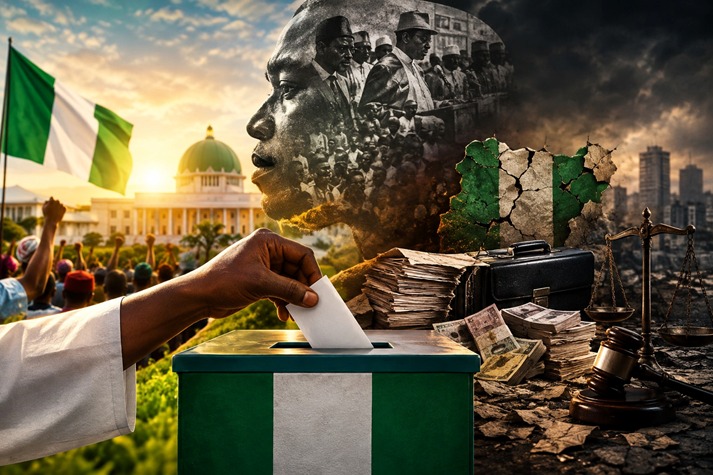
Nigeria’s story carries the whole drama. On 12 June 1993 Nigerians went to the polls in what many still regard as the freest and fairest election in the country’s history. Moshood Abiola appeared to have won across ethnic and religious lines. The military government of Ibrahim Babangida annulled the result. The clearest expression of the popular will Nigeria had ever produced was simply cancelled by men with guns, and the country paid for it with five more years of military rule under Sani Abacha.
When civilian rule returned in 1999, there were moments that showed the residue I will defend later in this essay. In 2006 the Senate rejected the constitutional amendment that would have allowed President Olusegun Obasanjo a third term. In 2015 Goodluck Jonathan became the first sitting Nigerian president to lose an election, and he telephoned Muhammadu Buhari to concede before the final results were announced, having said more than once that his ambition was not worth the blood of any Nigerian. Those were not small things. In much of the world they would still be remarkable.
But beneath those moments, the substance hollowed out. The political scientist Richard Joseph gave the condition its name in 1987: prebendalism, a system in which public offices are contested not as trusts but as shares in the revenue of the state, to be enjoyed by the holder and distributed to his supporters and his kin. Elections under prebendalism are not contests over policy. They are auctions for access.
Nigerians, who have never been short of a phrase for their own predicament, invented a vocabulary for this auction. When Ayo Fayose defeated the incumbent Kayode Fayemi in the Ekiti governorship election of 2014, he mocked his opponent’s focus on roads and public works: the people, he said, did not want road infrastructure, they wanted stomach infrastructure. The phrase entered the national language overnight.
By the 2018 Ekiti election, civil society monitors were reporting that the practice had a new name, “see and buy,” in which voters showed party agents their marked ballots before collecting payment. Reports put the going rate at a few thousand naira a vote. In neighbouring Ondo the expression was “dibo ko se obe,” vote and cook soup. And lest anyone think this is a recent decline, the independence-era minister Kingsley Mbadiwe had already spoken of a democracy of the stomach. The vocabulary changes. The transaction does not.
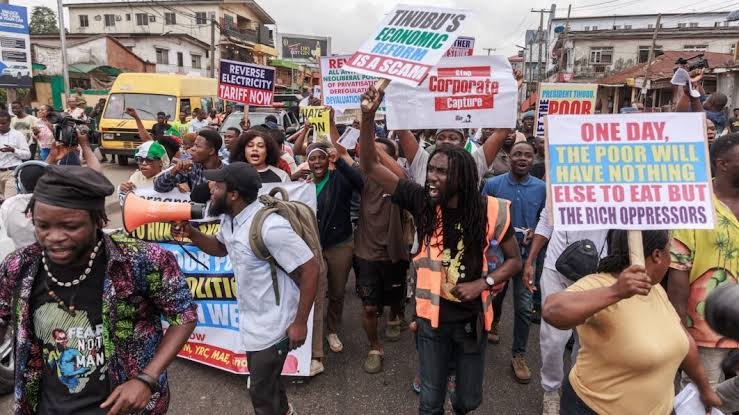
The citizens, meanwhile, have begun to walk away. In 2003, about sixty-nine percent of registered voters turned out for Nigeria’s presidential election. In 2023, of roughly 93.5 million registered voters, only about 24.9 million cast a ballot, a turnout of under twenty-seven percent, the lowest since the return to civilian rule and among the lowest recorded in any recent African election. The European Union’s observer mission concluded that failures of law and administration had damaged public trust in the electoral commission. When people stop voting in a country that once queued for hours in the sun to vote, they are telling you something about what they believe their vote is worth.
Elsewhere, the fracture takes the form of the ruler who will not leave. In Cameroon, Paul Biya came to power in 1982, removed the presidential term limit in 2008, and in October 2025, at the age of ninety-two, was declared the winner of an eighth term with about fifty-four percent of the vote. His main challenger claimed victory, protesters took to the streets of Douala, and four people were killed in clashes with security forces. More than seventy percent of Cameroonians are under thirty-five. Biya has ruled for longer than most of his citizens have been alive.
In Tanzania the same month, President Samia Suluhu Hassan was declared re-elected with nearly ninety-eight percent of the vote after her two most significant challengers were excluded from the race. The main opposition party called it a coronation. Protests erupted; the United Nations human rights office cited credible reports of at least ten deaths, while the opposition claimed far more. In Uganda, Yoweri Museveni, in power since 1986, has twice had the constitution amended to stay there, first removing term limits and later the presidential age limit. These are elections in form. In substance they are rituals of confirmation.
And then there is the coup belt. Since 2020, soldiers have seized power in Mali, Guinea, Burkina Faso, Niger, Gabon and Madagascar, among others. In some of those capitals, crowds came out not to resist the soldiers but to cheer them. The surveys explain why. Afrobarometer’s most recent round, based on interviews in thirty-eight countries during 2024 and 2025, found that a solid majority of Africans, sixty-four percent, still say they prefer democracy to any other system, and sixty-five percent reject military rule.
But opposition to military rule has fallen by eleven percentage points over a decade. Fewer than half of Africans now consider their own country a democracy, and only thirty-eight percent are satisfied with how democracy works where they live. More than half say they would tolerate the army stepping in when elected leaders abuse power for their own ends, and young people are more willing than their parents to say so. In South Africa, the continent’s showpiece of negotiated transition, the latest survey found that for the first time in over a quarter century, more citizens say they would accept military rule than oppose it.
It would be easy to read these numbers as a rejection of democracy. I read them differently. Africans are not rejecting the idea. They are rejecting the version they have been sold, the one in which the vote is a purchase, the court is a branch of the ruling party, and the outcome is known before the ballots are counted. Afrobarometer’s own analysts have noted that support for democracy is surprisingly resistant to economic hardship and far more sensitive to political failures: rigged elections, corruption, the collapse of the rule of law. People will tolerate being poor under a government they chose. They will not indefinitely tolerate being cheated.
And here is the part of the African story that the pessimists leave out. Wherever an institution has held its nerve, the residue of democracy has shown what it can do.
On 1 September 2017, Kenya’s Supreme Court, led by Chief Justice David Maraga, annulled the re-election of President Uhuru Kenyatta on the grounds that the vote had not been conducted in accordance with the constitution. It was the first time any court in Africa had overturned a presidential election. Kenyatta called the judges crooks and promised to deal with them. The ruling stood. The story did not end cleanly, because the opposition boycotted the rerun and Kenyatta won it easily, but a line had been crossed that could not be uncrossed: an African court had told a sitting president that his victory was void.
Malawi went further. In 2020 its Constitutional Court annulled the 2019 re-election of Peter Mutharika, citing widespread irregularities, among them the use of correction fluid on results sheets. Lazarus Chakwera won the rerun. Five years later, with the economy in crisis, Malawians turned on Chakwera, and in September 2025 he went on national television to concede defeat to the same Peter Mutharika, saying it was only right to accept the will of the citizens and the constitution. The man who had been removed by a court returned by a ballot, and the man who had replaced him left peacefully. That is democracy doing the one thing it does best.
Senegal offers perhaps the most dramatic example. In February 2024, three weeks before a scheduled presidential election, President Macky Sall announced that the vote would be postponed, and the National Assembly backed him with a ten-month delay. His opponents called it a constitutional coup. More than a hundred civil society organisations formed a coalition called Aar Sunu Election, let us protect our election.
On 15 February the Constitutional Council struck down both the decree and the law, ruling that neither the president nor the legislature had the authority to postpone the vote. Bassirou Diomaye Faye, an opposition candidate who had been sitting in prison, was released under an amnesty in March, won the election outright with about fifty-four percent, and was sworn in on 2 April, the very day Sall’s mandate expired, as the youngest president in Senegal’s history.
And in Ghana in December 2024, Vice President Mahamudu Bawumia, the ruling party’s candidate, did not wait for the electoral commission. Once his own party’s tally showed that John Mahama had won decisively, he called Mahama to congratulate him and then told the nation that Ghana had won.
Put the two halves of the African story side by side and the lesson is plain. Democracy in Africa fails where it is run as a market, in which votes are bought, offices are prebends and the referee belongs to one of the teams. It survives where some institution, a court, an electoral commission, a coalition of citizens, or simply a defeated candidate with a conscience, holds the line. The demand is there. It is the supply that has been short.
What Actually Survived
Strip away the promises that democracy could not keep and four durable achievements remain.
The first is the bloodless removal of rulers. Karl Popper argued that political philosophy had been asking the wrong question for two thousand years. The question is not who should rule, which leads straight to Plato’s philosopher-kings and every tyranny that has claimed to know best. The question is how we can get rid of bad rulers without violence. Democracy is the only system yet devised that answers it reliably.
The political scientist Adam Przeworski built his entire defence of democracy on this modest foundation: a system in which parties lose elections and then actually leave office is a civilisational achievement, however poor the choice on the ballot. Chakwera’s concession in Lilongwe and Bawumia’s in Accra are not footnotes. They are the main event.
The second is error correction. Amartya Sen observed that no substantial famine has ever occurred in a functioning democracy with a free press. The reason is not that democratic governments are wise. It is that they cannot hide. A free press reports the first deaths, an opposition makes noise, and a government that wants to keep its job is forced to act. Democracy, in other words, is the second trireme to Mytilene. It does not prevent the first mistake. It makes the reversal possible.
The third is relative peace between democracies. Established democracies have very rarely gone to war with one another, though they have fought plenty of others. Scholars still argue about why, and about how much weight the finding can bear, but the pattern has held up remarkably well.
The fourth is rights and the rule of law, and here lies the deepest irony of the whole subject. The protections we most value in modern democracies, free speech, independent courts, constitutional limits on what any government may do, do not come from democracy’s majoritarian heart. They come from its liberal shell, and that shell is counter-majoritarian by design.
Constitutions and courts exist precisely to stop the majority from doing whatever it likes. The Kenyan Supreme Court in 2017 and the Senegalese Constitutional Council in 2024 were not expressing the will of the people. They were restraining the will of the people’s elected representatives. The most valuable parts of what we call democracy are the parts that restrain the demos.
And it is exactly these parts that are now eroding fastest. The V-Dem report found that in the United States the liberal components of democracy have shown the steepest decline, and that across the world freedom of expression is the single most damaged dimension, falling in forty-four countries during 2025 alone. The elections continue. It is the restraints around them that are being dismantled.
The Verdict
On 11 November 1947, Winston Churchill, recently thrown out of office by the British electorate, stood in the House of Commons and offered what may be the most honest defence of democracy ever made. Many forms of government have been tried, he said, and no one pretends democracy is perfect or all-wise. Indeed it has been said that democracy is the worst form of government except all those other forms that have been tried from time to time.
The line endures because it makes a modest claim and no larger one. Democracy promised self-government and delivered, at best, the right to dismiss one’s governors. It promised equality and delivered equal ballots inside deeply unequal societies. It promised collective wisdom and delivered a mechanism that is frequently foolish but can correct its foolishness without a coup. It promised to express the will of the people and turned out to depend on the integrity of a few institutions that the people often barely notice until they are gone.
That residue is small relative to the original ambition. It is not trivial. The alternative to an imperfect ability to remove rulers is not a perfect ability; it is usually none at all. The Malian who cheered the soldiers in 2020 and the Nigerian who sold his vote for the price of a pot of soup are not fools. They have been offered a counterfeit and have, understandably, stopped believing in the currency.
The task for those of us who still care about the real thing is not to repeat the old promises louder. It is to stop overselling democracy as the voice of a collective will that cannot be shown to exist, and to start defending it for what it actually is: a fragile, often embarrassing, irreplaceable device for correcting our rulers before they destroy us.
The Athenians who voted for the massacre of Mytilene were not saved by their wisdom. They were saved by their second thoughts, and by a crew of rowers who did not stop to sleep. That is not much to build a civilisation on. It may be all we have ever had.
Against This Reading
An honest audit should end by giving the strongest objections their due, and there are several.
The deliberative and participatory democrats argue that I have described the failure of thin democracy, not of democracy itself. When ordinary citizens are given time, information and genuine authority, they reason well. Ireland’s Citizens’ Assembly, a randomly selected body of ordinary people that met between 2016 and 2018, deliberated over the country’s constitutional ban on abortion and recommended change. In the referendum that followed in May 2018, about sixty-six percent of voters agreed. On this view, the remedy for democracy’s failures is more and better democracy, not less.
The growth economists challenge my implicit claim that democracy’s developmental promise has failed. In a widely cited 2019 study, Daron Acemoglu and his colleagues found that countries which democratise go on to enjoy GDP per capita roughly twenty percent higher over the following quarter century than they otherwise would have. If that is right, democracy delivers material as well as political goods.
From the other direction, epistocrats such as the philosopher Jason Brennan argue that the evidence on voter ignorance should lead us further than I have gone, toward systems that weigh political power by demonstrated knowledge. And defenders of political meritocracy, such as Daniel Bell, point to China’s system of performance-based promotion as a serious rival model. Their critics answer, I think correctly, that such systems have no reliable way to correct a catastrophic error at the top, which is precisely the one virtue democracy has never lost.
Finally, the African survey data contains its own rebuke to pessimism. Even now, after decades of stolen elections and stomach infrastructure, nearly two-thirds of Africans say they prefer democracy to any alternative. The people have not given up on the idea. They are waiting for someone to deliver it.
Charles is a contrarian thinker writing from Lagos