President and Chief Executive Officer of Dangote Industries Limited (DIL), Aliko Dangote, has announced ambitious plans to establish a comprehensive petroleum distribution network across the African continent. The initiative aims to enhance energy security, eliminate distribution bottlenecks, and link major refining hubs with underserved regional markets.
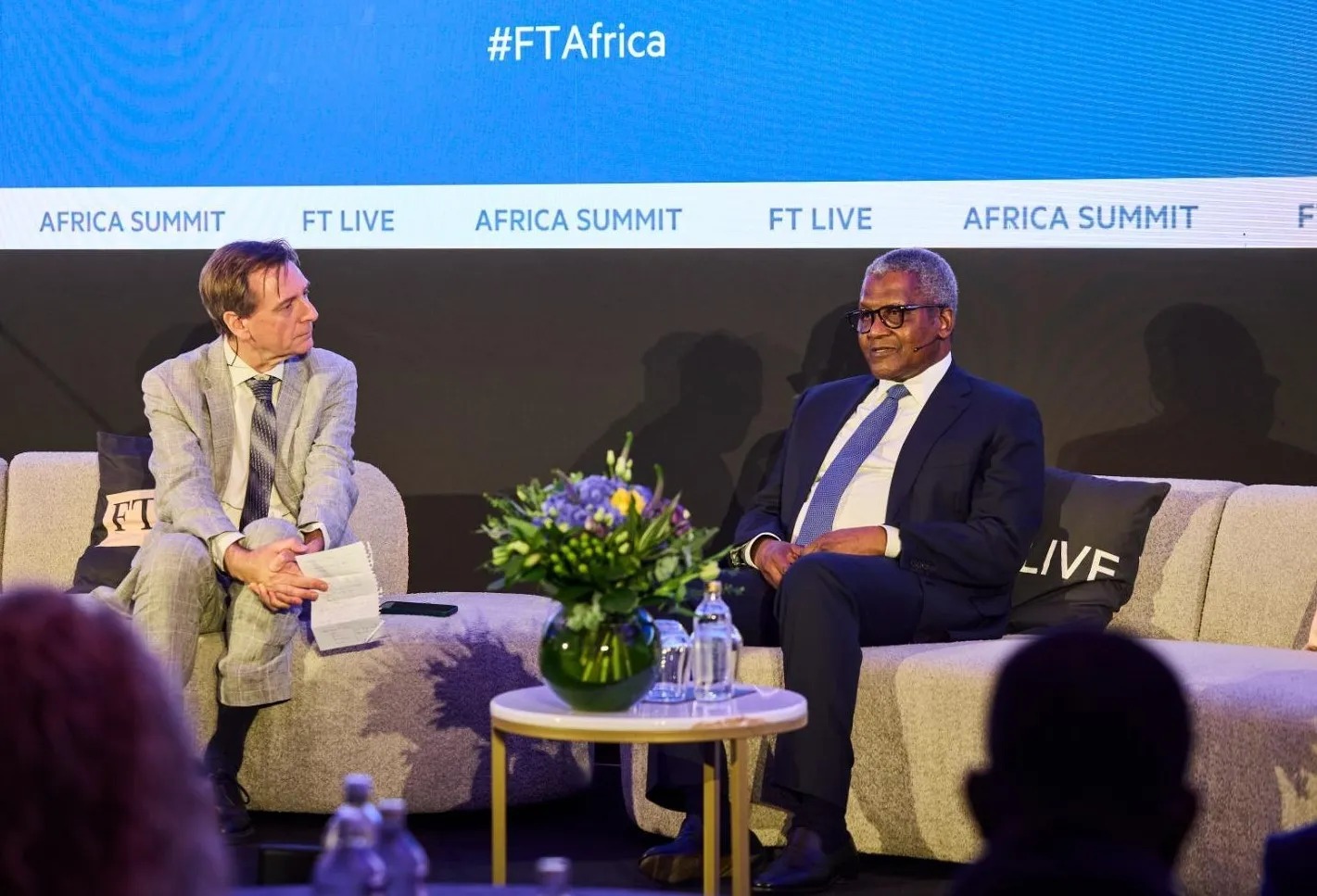
Dangote revealed the strategic expansion on Wednesday, October 21, 2026, during an interactive session with David Pilling, Africa Editor for the Financial Times, at the FT Africa Summit held in London.
Speaking during the interview session, Dangote outlined how the Group is aggressively scaling up its downstream logistics and infrastructure footprint across East, Central, and Southern Africa.
As part of this regional expansion, the Group recently secured a 25 percent equity stake in Kenya’s petroleum products pipeline network with the backing of the Kenyan government. The conglomerate is also pursuing additional pipeline and supply corridor projects connecting Djibouti and Ethiopia, along with major infrastructure investments in Cameroon and Namibia.
In addition, Dangote disclosed that the Group has earmarked $50 billion for strategic capital investments between 2026 and 2030 to accelerate the continent’s industrial integration.
“The legacy we are trying to set up is how do we industrialise our continent? The journey has started. But now we’re awake, and we will make it happen,” Dangote declared.
Beyond logistics investments, Dangote made a passionate plea to African governments to adopt industrial policies that safeguard domestic manufacturing against excessive import dependence and unfair foreign competition.
He warned that failure to shield emerging local industries threatens long-term economic growth and employment generation; “Allowing imports to displace local production means we are exporting our jobs out of the continent and importing poverty into the continent,” Dangote stated.
Addressing broader structural impediments to African industrialisation, Dangote identified persistent power deficits, underdeveloped financial institutions, and inadequate industrial policies as critical challenges.
He pointed out that approximately 650 million Africans still lack access to reliable electricity, highlighting power shortages as a severe barrier to value-addition in sectors like mining and mineral processing.
Dangote questioned why a continent rich in arable land, mineral resources, and a vibrant youth demographic continues to suffer widespread poverty, reaffirming his confidence that Africa possesses all the required fundamentals to transform into a major global industrial powerhouse.