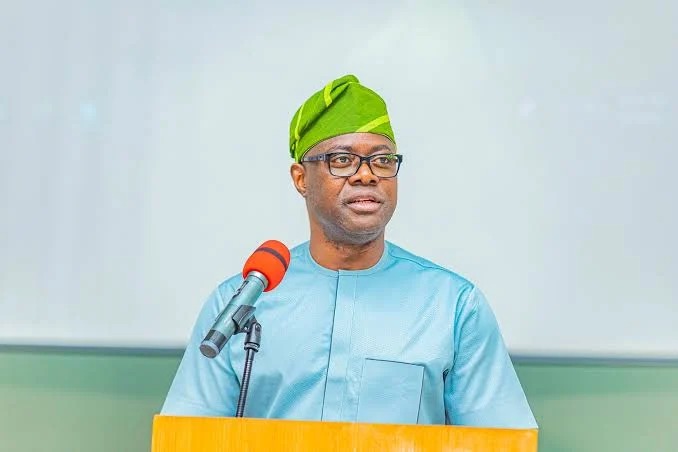
Oyo State Governor, Seyi Makinde, has sharply criticized the Federal Government’s economic policy direction, declaring that worsening poverty across the nation underscores an urgent need to evaluate leadership by its direct impact on citizens rather than abstract macroeconomic metrics.
Speaking on Thursday evening, October 15, 2026, during an address at a political and regional leadership engagement in Yola, Governor Makinde asserted that statistical stability reported by international financial institutions has failed to translate into better living conditions for ordinary Nigerians.
Addressing party stakeholders, delegates, and newsmen, Governor Makinde noted that while the Federal Government continues to cite structural assessments from the World Bank and International Monetary Fund (IMF), millions of citizens remain trapped in severe financial hardship.
”Macroeconomic stability has not translated at the same pace into jobs, lower poverty, and improved living standards for the majority of Nigerians,” Makinde stated. “We must assess leadership by how it affects the average citizen, not by abstract numbers or theoretical economic indicators. When economic choices result in deepening poverty, human-centered leadership must take priority.”
He stressed that the electorate retains the constitutional power to hold elected officials accountable, reminding citizens that leaders who fail to deliver tangible relief after a four-year term can be voted out of office.
Drawing a contrast with the Federal Government’s fiscal approach, Governor Makinde highlighted his administration’s governance model in Oyo State, arguing that public welfare and infrastructure development can be pursued simultaneously.
Key operational strategies highlighted in his address states; Timely Civil Service Remuneration, consistent payment of workers’ salaries on or before the 25th of every month. Regularisation of monthly pension disbursements and ongoing clearance of inherited gratuity arrears.
His strategy also include financing major road network expansions and agribusiness initiatives without sacrificing the purchasing power of state workers.
”We could have easily claimed that the government needed every available naira for capital projects and asked our civil servants and pensioners to wait,” Makinde noted. “Instead of choosing between paying our people and building infrastructure, we chose to do both.”
Reacting through official channels following the address, state media officials confirmed that Governor Makinde’s statements represent a broader call for a people-centered economic reset across the country.
Special Adviser on Media and Strategy, Sulaimon Olanrewaju, reaffirmed that governance must fundamentally be judged by public welfare, household purchasing power, and local economic security rather than tight fiscal contraction.
Federal Government representatives maintain that current market-based reforms, including subsidy removals and foreign exchange alignment, are necessary structural adjustments required to secure long-term fiscal stability and attract sustainable investment despite temporary transition pressures.