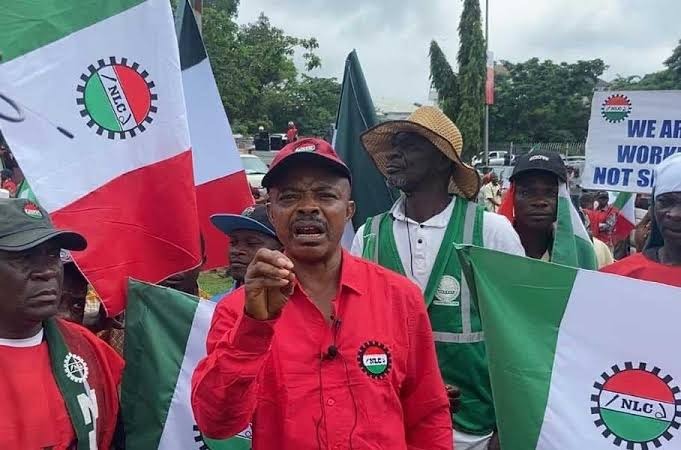
Industrial tension mounted across Nigeria on Thursday as the Nigeria Labour Congress (NLC) formally rejected the Federal Government’s official response to its package of economic demands, raising the spectre of a nationwide industrial action as a 14-day ultimatum draws closer to expiration.
The confrontation stems from an emergency joint meeting of the NLC National Executive Council (NEC) held on Thursday, October 8, 2026, at the Paschal Bafyau Labour House in the Central Business District of Abuja. Following the session, NLC President Comrade Joe Ajaero issued a communiqué establishing a two-week ultimatum that officially took effect on Friday, October 9, 2026.
The labour body demanded an immediate rollback of pump prices for Premium Motor Spirit (PMS) to levels seen when the current N70,000 national minimum wage was enacted in July 2024, alongside the commencement of fresh minimum wage renegotiations before the end of October.
Additionally, the union pressed for worker tax reliefs, the payment of outstanding wage awards, and the full implementation of the February 5, 2026 settlement terms reached with the Joint Health Sector Unions & Assembly of Healthcare Professionals (JOHESU) and the Joint Public Sector Negotiating Council (JPSNC).
In a counter-statement issued from the Federal Ministry of Labour and Employment in Abuja, the Minister of Labour and Productivity, Hon. Nkeiruka Onyejeocha, firmly rejected the demand for an early wage review. She asserted that under the National Minimum Wage Act, the existing N70,000 baseline remains legally binding and is not due for statutory review until June 1, 2027.
“Commencing a fresh review exercise barely two years into the implementation of the current wage, which represented an increase of over 133 per cent from the previous minimum wage of N30,000, would be premature, inconsistent with the law, and disruptive to the orderly industrial relations system envisaged by the Act,” Onyejeocha stated.
Rejecting the minister’s stance, Ajaero countered that persistent naira depreciation and escalating inflation have effectively rendered the N70,000 baseline worthless, leaving workers unable to afford basic shelter, healthcare, transportation, and food.
With the 14-day deadline expiring at midnight on Thursday, October 22, 2026, the NLC has put all state councils, industrial union affiliates, and progressive civil society allies on high alert to prepare for decisive industrial action should the Federal Government fail to yield.
Clock Ticks on Nationwide Strike as NLC Rejects FG’s Stance on Wages and Petrol Prices
Industrial tension mounted across Nigeria on Thursday as the Nigeria Labour Congress (NLC) formally rejected the Federal Government’s official response to its package of economic demands, raising the spectre of a nationwide industrial action as a 14-day ultimatum draws closer to expiration.
The confrontation stems from an emergency joint meeting of the NLC National Executive Council (NEC) held on Thursday, October 8, 2026, at the Paschal Bafyau Labour House in the Central Business District of Abuja. Following the session, NLC President Comrade Joe Ajaero issued a communiqué establishing a two-week ultimatum that officially took effect on Friday, October 9, 2026.
The labour body demanded an immediate rollback of pump prices for Premium Motor Spirit (PMS) to levels seen when the current N70,000 national minimum wage was enacted in July 2024, alongside the commencement of fresh minimum wage renegotiations before the end of October.
Additionally, the union pressed for worker tax reliefs, the payment of outstanding wage awards, and the full implementation of the February 5, 2026 settlement terms reached with the Joint Health Sector Unions & Assembly of Healthcare Professionals (JOHESU) and the Joint Public Sector Negotiating Council (JPSNC).
In a counter-statement issued from the Federal Ministry of Labour and Employment in Abuja, the Minister of Labour and Productivity, Hon. Nkeiruka Onyejeocha, firmly rejected the demand for an early wage review. She asserted that under the National Minimum Wage Act, the existing N70,000 baseline remains legally binding and is not due for statutory review until June 1, 2027.
“Commencing a fresh review exercise barely two years into the implementation of the current wage, which represented an increase of over 133 per cent from the previous minimum wage of N30,000, would be premature, inconsistent with the law, and disruptive to the orderly industrial relations system envisaged by the Act,” Onyejeocha stated.
Rejecting the minister’s stance, Ajaero countered that persistent naira depreciation and escalating inflation have effectively rendered the N70,000 baseline worthless, leaving workers unable to afford basic shelter, healthcare, transportation, and food.
With the 14-day deadline expiring at midnight on Thursday, October 22, 2026, the NLC has put all state councils, industrial union affiliates, and progressive civil society allies on high alert to prepare for decisive industrial action should the Federal Government fail to yield.