A review of The Vanguard Chronology: 40 Years of Nigeria’s Leading Tabloid
By Chido Nwakanma
When it hit the newsstands forty-two years ago, Vanguard announced itself with brilliant feature pages, racy sports coverage, and cartoons that lingered in the mind. It paid attention to gender through women-focused features and columns. It lived up to its own billing as “refreshingly different”.
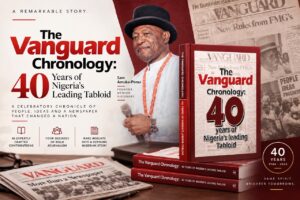
Reading the fortieth-anniversary tribute assembled in honour of the paper and of its founder, Uncle Sam Amuka-Pemu, those feature-style pages return with force. The Vanguard Media Alumni Association commissioned the volume. Jossy Nkwocha, Eyobong Ita and Deba Uwadiae collated and edited the contributions. The book fits the occasion.
Forty Years, and Why the Number Matters
Forty years often functions as more than a round figure. In biblical tradition it marks a complete generation, a season of testing or preparation, a threshold before a new stage of life. Scripture uses the number repeatedly: the wilderness generation dying off before Israel enters the Promised Land; a year of wandering for each day the spies scouted Canaan; Moses’ life in 40-year blocks; the 40-year reigns of Saul, David and Solomon.
In private life the same number carries weight. The 40th wedding anniversary is the ruby anniversary. Ruby stands for lasting passion, protection and devotion after four decades together. Turning 40 is a recognised landmark – sometimes a midlife reassessment, sometimes “still in your prime,” sometimes the start of a more grounded adulthood. In some Islamic and Jewish traditions, 40 is associated with fuller maturity.
Vanguard first appeared on 3 June 1984. The Vanguard Chronology reads like a ruby anniversary. After four decades the book carries considerable passion, remembrance and devotion, even though many of the contributors have long since moved on.
How the Book Is Built
The editors arrive early. Eyobong Ita writes the preface, Jossy Nkwocha the introduction, Deba Uwadiae the acknowledgement. Before them, Chief Olusegun Osoba contributes a rousing foreword in tribute to Sam Amuka, describing him as “a Journalism Field Marshal” and reflecting on a friendship of six decades.
Nkwocha sets the paper’s claim plainly: “Vanguard was not your conventional newspaper of headlines, deadlines, and bylines. From the very beginning, Vanguard was a portfolio of innovative journalism, unveiling a new niche that appeals to a new generation of readers, especially the young at heart.”
The volume then presents 46 chapters of recollection, tribute and analysis. Former General Manager Ralph Ibiwoye traces the story from The Punch through Amuka’s fishing venture to the launch of Vanguard. The editors follow in sequence:
1. Muyiwa Adetiba, first editor, formerly of The Punch.
2. Toye Akiyode, second editor.
3. Frank Aigbogun, third editor, who came from The Guardian.
4. Gbenga Adefaye, who rose through the paper’s later editorial leadership.
5. Mideno Bayagbon, who grew through the ranks.
6. Eze Anaba, current editor, also grown from within.
The founding of Vanguard in 1984 is told mainly in four early contributions: Ralph Ibiwoye’s long interview-style memoir as pioneer General Manager (“From Fishery to Newspaper,” Chapter 1); Muyiwa Adetiba’s two pieces as pioneer editor (“Vanguard at 40: How It All Began,” Chapter 2; “Why I Joined Vanguard,” Chapter 3); and Toye Akiyode’s short reflection as second editor (“Vanguard Is Samson Amuka-Pemu, Amuka Is Vanguard,” Chapter 4). Brief framing remarks in Osoba’s foreword and the editorial front matter complete the cluster.
Together they form the book’s densest first-hand testimony about the paper’s origin.
The Founding Accounts
Ibiwoye supplies the operational backbone. He recounts his earlier rescue of The Punch from a Scandinavian newsprint foreclosure; his recruitment by Amuka-Pemu after both left The Punch; the short-lived Mermaid Merchants fishing venture, which failed partly because Amuka gifted away too many fish; the purchase and installation of a second-hand Spanish press; the reclamation of submerged land at Kirikiri Canal; the borrowing of five reels of newsprint from Sketch Press in Ibadan for the first run; the recruitment of staff, mostly Punch veterans; and the constant scramble for working capital. He left in 1988 after a clash over cash-handling controls in the advertising department.
Adetiba’s essays focus on the editorial and personal side. The longer anniversary piece recalls the delayed debut – generator unfinished, a truck knocking down the electric pole, Spanish engineers testing the press in darkness – and the small team’s week of round-the-clock labour that produced the first Sunday Vanguard on 3 June 1984. His shorter piece explains why he left a secure, rising career at The Punch: loyalty to Amuka-Pemu, who had mentored him for a decade. Salary and title were secondary.
Akiyode’s contribution is the most concise and, in some ways, the most effective. He emphasises the circle of “Amuka lovers” who first gathered at the fishing huts in Ajegunle, the early recruitment drive—Frank Aigbogun, Ikeddy Isiguzo, Helen Ovbiagele’s future colleagues, cartoonists and others—and his own rapid move from National Concord State House correspondent to Deputy Editor.
What these essays do well
They supply concrete operational detail unavailable elsewhere. Ibiwoye’s account of machine acquisition in Barcelona, land dredging, newsprint logistics, and the nine-month cheque scheme that once saved The Punch gives the founding a material texture rarely found in Nigerian media histories.
They establish a clear chain of personal loyalty. All three authors portray the paper as an extension of Amuka-Pemu’s second chance after The Punch. Leaving established jobs for an unproven title is framed as debt repayment rather than career calculation. That framing helps explain the early cohesion and the willingness to work under severe constraints.
They preserve atmosphere. Adetiba’s recollection of the power failure, the Spanish technicians, Uncle Sam sleeping on site, and the determination not to miss the 3 June target is the single most memorable scene in the volume.
They name the early cohort. Akiyode’s roll call and Ibiwoye’s references to specific production and finance staff preserve a roster that would otherwise be lost.
Synopsis
The Beginning
The book opens with foundational accounts from Ibiwoye and Adetiba, tracing Vanguard from a failed fishery to a working newspaper. These pages capture the precarious early days: borrowing newsprint from Sketch Press, dredging submerged land at Kirikiri Canal, and assembling a team of talented journalists under severe constraint.
The Editors
Successive editors – Adetiba, Akiyode, Aigbogun, Gbenga Adefaye, Bayagbon and Anaba – reflect on their tenures, the paper’s evolution, and Uncle Sam’s distinctive leadership. Their accounts chart the transformation from struggling upstart to an award-winning title that won Newspaper of the Year four years running.
The Reporters
Journalists across beats – crime, labour, the judiciary, sports, tourism, health and entertainment – contribute. Jossy Nkwocha, Kehinde Olaosebikan, Owei Lakemfa, Funmi Komolafe and Onochie Anibeze, among others, recall mentorship, harrowing encounters with military regimes, and the camaraderie of the Vanguard newsroom.
The Family
A recurring theme is Vanguard’s familial culture, centred on “The Canal”—the newspaper’s restaurant and bar where staff gathered to eat, drink and bond. Uncle Sam’s generosity, accessibility and humility define the organisation’s ethos.
The Fallen Heroes
The book pays tribute to departed colleagues—Ely Obasi, Bisi Lawrence, Kola Animashaun, Tunji Oyeleru and others—who helped make the paper what it became.
A Rich Tapestry of Nigerian Journalism History
The Vanguard Chronology is more than a commemorative volume. It is a significant contribution to the documentation of Nigerian media history. Through its polyphonic structure – many voices telling the same story from different angles – the book captures the texture of newsroom life in ways a single-authored history could not. It functions at once as institutional history, memoir and cultural commentary.
The Central Figure: Uncle Sam Amuka-Pemu
What emerges most powerfully is a portrait of Sam Amuka-Pemu, a man whose vision, generosity and leadership shaped not only Vanguard but Nigerian journalism more broadly. Contributors describe him in near-hagiographic terms—“the best publisher any journalist could have” (Obi Nwakanma), “a special human being created for newspapering” (Ralph Ibiwoye) – yet the anecdotes that support these claims are concrete. He lends his London apartment to a newlywed editor. He offers “night entertainment” money to a young sports reporter in Sapele. He tells a cartoonist facing government pressure, “Is he your employer? Go on with it!”
The pattern is consistent: a leader who invested in people.
The book also reveals his journalistic philosophy: “The best editor is the one who knows what not to publish.” Several contributors echo the line. It illuminates a nuanced understanding of press freedom – one that balances boldness with strategic restraint, particularly during Nigeria’s military years.
Valuable Historical Documentation
The anthology offers eyewitness accounts of Nigerian journalism at critical moments.
* Military dictatorship. Contributors recount the dangers of practising journalism under Buhari’s Decree 4 and Abacha’s regime. Kehinde Olaosebikan’s account of how he helped save Vanguard from proscription – by mobilising contacts in the Abuja judiciary to issue a commendatory press release that pre-empted arrest orders – reads like a thriller.
* The June 12 crisis. Several contributors describe covering the annulled 1993 election and its aftermath: police harassment, surveillance, and the personal risks journalists took to report the truth.
* The digital transition. John Abayomi’s contribution on Vanguard Online’s rise to become Nigeria’s leading news website is a useful case study in media transformation.
Strengths and Limitations
Strengths
1. Diversity of perspectives. Voices from editors, reporters, photographers, cartoonists, librarians and advertising staff give a fuller picture of how a newspaper actually works.
2. Authentic voice. The contributions are refreshingly unpolished in places. They preserve the idiosyncrasies of individual writers rather than flattening them into corporate prose.
3. Balanced coverage, within limits. Though celebratory in tone, the book does not entirely avoid internal conflict, political pressure, or the occasional misstep.
Limitations
1. Insider perspective. As a publication of the Vanguard Alumni Association, the book naturally skews positive. Critical assessments of Vanguard’s failures or controversies are largely absent.
2. Uneven quality. As with any anthology, contributions vary in depth. Some pieces are richly detailed; others feel perfunctory.
3. Limited external context. The book is rich in personal experience but thin on Vanguard’s place in broader Nigerian media history, and on its competitive dynamics with The Punch, Daily Times and The Guardian.
4. Narrow vantage points. The accounts come almost exclusively from the innermost circle. There is no testimony from the Spanish technicians, from the Sketch Press managers who lent the newsprint, or from anyone who declined to join. Financial stress, equipment limits and early sales struggles appear only in passing.
5. Hagiographic framing. Amuka-Pemu appears almost exclusively as visionary, generous and infallible. Ibiwoye’s departure over cash-control differences is the sole note of internal tension; even then the tone is softened and the narrative pivots to praise. Questions that a historian would press – why outsiders considered the press a “toy,” how the paper achieved a market breakthrough within a year, the exact sources of capital – remain unanswered.
6. Thin institutional and commercial analysis. Circulation figures, pricing strategy (the cover price of the first edition appears only later, as 20 kobo), advertising acquisition, distribution networks and competition receive little systematic treatment. The essays excel as personal memory. They are thin as business or organisational history. The absence of an analysis of publishing economics—and of the newspaper as a management case study – is a major weakness.
Cultural and Historical Significance
Beyond its institutional focus, the book is a record of Nigerian social history. Anecdotes about the Amala Group, a monthly gathering of journalists; the “night crawlers” who covered Lagos society; and the evolution of the Kirikiri Canal area from derelict warehouses to a media hub capture aspects of Lagos life that might otherwise be lost.
The book also illuminates the role of newspapers in Nigerian democracy. Contributors repeatedly emphasise Vanguard’s commitment to “worthy causes and empathy” – championing Niger Delta rights, labour issues and press freedom – and show how journalism can check power and give voice to the marginalised.
The Vanguard Chronology is the second recent book by alumni chronicling their work on the influential Nigerian newspapers of the 1980s. Aaron Ukodie and Seun Ogunseitan did a yeoman’s job in The Making of The Nigerian Flagship: A Story of The Guardian (2021).
Who Should Read This Book
1. Journalism students and practitioners. The book offers practical lessons in reporting, editing and newsroom management from some of Nigeria’s most experienced journalists.
2. Media historians. It provides primary-source material on Nigerian print journalism from the 1980s to the present.
3. General readers interested in Nigerian history. The personal narratives bring to life the political and social upheavals of the past four decades.
4. Students of leadership and management. Uncle Sam’s philosophy – trust, generosity and high standards – boffers lessons beyond the media industry.
Conclusion
The Vanguard Chronology: 40 Years of Nigeria’s Leading Tabloid is a fitting tribute to both a newspaper and its founder. Its insider perspective limits critical distance, but the authenticity and richness of its first-hand accounts compensate. The book succeeds in its apparent aim: to preserve the stories, milestones and personalities that made Vanguard a “refreshingly different” publication and a training ground for generations of Nigerian journalists.
For those who worked at Vanguard, it will evoke nostalgia and pride. For others, it offers a window onto the challenges, triumphs and everyday realities of Nigerian journalism – a profession that, as Ikeddy Isiguzo writes, is “madness best unleashed in youth.”
Above all, it stands as a testament to the power of a single person’s vision, generosity and persistence in building institutions that outlast him.
Note. The book would benefit from stronger editorial consistency, additional photographs with clearer captions, and a timeline or index for easier navigation.
As a commemorative volume and a primary-source document, however, it succeeds admirably.