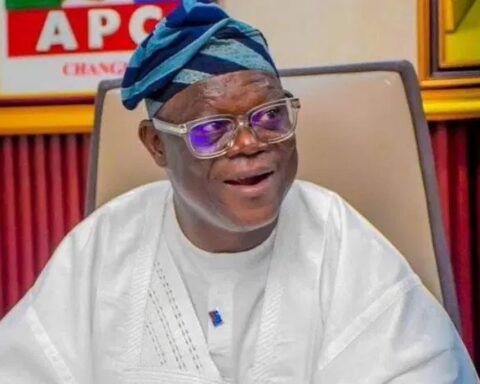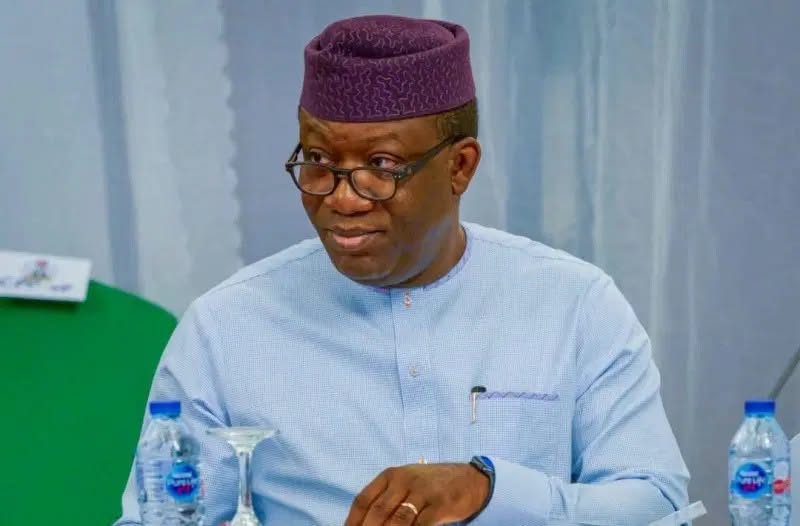
Former Governor of Ekiti State and ex-Minister of Solid Minerals Development, Dr. Kayode Fayemi, has described the campaign proposal by former Vice President and African Democratic Congress (ADC) presidential candidate, Atiku Abubakar, to restore the petrol subsidy as an electoral calculation rather than a genuine economic model.
Speaking during an interview on Arise News’ Prime Time program on Monday evening, September 7, 2026, Fayemi argued that Atiku’s promise is directly comparable to the same-faith (Muslim-Muslim) presidential ticket adopted by the ruling All Progressives Congress (APC) ahead of the 2023 elections.
Addressing the ongoing national debate surrounding energy prices and cost-of-living challenges, Fayemi stated that the promise to bring back fuel subsidies is designed to tap into public anger ahead of the 2027 general elections.
”My take on that is that Atiku’s proposal of subsidy is politically equivalent to our own Muslim-Muslim ticket in 2023. It’s a political strategy; it’s not an economic construct,” Fayemi noted during the broadcast. “Understandably, it’s a political strategy that will sell with those who are hard done by the impact of fuel subsidy removal.”
Fayemi explained that just as the APC strategically leveraged its 2023 ticket to secure a specific voting block, Atiku is attempting to capitalize on the economic pressures faced by low-income families.
Reaffirming his long-standing position on energy sector reforms, the former chairman of the Nigeria Governors’ Forum (NGF) emphasized that he remains a firm believer in the deregulation of the downstream petroleum sector.
Fayemi highlighted that during his four-year tenure as NGF Chairman, state governors repeatedly pushed for the removal of fuel subsidies to free up revenues for critical infrastructure and social services.
He pointed out that state governors had previously collaborated with the Federal Government and the World Bank to design targeted social safety nets to cushion the effect on low-income households, though he conceded that the execution fell short of expectations.
Fayemi acknowledged that ordinary Nigerians are struggling with high food and transport costs, leaving them receptive to populist promises.
”The vulnerable segment of the population is still hard done by,” Fayemi added. “They just want to live reasonably well, eke out a living, have one or two meals a day, and send their kids to school.”
The comments follow a recent social media broadcast and subsequent media engagements where Atiku pledged to restore fuel subsidies within a fiscal ceiling if elected president in 2027.
Atiku argued that the fiscal savings generated since President Bola Ahmed Tinubu announced the policy on May 29, 2023, have not translated into visible improvements in health, education, or infrastructure.
The Presidency, through Special Adviser on Information and Strategy, Bayo Onanuga and APC stakeholders have strongly rejected Atiku’s proposal, warning that re-establishing fuel subsidies would bankrupt government finances and sabotage domestic refining initiatives.