Under the blistering Lagos sun, the city often feels like a restless drum—always beating, always loud.
But in ‘White Lagos’, travel journalist Pelu Awofeso invites readers into a different rhythm of the metropolis: one dressed in flowing white, whispering in the language of drums, chants, and memory.
The book, now in its second edition, is the product of more than a decade of watching Lagos shed its everyday skin and step into the ancient world of the Eyo Festival—a world most Lagos residents only glimpse from the roadside.
Coastal heritage, urban history, and cultural preservation are intertwined in Pelu Awofeso’s work on the Eyo Festival, exploring how the historic Eyo festival is documented, remembered, and represented in contemporary Lagos culture.
Awofeso’s journey into this world began in 2003, when, as a young journalist, he first covered the festival held to mourn Oba Adeyinka Oyekan 11 and usher in a new Oba of Lagos.
According to him, what he saw that year will anchor his work for years to come.
“Since 2003, I’ve seen about four Eyo festivals,” he tells the News Agency of Nigeria (NAN) at reading of the book during the opening of the Port City Reading Room in Apapa, Lagos.
“I kept field notes, conducted interviews, collected every scrap of information I could. All of that became White Lagos.”
Published first in 2017 as part of the Lagos@50 celebrations, the manuscript he had nursed for years finally found its form when he pitched it as a cultural gift to VIPs attending the anniversary events.
The state’s Commissioner for Information affirmed this, adding that the maiden edition was sold out.
Now in a fresh second edition, White Lagos returns with a new cover and updated content.
Unveiled at a programme hosted by Goge Africa, its first public reading is an invitation to re-examine a festival many believe they already know.
Yet, as Awofeso insists, most people don’t.
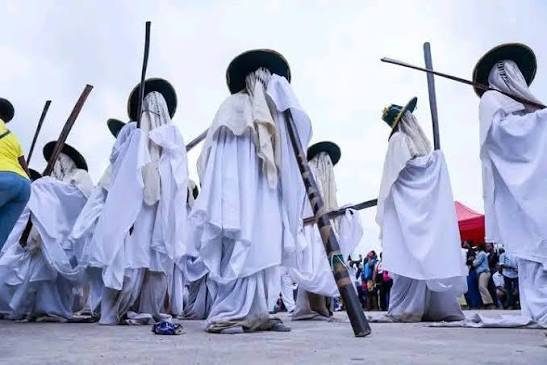
From the sidelines, Eyo is spectacle: a sea of masked figures in white agbada, tall hats bobbing like waves on a human ocean, staff striking the air as they sweep through streets emptied of vehicles and filled with reverence.
Then, the book turns the reader around, away from the performance, and leads them quietly backstage.
“Many people only see Eyo from a distance.
“They don’t know what happens behind the scenes—the months of divination, the rituals, the family negotiations, the daily steps that lead to that one grand day.”
At the heart of White Lagos is a festival that refuses to be ordinary.
The Eyo Festival is not annual, cannot be scheduled casually, and will not be reduced to a tourism slogan.
It is, first and always, a rite of passage for the dead—kings, white-cap chiefs, and Lagos indigenes whose lives etched deep marks into the city’s history.
“Every time there is an Eyo Festival, it must be attached to someone who has died,” Awofeso explains.
“A royal, a chief, or a Lagosian who contributed to the growth and development of the city.”
Occasionally, Eyo is summoned for a living dignitary—a visiting traditional ruler , a president, a world-stage moment like Queen Elizabeth II’s visit in 1956 or FESTAC ’77.
Yet even then, tradition insists that a deceased figure be attached, anchoring the festival firmly in its ancestral duty.
The ritual, as Awofeso describes it, is both lavish and costly. The Lagos State government spends heavily—he heard in confidence that the most recent edition cost around ₦10 billion—not to make money, but to make meaning.
“It is not a revenue-generating event.
”The government doesn’t earn from it; it spends on it.
“On a micro level, small businesses benefit—the fabric sellers, the food vendors, the people who supply everything needed for a week of feasting. But for the state, it is more about heritage than profit.”
Heritage, in this case, is measured in centuries.
Depending on which account you choose, the first Eyo either strode into Lagos in 1750 or 1854.
Either way, the festival has survived for 200 years or more, slipping through colonialism, modernity and rapid urbanisation without losing its core.
Preservation is not an abstract concept here; it is embodied. Young boys and teenagers, cloaked in white from head to toe, walk side by side with elders. Through them, Lagos rehearses its memory.
“It’s a salute to the consciousness of the people.
“They are saying: this culture must not die. It was handed to us by our ancestors; we are determined to pass it on, ” Awofeso says.
Then, there is the question that lingers in the title: why white?
The city is famous for its chaos of colour, yet Eyo insists on a startling, almost blinding uniformity.
“There is no clear documented reason,” Awofeso admits.
“But from the records, the first Eyo that walked into Lagos was dressed in white. At some point, they even wore Ankara, but eventually the tradition returned to white and stayed there.”
If history is silent, symbolism is not. In the cosmology of traditional worship, white is purity, sacrifice, and cleansing.
The garments, he notes, are deliberately oversized, flowing like waves as the masquerades move in procession towards Tafawa Balewa Square.
“They believe that as the Eyo move through the community, they are sweeping away evil, sickness, bad blood. It is a cleansing event. The white suggests purification.”
In White Lagos, that movement- the sweep of white across a restless city-is rendered in prose and reportage, an attempt to fix in words what is always in motion.
It is, at its core, an act of translation: taking a living, breathing tradition and laying it gently on the page without draining it of its mystery.
“I wanted readers to understand that what they see on that single day is only the surface.
“There is a long journey before the drums start. This book is my way of opening that door.”
Reviewing the book, Dr Hope Orivri, a Development Communication Specialist, tells NAN that White Lagos presents the new guidebook as a vital lens into the Eyo festival, designed to help both locals and visitors truly engage with this iconic cultural event.
According to her, rather than merely observing the spectacle from afar, readers are invited to understand the layered history, meanings, and symbolism that define the festival.
Orivri, also a journalist and CEO of Ports City Reading Room, notes that the book explores the dual narratives of Eyo’s origins: one tradition traces its roots to the ancient Benin Kingdom, while another locates its beginnings in Ikorodu, north of Lagos.
In spite of these differing accounts, both converge on a central legend—that of a barren queen who, through traditional worship aligned with her people’s beliefs, miraculously becomes fertile.
This narrative establishes fertility and birth as core themes, casting the festival as a celebration of life-giving forces and renewal.
Beyond fertility, the guidebook emphasises Eyo’s deep association with royalty and transition.
The festival is not an everyday celebration; it is reserved for marking significant royal events, especially the passage of kings into the afterlife and, at times, the installation of new rulers.
In this way, Eyo becomes a ritual bridge between worlds, honoring both earthly authority and spiritual continuity.
Ultimately, White Lagos positions the Eyo festival as a living archive of cultural identity—showcasing the values, beliefs, and aesthetic richness of the people of Lagos.
“For travellers and locals alike, the guidebook functions as both an introduction and an invitation to appreciate the depth of this heritage,’’ Orivri said.
Simply put, in a city that rewrites itself daily, White Lagos stands as a reminder that beneath the billboards and flyovers, some stories are still told in white—slowly, solemnly, and in honour of the dead, so the living may remember who they are.