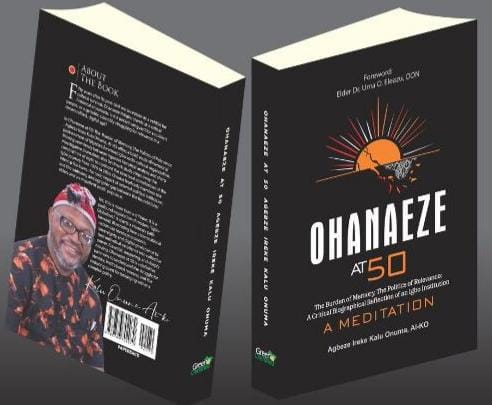
Agbeze Ireke Kalu Onuma, AI-KO, Ohanaeze at 50: The Burden of Memory, The Politics of Relevance.
By Chido Nwakanma
At its golden jubilee, Ohanaeze Ndigbo stands at a crossroads. The organisation, born from the ashes of Nigeria’s civil war, faces an existential choice: evolve into a dynamic, relevant institution or fossilise into a revered but powerless museum piece.
This central tension is explored in Agbeze Ireke Kalu Onuma’s monumental 602-page work, Ohaneze at 50: The Burden of Memory, The Politics of Relevance – part institutional dissection, part prophetic summons, and entirely unflinching in its honesty.
Onuma is an insider who served as personal assistant to President-General Justice Ezebuilo Ozobu (2000–2003). He writes with the intimacy of deep involvement and the distance of critical reflection. He declares early on that this is “A Meditation,” not hagiography. The foreword by Elder Dr Uma O. Eleazu reinforces this stance, framing the book as a “watchman’s voice”—a warning cry, not decorative praise.
The Iroko Metaphor
The book’s guiding metaphor is the iroko tree – enduring and majestic, sometimes appearing lifeless in the dry season, yet capable of bursting into new leaves when it draws water from its deep roots. Onuma asks whether Ohanaeze remains a living iroko, drawing sustenance from Igbo cultural and historical foundations, or whether it has become a museum piece -honoured in memory but irrelevant in practice, preserved under glass rather than growing in the soil of contemporary Igbo life.
Structure and Substance
Organised into nine parts with extensive appendices, the work traces Ohanaeze’s journey from its founding vision—embodied by figures such as Akanu Ibiam and Jerome Udoji—through five decades of political engagement, internal crises, and evolving challenges. The philosophy of ako-na-uche (wisdom and understanding) that guided early leadership receives careful treatment: its strategic patience and consensus-building are acknowledged as strengths, while the work takes seriously critics who dismiss it as a “toothless bulldog” or a “Trojan horse” for elite interests.
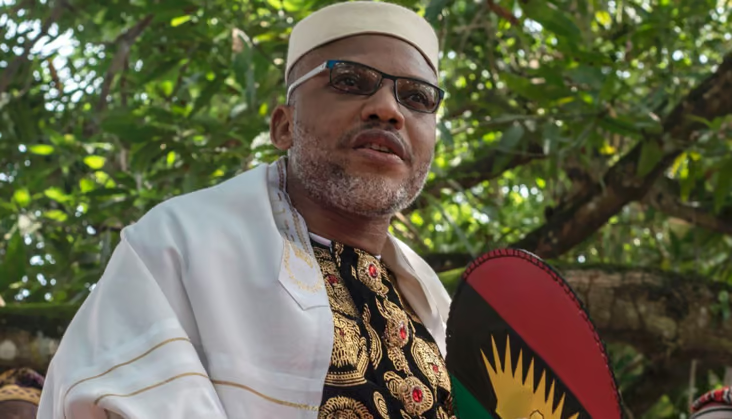
The political evolution section examines Ohanaeze’s “dance with the Leviathan” – its engagement with successive military regimes, navigation of democratic transitions, advocacy for state creation, and the increasingly fraught question of an Igbo presidency. The Nnamdi Kanu conundrum and the 2023 election receive particular attention, revealing the organisation’s difficulty in mediating between its cautious elder leadership and radicalised youth movements.
The Forensic Section: Internal Dynamicsť
Perhaps the most valuable section examines internal dysfunction. Onuma dissects the structural weaknesses that have plagued Ohanaeze: succession wars, state-level crises (particularly in Lagos and Mali), accountability deficits, and the funding trap that makes the organisation dependent on wealthy patrons. The detailed interlude on the 2004–2006 Joe Irukwu tenure-elongation crisis serves as a moral and constitutional template for subsequent failures – a case study in how elite capture and weak enforcement erode legitimacy.
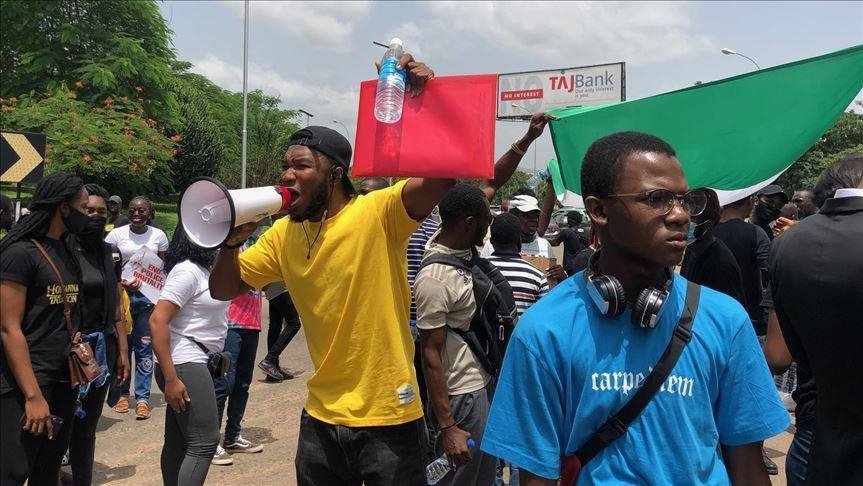
The generational chasm receives extended treatment. Elders operate through ceremonial protocols and private negotiations, while youth organise through MASSOB, IPOB, and digital networks. For Onuma, the failure of intermediation between these worlds is one of Ohanaeze’s most consequential failures.
The Ledger: Balancing Success and Failure
Onuma offers a balanced accounting. Successes include 50 years of continuous institutional existence across turbulent political regimes, advocacy for state creation, cultural work including World Igbo Day and language preservation, the rotational presidency across seven Igbo-speaking states that promoted equity, diaspora reconnection through Igbo Landing commemorations, and participation in the Oputa Panel’s human rights investigations.
Failures are equally significant: persistent elite capture that leaves the organisation perceived as a club of politicians and businessmen disconnected from grassroots; weak institutional capacity that allows constitutions to be routinely undermined; generational and digital disconnect; funding opacity; and a reactive posture that translates communiqués into sustained action only rarely.
Comparing Ohanaeze with the Igbo State Union
The book implicitly invites comparison with the Igbo State Union (ISU), formed in 1948. The differences are instructive. ISU was a federation of town and clan unions – membership flowed from existing community organisations, making it genuinely grassroots. Ohanaeze, by contrast, operates as an umbrella body with state chapters and affiliate groups, often described as “elitist.” ISU had an explicit political objective; Ohanaeze has a multi-headed focus on sociocultural and economic development, combined with political advocacy. This structural difference explains much of why ISU mobilised mass action while Ohanaeze often struggles to move beyond elite consensus.
The Prescriptions and Their Challenges
Onuma’s prescriptions for renewal are ambitious: genuine democratisation, enforced term limits, independent audits, mass-membership models, formalised and empowered youth and women’s wings, digital fluency, transparent fundraising, and ideological pluralism. He insists that renewal is a “moral economy” – elders must convert moral authority into reform rather than personal aggrandisement, and youth must convert impatience into disciplined strategy.
The implementation pathways, however, remain high-level. Critics may argue that Onuma over-emphasises internal moral failure relative to the constraints of Nigeria’s hostile political environment. External fire (Nigerian structural marginalisation) and internal fire (institutional betrayal and moral capture) both threaten the iroko; renewal requires addressing both.
Critical Assessment
The book’s greatest strength lies in its moral seriousness, married to practical institutional insight. The prose is literary – rich in Igbo proverbs and extended metaphors – yet remains grounded in specific episodes, constitutional details, and personal observation. The insider perspective, while occasionally intense and personal, lends the work an authenticity that external analysis could not match.
Weaknesses include the book’s density and occasional repetition; some readers may wish for tighter editing or more quantitative data on membership, finances, and measurable outcomes. At 602 pages, it demands significant commitment from readers.
Conclusion: The Choice Remains Open
Onuma has performed a public service. He has clearly identified the wounds and proposed the structural work required to heal them. The choice—museum piece or renewed iroko—remains open, though the window is narrowing. The question is whether Ohanaeze’s leadership and constituency will treat this book as a moral summons or as optional reading.
Ohaneze at 50 is essential reading for anyone interested in Igbo politics, ethnic associations within multi-ethnic federations, post-conflict institutional recovery, or the broader challenge of making elite organisations accountable to the people they claim to represent. It is less a final verdict than an invitation to debate and action – and an urgent reminder that survival without renewal is merely prolonged decline.
As the Obi of Onitsha and other distinguished commentators affirm, this is not optional reading. It is a mirror held up to an institution at a critical juncture, asking whether it will draw water from its roots and sprout new leaves, or whether it will become a monument to what once was – honoured, perhaps, but no longer living.