By Peter Agi
August 2026. Three years and three months since that May morning when a quiet man with a small bag walked into a presidential race and broke the algorithm of Nigerian politics. The country today is bleeding in ways that feel familiar and new at the same time.
Petrol is above N1,050 in most places. Diesel is above N1,600. A bag of rice is N50,000 to N85,000. Transport has tripled since 2023. School fees have doubled twice. Hospital bills have doubled.
The government is announcing record revenue every quarter, FAAC allocations are in the trillions, 2025 beat 2024 and 2026 is on course to beat 2025, and yet the market woman in Mile 1, the teacher in Kubwa, the welder in Aba, are all poorer than they were in 2023.
Budgets are rolled over year after year because implementation is abysmally poor. Debt service at times gulps close to 70% of revenue. Direct charges go up every quarter. The state is richer. The citizen is emptier.
And in the middle of all of this, one name refuses to leave the national conversation.
Peter Obi.
Not because he is president. He is not.
Not because he has a war chest. He does not.
Not because he controls governors or a political machine. He does not.
He refuses to leave the conversation because when you are truly different, people become truly uncomfortable with your existence. And Nigeria, for all its noise, has never met a politician like this.
Nigerian politics has always run on a predictable script. First, get the money. Second, get the godfathers. Third, get the structure. Fourth, share it around. Fifth, win. Sixth, recover everything you spent and more. Peter Obi walked into that script in 2022 and tore it up.
He did not go to the hotel rooms. He did not buy delegates. He announced, and young people did the rest. They printed the shirts. They rented the halls. They trekked in the sun. For the first time in our history, a presidential campaign was funded by N1000 transfers and by people who believed that maybe, just maybe, competence could be charisma.
That broke something in the system. Because if you can run without money, then what is the point of money in politics. If you can win Lagos as an Igbo man without a godfather, then what is the point of godfathers. If you can fill a stadium in Kano, in Kaduna, in Jos, then what is the point of the old ethnic arithmetic. If you can lose the election in the official result and still win the argument in the streets, then what is the point of the old definition of victory.
So they tried to delete him. They called him a religious candidate until the votes in the north proved them wrong. They called him a social media candidate until the turnout proved them wrong. They called him a spoiler until the map showed he had taken the capital, taken Lagos, taken Plateau, taken Nasarawa, and made the two biggest parties spend more time attacking him than attacking each other.
The dilemma is not that Peter Obi exists. The dilemma is that he exists and he cannot be categorised. He is Igbo, but his biggest crowds were outside the South-East. He is a capitalist, but young people call him father. He is frugal in a class of extravagance.
He is calm in a culture of shouting. He is a businessman who left office ten years ago and is not a billionaire contractor. He is a former governor who does not need the presidency to eat, but says he wants it to fix. In a country where most people in power need power to live, a man who does not need power is the most dangerous man in the room.
That is the intractability. That is the unconquerable part. You cannot buy him because he is not for sale. You cannot intimidate him because he does not fear losing what he never chased. You cannot scandalise him because there is no hidden file, no overnight mansion, no secret that has not been searched for in the last three years.
You cannot absorb him because he is not angry, he is not bitter, he is calm, and calm in Nigerian politics is the most disruptive thing of all. Angry men can be negotiated with. Bitter men can be bought. Calm men who have seen the numbers and refuse to lie are a problem that does not go away.
And the problem has only grown because of what has happened to Nigeria between 2023 and August 2026. This is the season Peter Obi’s strength was built for, not the season of plenty. His strength grows when the government says revenue is at an all-time high and the people cannot afford garri.
His strength grows when subsidy is removed and prices triple and the promised palliatives disappear. His strength grows when the Naira is floated and the exchange gain makes Abuja rich and the market poor. His strength grows when debt service takes most of the money and the roads are still bad and the hospitals are still empty.
In 2022 when he said “we must move from consumption to production,” it sounded boring. In 2026 it sounds like prophecy. When he said you cannot remove subsidy without planning, without CNG, without mass transit, people called him cautious. Today they call him the man who saw it. When he said debt service was killing us, people said he was exaggerating.
Today the budget says almost 70 kobo of every naira goes to creditors before a single clinic is built. When he said the cost of governance must be cut first, people said he was playing saint. Today the government is buying new jets while telling citizens to tighten their belts, and people remember who said that first.
He is not in government, but he is framing the government. That is power without office. And under current circumstances, that power is compounding. The hardship has done what three years of campaigning could not do. It has removed tribe from the conversation for millions.
When your child is out of school, you do not ask what tribe the man who can fix it is. When your business closed because diesel is N1600, you do not care about region. You care about who warned you and who has a plan.
That is why the base that was called “Obidients” in 2023 has not dissolved. It has gone deeper. From Twitter to town halls. From stadiums to churches and mosques and market associations. A generation that learned how to organise without money is not going to forget how to do it.
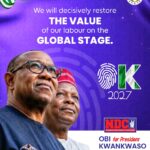
Come 2027, the landscape will be different, but the man will be the same reference point. The government will campaign on “we tried difficult reforms, give us more time.” Peter Obi will campaign on “we told you how to do difficult reforms without destroying people.”
The other opposition will campaign on “we can manage the system better.” He will campaign on “the system itself is the problem.” That is why he is matchless. He is not asking to manage the sharing of oil money better. He is asking to build a country where we do not need to share oil money to survive.
His projection for 2027 rests on three things that have only gotten stronger. The youth who voted in 2023 have not disappeared, they have aged into the electorate with voter’s cards and with memory. The middle class that was managing in 2023 has collapsed into poverty and is looking for an alternative that does not sound like the same voices. And the establishment can no longer pretend he is a third force. He is either the main opposition or he forces everyone to realign around him. Either way, he sets the terms.
The attacks will get worse, because that is what happens when you are truly different. They will try to paint him as tribal, as religious, as elitist, as anything that makes him fit into the old boxes. They will say he is too calm, that he talks too much about data, that he does not “play politics.” But Nigeria in August 2026 is tired of politics. We are tired of rallies and sirens and promises. We want proof, or at least the promise of a plan that looks like it can produce proof.
The story of Peter Obi is no longer the story of one man. It is the story of whether Nigeria is ready to reward difference.
For 24 years of this republic we have voted for the familiar and gotten the familiar result. More revenue, more poverty. More budgets, more rollovers. More announcements, less implementation.
Peter Obi represents the uncomfortable alternative. Less drama, more data. Less consumption, more production. Less entitlement, more work. He is not perfect.
No human is. But he is different in the one way that matters in 2027. He does not need the system to survive, so he can afford to tell the truth about the system.
The dilemma is not his. The dilemma is ours. Do we want a leader who is like us, who understands how “the system” works, or do we want a leader who is different enough to change how the system works. You cannot have both.
History tells us you cannot kill an idea by attacking the man carrying it. You can only kill an idea by proving it wrong. Three years of subsidy removal without relief, three years of record revenue without development, three years of budgets without implementation, have only proven the idea right.
When you are truly different, people become truly uncomfortable with your existence. They will mock you. They will isolate you. They will call you names. But they cannot ignore you. And they cannot defeat you, because you are not playing their game.
2027 is coming. And the question will not be whether Peter Obi is ready for Nigeria.
The question will be whether Nigeria is finally ready for a leader who makes us uncomfortable, because that discomfort may be the only sign that we are about to become a different country.
Agi, fca, a public affairs commentator, writes from Ijegu Ojor, Yala LGA of Cross River State