The Economic and Financial Crimes Commission (EFCC) has confirmed plans to contest a Federal High Court decision that rejected its application for the permanent forfeiture of nine assets connected to former Attorney-General of the Federation (AGF) and Minister of Justice, Abubakar Malami.
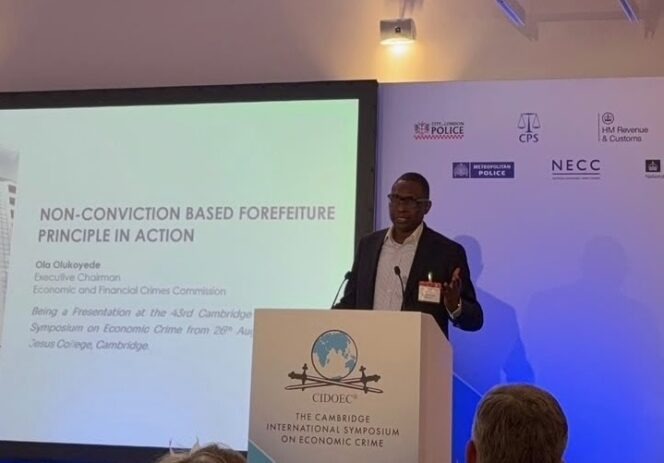
Ola Olukoyede, the Executive Chairman of the EFCC, announced the upcoming legal challenge on Wednesday, August 26, 2026. Speaking at the 43rd Cambridge International Symposium on Economic Crime at Jesus College, University of Cambridge, Olukoyede briefed international delegates on the status of high-profile asset recovery efforts.
In his keynote address titled “Asset Recovery and the Rule of Law – Taking the Profit Out of Crime,” Olukoyede detailed how an investigation into Malami’s eight-year tenure (2015 – 2023) unraveled a massive network of real estate.
“Sometime last year, I opened investigations upon reasonable suspicion of criminal abuse of office by the immediate past Attorney-General of Nigeria,” Olukoyede told the assembly. “We discovered that within eight years of his being in office, we were able to trace about 57 such properties to him. We’ve been able to forfeit about 48. Even the nine that were left for him, I’m considering filing an appeal so that we can take everything away from him, and we’re going to do that.”
The decision to move to the Court of Appeal follows a ruling delivered on Wednesday, July 15, 2026, by Justice Joyce Abdulmalik of the Federal High Court in Abuja.
In that judgment, Justice Abdulmalik granted the EFCC final forfeiture of 48 prime properties valued at approximately ₦180.4 billion. The court held that under Section 17 of the Advance Fee Fraud and Other Fraud Related Offences Act, Malami and his co-respondents failed to disprove reasonable suspicion that the assets were acquired using proceeds of unlawful conduct.
However, the judge refused the anti-graft agency’s prayer regarding nine remaining properties situated in Kebbi and Kaduna states, estimated to be worth ₦28.7 billion. Justice Abdulmalik ruled that the EFCC had not established a sufficient evidentiary link connecting those specific assets to criminal activities, emphasizing that mere suspicion without clear proof was inadequate to support civil forfeiture.
Addressing international stakeholders, Olukoyede highlighted that non-conviction-based asset forfeiture remains essential to preventing corrupt public officials from hiding or dissipating ill-gotten wealth during lengthier criminal prosecutions.
To further boost international asset recovery, the EFCC Chairman announced an aggressive whistleblower bounty program. Under this initiative, the agency will payout 2.5% to 5% of recovered assets to individuals who provide actionable intelligence leading to the successful retrieval of looted Nigerian funds hidden abroad.