By Kio Amachree
There is something deeply wrong with the way the word “Pastor” is used in Nigeria.
In most serious professions, you cannot simply wake up tomorrow morning and announce that you are a doctor, lawyer, airline pilot or accountant. There are qualifications, professional bodies, standards of conduct and consequences for malpractice.
But apparently you can wake up, buy a microphone, rent a warehouse, put “Pastor,” “Prophet,” “Apostle” or “General Overseer” before your name, quote a few passages from the Bible and begin collecting money from desperate people in the name of Jesus Christ.
Nigeria has allowed religion to become one of the country’s least accountable industries.
And the victims are frequently the people who can least afford it.
From Salvation to Prosperity Marketing
Christianity itself is not the problem. Millions of Nigerian Christians quietly practise their faith, support their communities, educate children, operate hospitals, feed the poor and provide comfort where the Nigerian state has failed.
The problem is the commercialisation of Christianity and the emergence of the celebrity pastor as businessman, miracle salesman and financial gatekeeper to God.
The message has too often mutated from “love thy neighbour” into something resembling: give me money and God will give you more money.
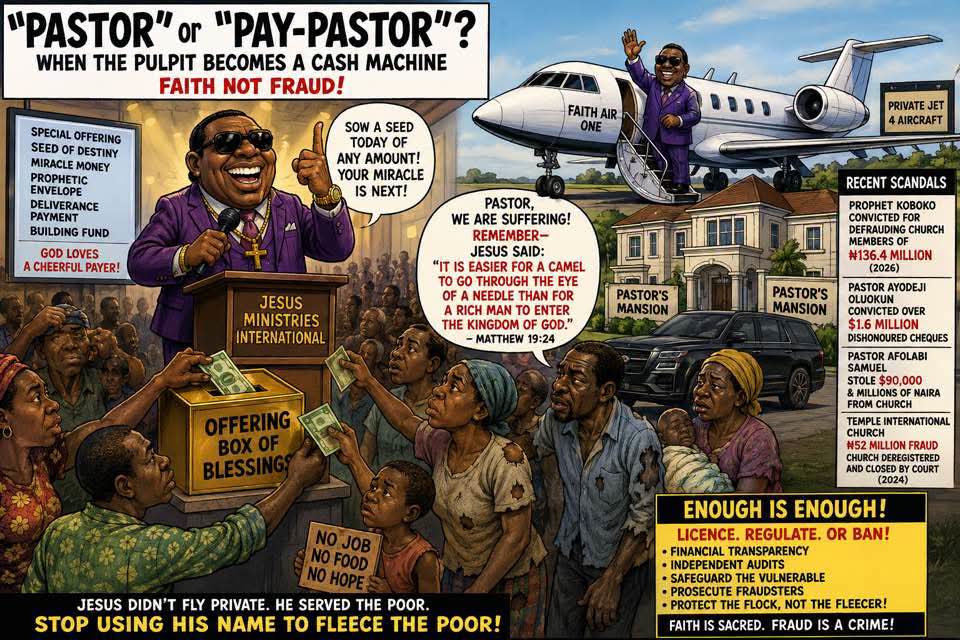
Seed offerings. Miracle offerings. Prophetic offerings. Deliverance payments. Tithes. Building funds. Special envelopes. Prosperity products.
Meanwhile, unemployment and poverty surround enormous auditoriums in which some worshippers are encouraged to believe that their financial breakthrough depends upon how much they surrender.
That relationship deserves far greater scrutiny.
Follow The Money
The amounts involved can be extraordinary.
Forbes estimated Bishop David Oyedepo’s wealth at $150 million in 2011 and reported that he owned four aircraft. The same report estimated Pastor Chris Oyakhilome’s wealth at $30–50 million. These are old estimates and should not be treated as current valuations, but they demonstrate how enormous Nigerian religious enterprises had already become more than a decade ago. (Forbes)
We should be careful here: being wealthy is not evidence of criminality, and neither Oyedepo nor Oyakhilome should be called fraudulent merely because their ministries became wealthy.
But citizens are perfectly entitled to ask a moral question.
When a ministry receives enormous sums from ordinary worshippers, how much goes to feeding the hungry? How much goes to hospitals? How much goes to scholarships? How much goes to administration? How much benefits the religious leader personally?
Those questions are not attacks on Christianity.
They are questions about accountability.
Then There Are Actual Criminal Cases
The argument for stronger oversight becomes much harder to dismiss when we examine what Nigerian courts and the EFCC have actually uncovered.
In July 2026, an Enugu State High Court convicted self-described prophet Godwin Sunday Ajuluchukwucheya, popularly known as Prophet Sunday Koboko, of defrauding church members of ₦136.4 million.
According to the prosecution, he told worshippers that he had won ₦30 billion in a lottery and encouraged them to contribute money so that they could receive supposed dividends. He pleaded guilty. (Premium Times Nigeria)
Think about that.
The pulpit was not protecting vulnerable people from fraud. According to the court case, the authority of religion was part of the mechanism used to commit it.
In another case, Lagos pastor Ayodeji Ibrahim Oluokun was convicted over dishonoured cheques totalling $1.6 million and sentenced to two years’ imprisonment, with the court also ordering restitution. (efccnigeria.org)
A former Living Faith Church pastor and church treasurer, Afolabi Samuel, was convicted of stealing $90,000 and millions of Naira belonging to the church. The court ordered repayment. (Punch Newspapers)
Then there is perhaps one of the most revealing judgments of all.
In 2024, a Lagos court convicted Harry Uyanwanne and Oluwakemi Odemuyiwa in a ₦52 million fraud case involving Temple International Church. Justice Mojisola Dada went beyond sentencing the defendants: she ordered the church itself deregistered and closed because it had been used to defraud people under the guise of religion. (Channels Television)
That judgment should have started a national conversation.
It largely didn’t.
Not Every Investigation Means Guilt
Accountability must also mean fairness.
In 2026 the EFCC chairman disclosed that Pastor Jerry Eze had been investigated for approximately six months after substantial foreign-currency inflows into an account attracted attention. The EFCC ultimately cleared him of wrongdoing after tracing the transactions. (Premium Times Nigeria)
That case is important precisely because it demonstrates what proper oversight should mean.
Investigation is not conviction.
A pastor whose finances are legitimate should have nothing to fear from legitimate financial scrutiny, and an investigation that establishes innocence should say so just as loudly as one establishing criminal conduct.
Sexual Abuse Allegations Cannot Be Swept Under The Altar
Financial exploitation is not the only reason religious organisations require stronger safeguarding systems.
Nigerian televangelist Timothy Omotoso faced an extraordinary South African prosecution involving allegations including rape, sexual assault and human trafficking. He and his co-accused were ultimately acquitted in April 2025 because the state failed to prove the charges beyond reasonable doubt. The South African Parliament’s Justice Committee subsequently expressed grave concern about the quality of the prosecution. (Parliament of South Africa)
His acquittal must be stated clearly because accusations are not convictions.
Similarly, Pastor Biodun Fatoyinbo was publicly accused of rape by Busola Dakolo. He denied the allegation, and her civil suit was dismissed by the FCT High Court in 2019. (Punch Newspapers)
Again, fairness requires those outcomes to be stated.
But these controversies nevertheless demonstrate why churches need independent safeguarding procedures. A congregation cannot operate on the principle that an accusation against its spiritual leader is automatically an accusation against God.
No human being deserves that kind of immunity.
Nigeria Needs Religious Accountability
I am not proposing that government decide who is genuinely called by God. The Nigerian Constitution protects freedom of religion, and rightly so.
The state has no business licensing belief.
But the state absolutely has a legitimate interest in regulating organisations that collect enormous amounts of money from the public, employ people, operate schools and businesses, solicit donations and exercise extraordinary influence over vulnerable citizens.
Nigeria already regulates incorporated trustees under the Companies and Allied Matters Act, and the Corporate Affairs Commission has statutory responsibilities concerning registered organisations. (Corporate Affairs Commission)
What Nigeria needs is a serious framework of financial transparency and safeguarding, not government theology.
Large religious organisations should publish independently audited annual accounts. Donations above defined thresholds should be traceable. Related-party transactions involving pastors and their families should be disclosed. Church assets should be legally separated from personal assets. Trustees should have genuine independence.
Claims involving financial fraud should go directly to law enforcement.
Credible allegations of sexual abuse should go to the police, not merely to a committee of elders whose first concern may be protecting the reputation of the ministry.
Anyone collecting money while promising guaranteed miracles, supernatural investment returns or cures should face the same consumer-protection and fraud laws that apply outside a church building.
And where a court establishes that a religious organisation has systematically been used as an instrument of fraud, authorities should have the power to close it — exactly as the Lagos court did with Temple International Church.
Jesus Didn’t Need A Private Jet
There is an uncomfortable contradiction at the heart of Nigerian prosperity Christianity.
Jesus Christ preached among ordinary people.
He spoke about humility, compassion, sacrifice and the danger of worshipping wealth.
Yet Nigeria has somehow produced a version of Christianity in which fabulous personal wealth can itself become evidence of divine favour while poverty among the congregation is blamed on insufficient faith.
Something has gone badly wrong.
A widow giving her last ₦5,000 because she has been persuaded that a “seed” will produce a financial miracle is not participating in an ordinary commercial transaction. She may be acting under enormous spiritual and emotional pressure.
That vulnerability deserves protection.
The Nigerian government regulates banks because people entrust banks with their money.
It regulates doctors because people entrust doctors with their bodies.
It regulates lawyers because people entrust lawyers with their rights.
When millions of Nigerians entrust religious leaders with their money, marriages, fears, illnesses, children and hopes for eternity, why should there be virtually no comparable professional accountability?
The title Pastor should command respect.
But respect must be earned.
Nigeria must stop confusing scrutiny with persecution and accountability with an attack on Christianity.
A genuine church should welcome transparency.
A genuine pastor should welcome accountability.
And anyone using the name of Jesus Christ to deliberately fleece frightened, sick or impoverished Nigerians should discover that while forgiveness may belong to God, fraud belongs before a Nigerian court.
Enough of turning the House of God into a cash machine.