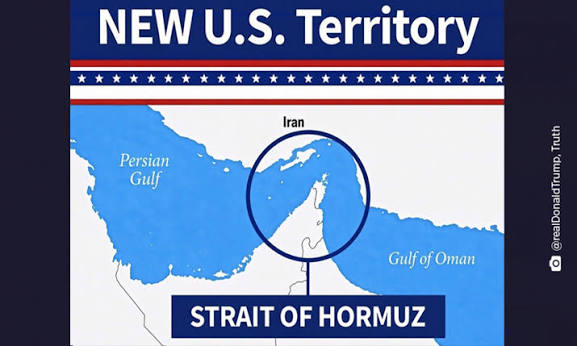
U.S. President Donald Trump escalated his administration’s confrontation with Tehran on Tuesday, August 18, 2026, by declaring the Strait of Hormuz a “NEW U.S. Territory” in a post on Truth Social. The assertion adds a dramatic territorial dimension to an ongoing military conflict and naval blockade that has choked off one of the world’s most critical energy transit corridors.
The post featured an image depicting a map of the narrow waterway linking the Persian Gulf and the Gulf of Oman, with the strategic passage framed and marked in bold text reading “NEW U.S. Territory”.
Tuesday’s digital declaration follows days of expanding comments from the U.S. president regarding American control over the waterway; Speaking at a rally on Friday, August 14 in Nassau County, New York, President Trump first publicly floated the idea. ”After we finish defeating Iran, which is being very badly defeated, pretty soon I’ll be declaring the Hormuz Strait a territory of the United States,” Trump told the crowd at the event in Garden City.
”After we finish defeating Iran, which is being very badly defeated, pretty soon I’ll be declaring the Hormuz Strait a territory of the United States,” Trump told the crowd at the event in Garden City.
On Monday, August 17, 2026, Addressing reporters in the Oval Office at the White House, President Trump reiterated his stance, claiming Washington maintained “total control” over the corridor via a U.S. naval blockade. ”I think it’s a great idea. I mean, we control it with the blockade. I like the idea of declaring it a territory,” Trump sai
”I think it’s a great idea. I mean, we control it with the blockade. I like the idea of declaring it a territory,” Trump said.
The president’s post came shortly after a 60-day negotiating window under a June memorandum of understanding expired on August 18 without a permanent resolution.
Speaking in Tehran, Iranian Parliament Speaker Mohammad Bagher Ghalibaf confirmed on state television that the waterway would remain closed to commercial shipping until Washington satisfied Iranian demands.
”I want to state clearly that the Strait of Hormuz will not be opened until the American commitments stipulated in the memorandum of understanding are implemented,” Ghalibaf declared, citing the removal of the U.S. naval blockade, the lifting of sanctions, and the unfreezing of Iranian assets overseas as mandatory conditions.
Concurrently, U.S. Treasury Secretary Scott Bessent announced in Washington that the United States is preparing to roll out unprecedented economic measures against Tehran.
The Strait of Hormuz ordinarily handles nearly 20% of the world’s petroleum and liquefied natural gas (LNG) traffic. The continued blockade and rhetorical escalation have sent shockwaves through global markets:
Addressing concerns over rising domestic energy costs on Friday, President Trump urged the American public to view higher fuel prices as a necessary trade-off to neutralize Tehran’s capabilities. “What we’re doing is a great service for the world, not only for ourselves,” Trump asserted.