Tech giant Huawei Technologies Nigeria has committed to powering Nigeria’s vision of a $1 trillion economy by expanding digital infrastructure, rolling out cloud capabilities, and upskilling local talent.
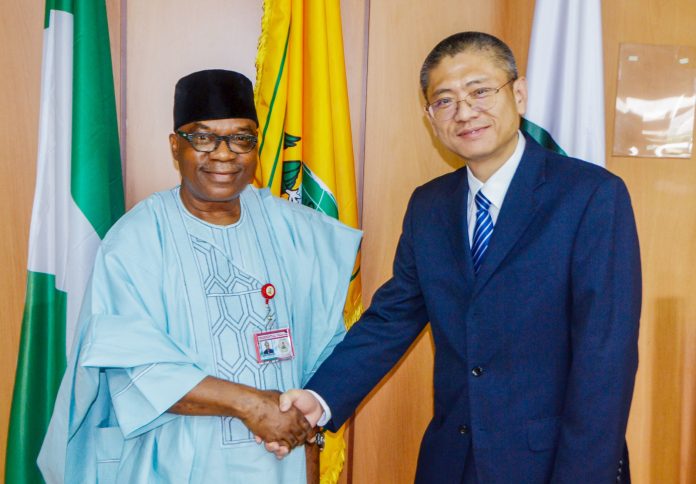
The commitment was formalized on Thursday, August 6, 2026, during a bilateral diplomacy session at the Tafawa Balewa House in Abuja. The meeting brought together senior executives from Huawei and officials led by the Minister of State for Foreign Affairs, Ambassador Sola Enikanolaiye.
Speaking on behalf of the ICT company, Board Director Jim Zhang outlined Huawei’s long-standing partnership with Nigeria since 1999 and presented an ambitious roadmap to deepen technological investments across the country.
A statement issued after the meeting by the Spokesperson for the Ministry of Foreign Affairs, Kimiebi Imomotimi Ebienfa, detailed key operational developments: By expanding regional operations, Tech Facilities & Localized Cloud and National continued development.
This partnership will kick off with Operation of four primary branches in Kano, Ibadan, Enugu, and Port Harcourt, with two additional facilities under active construction in Calabar and Katsina.
The two core training centers in Lagos and Abuja, an Open Lab, an Innovation Center, and Nigeria’s first localized cloud infrastructure based in Lagos.
National Continued deployment of 3G, 4G, and 5G networks, construction of a Tier 4 data center, and industrial-scale solar power installations to reinforce energy stability for tech infrastructure.
Zhang explained that Huawei’s contribution toward Nigeria’s trillion-dollar milestone is built around five digital pillars: Digital-enabled Government, Digital-enabled Society, Digital-enabled Industry, Digital Foundation and Digital Talent.
Central to the human capital component is Huawei’s LEAP Talent Development Framework. Having already trained over 100,000 Nigerians since 2018, the initiative aims to train an additional 120,000 tech professionals by 2027 through ICT academies, hackathons, and vocational programs.
Responding to the proposal, Ambassador Sola Enikanolaiye underscored the Federal Government’s resolve to drive economic growth in step with President Bola Ahmed Tinubu’s Presidential Priority Areas.
Enikanolaiye noted that Nigeria’s foreign policy is anchored on the “4Ds” framework—Demography, Development, Democracy, and Diaspora.
”Demography is our greatest strength. Our vibrant youth population remains the ultimate engine driving national innovation, enterprise, and sustainable growth,” Enikanolaiye said.
He urged Huawei to deepen technology transfer so local developers and engineers can directly drive and benefit from Nigeria’s expanding digital economy.
Ministry spokesperson Kimiebi Imomotimi Ebienfa added that the Foreign Ministry will continue using economic diplomacy to build strategic public-private alliances that solidify Nigeria’s position as Africa’s digital hub.