By Charles Obiajulu Ugwu – PhD
No civilization has ever built prosperity by making yesterday’s injury the organizing principle of tomorrow’s ambition. History explains much. It excuses very little. This is not a comfortable sentence to open an essay with, and it is not meant to be. It is meant to name, plainly, a habit of mind that has quietly hardened into orthodoxy across much of the African intellectual and political landscape: the conviction that the continent’s present condition is best understood, and perhaps only understood, as the residue of what was done to it.
Africa’s greatest obstacle today may no longer be colonialism or slavery as such. It may be something subtler and more self-inflicted: the reflex of explaining present failure almost entirely through the syntax of past injustice. Left unexamined, that reflex does something no invading army ever could. It teaches a continent to mistake the diagnosis of an old wound for a strategy to heal it. The first act of genuine liberation, the kind that outlasts flag ceremonies and Independence Day speeches, is recovering ownership of one’s own future.
The World’s Longest Excuse
Walk into almost any serious conversation about why an African economy remains weak, why an institution keeps failing its citizens, why an education system produces graduates unfit for the world they enter, why insecurity festers in one region after another, and you will notice the conversation beginning, with a kind of reflexive gravity, at the same coordinates. Colonialism. Slavery. Imperial exploitation. Foreign interference.
None of these explanations is false. That is precisely what makes the habit so difficult to interrupt. Each one describes something that actually happened, with consequences that continue to shape institutions, borders, and the terms on which African economies still meet the rest of the world. The trouble is not that these explanations exist. The trouble is that they have quietly become the default account for nearly everything, from the state of a highway to the collapse of a currency to the theft discovered in a ministry’s books. An explanation that is asked to carry too much weight for too long stops functioning as history and starts functioning as alibi.
History Must Be Faced Completely, Not Selectively
Let there be no mistake about what this essay is not arguing. Europe participated massively, and knowingly, in the Atlantic slave trade. Colonial extraction enriched imperial treasuries on a scale that still underwrites patterns of global capital today. Borders drawn by clerks in Berlin and London, with no reference to the peoples who would have to live inside them, complicated the project of governance from the very first year of independence. Unequal terms of trade, in commodity pricing, in debt structuring, in the architecture of global finance, persist in forms that are not difficult to document.
All of this is true, and a serious essay does not tiptoe around it. But there is a second reality that tends to disappear from the account precisely because it is uncomfortable rather than because it is untrue: history was rarely imposed upon societies that were simply and passively unwilling. Almost every major episode of exploitation on the continent, the slave trade, the colonial concessions, the post-independence looting of national treasuries, involved substantial local participation.
Leaving that fact out does not make the story of exploitation more true. It only makes it less complete, and a history that is less complete is a history that has already decided, in advance, who is permitted to be an agent and who is only permitted to be an object.
The Forgotten Collaborators
Here the argument turns, and here it becomes genuinely uncomfortable, because the questions cannot be answered from a safe distance.
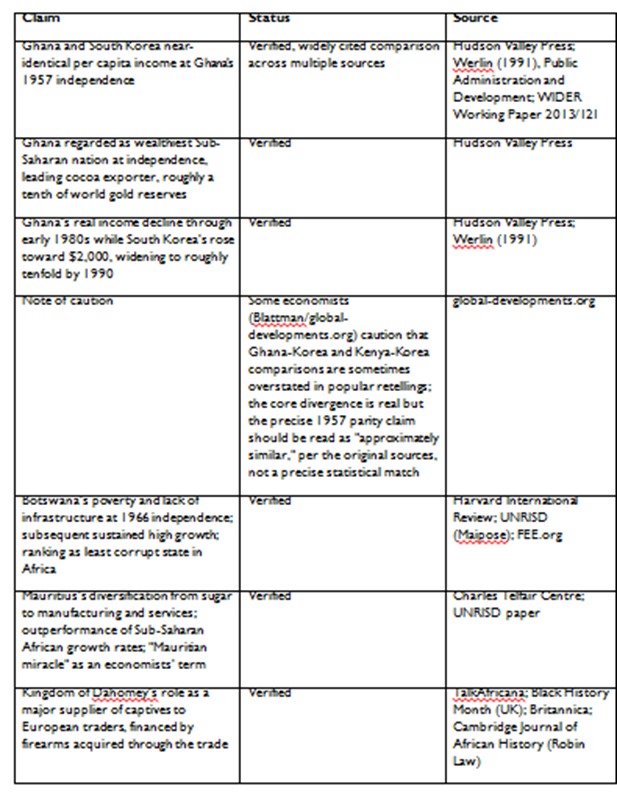
Who captured the men, women, and children who were marched to the coast and sold? Who built the markets where they were priced and exchanged? The historical record on this point is not ambiguous. The kingdom of Dahomey, in what is now Benin, built an entire state apparatus around the supply of captives to European traders, using the proceeds to buy firearms that then financed further campaigns of capture.
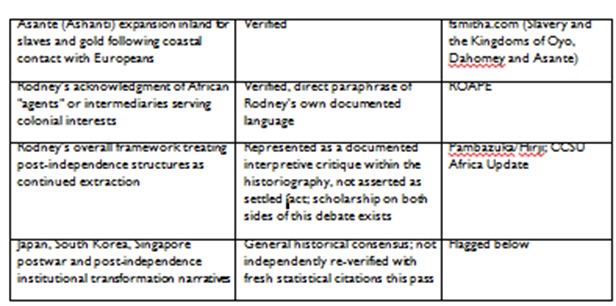
The Asante state to the west followed a comparable trajectory, expanding inland in search of both slaves and gold once its access to the coast opened new lines of exchange with European buyers. These were not marginal actors coerced into complicity. They were sophisticated, often highly centralized states that treated the trade as a central pillar of statecraft, not an unfortunate accident forced upon them by circumstance.
Move forward a century, and the same pattern of local initiative recurs in different clothing. Who negotiated the treaties that quietly signed away sovereignty in exchange for protection? Who accepted colonial patronage because it offered a shortcut past a rival chief or a competing lineage? Who signed the concessions that handed mineral wealth to a foreign company for a fraction of its true worth? And in the decades since independence, who has diverted public wealth into private accounts, and who sustains the machinery of everyday corruption long after the last colonial administrator boarded the last ship home?
The honest answer, in every case, complicates any narrative that treats the foreign actor as the sole author of the story. Empire rarely arrived as pure conquest imposed on a helpless population. It arrived, again and again, through invitation before it hardened into domination: through a ruler who saw advantage in a foreign alliance, a merchant who saw profit in a foreign trade route, an elite who saw in a foreign patron the fastest route to power over his own rivals. None of this excuses the foreign actor. It does, however, make it considerably harder to write African history as a morality play with a single villain.
Walter Rodney Was Right, But Not Completely
No essay of this kind can walk past Walter Rodney’s How Europe Underdeveloped Africa and pretend it does not exist. It remains one of the most consequential books ever written about the continent’s economic history, and it deserves to be engaged seriously rather than dismissed or, worse, misremembered.
Rodney was not naive about African participation in the machinery he was describing. He wrote directly, in his own language, about the class of African agents and intermediaries who served European colonial interests, describing them plainly as instruments already working on behalf of the colonizer. He understood, arguably better than many of his later critics have given him credit for, that empire required local hands to function at all.
Where the conversation Rodney opened remains genuinely unfinished is not whether he saw African actors. He did. It is how much explanatory weight his framework assigns to those actors once the colonial period formally ends. Read in full, the architecture of the book treats the postcolonial African state largely as a continuation of externally imposed underdevelopment, a system still organized, structurally, around extraction for the benefit of outside interests. That is a defensible reading for a number of post-independence economies in the years immediately following the transfer of flags. It is a much harder argument to sustain across six decades and dozens of countries that inherited nearly identical colonial structures and produced wildly divergent outcomes.
Europe could not have underdeveloped Africa indefinitely without fragmented political systems, elite collaboration, recurring internal conflict, and institutional weakness that did not disappear the day the colonizer left. It required, critically, the governance choices that African leadership itself went on to make once the anthems were written and the choices belonged, unambiguously, to nobody but them. Rodney explained the external machinery with genuine brilliance. What his framework leaves comparatively thin is the account of what happens to agency once the external actor has, in the most literal sense, gone home.
Independence Changed the Actors
Here is perhaps the most uncomfortable question a continent can put to itself: if colonialism explains everything, why have more than sixty years of independence produced so little institutional transformation in many countries, while producing so much in a handful of others that began from strikingly similar positions?
Consider Ghana and South Korea in 1957, the year Ghana became the first Sub-Saharan African nation to win its independence. By most contemporary estimates the two countries stood at nearly identical levels of per capita income, with Ghana in fact regarded at the time as the wealthiest nation in Sub-Saharan Africa, flush with cocoa exports and a tenth of the world’s known gold reserves.
Kwame Nkrumah, an early and eloquent voice for pan-African socialism, presided over a country that development economists of the era genuinely expected to lead the continent. By the early 1980s, Ghana’s per capita income had fallen in real terms while South Korea’s had climbed toward two thousand dollars. By 1990 the gap had widened to roughly tenfold. The two countries did not begin from different starting lines. They diverged because of what each did, or failed to do, with the decades that followed.
Botswana offers a similarly sharp case, though moving in the opposite direction from what conventional wisdom about African resource wealth would predict. At independence in 1966 it ranked among the poorest countries on the planet, without a functioning road network to speak of. In the decades since, it has posted growth rates that stand among the fastest sustained in modern economic history, built on disciplined management of diamond revenue, a multiparty democracy that has held without interruption, and institutions strong enough to restrain the very chiefs and politicians who, in a less disciplined polity, might have simply captured that wealth for themselves. It remains, by most available measures, the least corrupt state on the African continent.
Mauritius tells a related story from a different angle. A small island economy built on colonial-era sugar production diversified over successive decades into manufacturing and, later, financial and information services, outpacing the rest of Sub-Saharan Africa’s growth rate by several percentage points a year for a generation, in a run so sustained that economist eventually gave it a name without irony: the Mauritian miracle.
Set these trajectories against countries that inherited comparable colonial structures, comparable resource endowments, and in some cases a considerably stronger position at independence, yet produced decades of stagnation and institutional decay instead. The colonial inheritance is not the variable that diverges most sharply among these cases. Leadership is. History created constraints that were real and, in places, brutal. Leadership determined which of those constraints hardened into permanent fate and which were engineered around.
Victimhood Can Become Political Capital
A harder observation follows from this, and it is one that many will resist. Victimhood carries genuine social value, and that value has a shelf life that certain actors have every incentive to extend indefinitely.
It attracts international sympathy. It justifies development aid and periodic debt relief. It secures diplomatic concessions that would not otherwise be granted. It confers legitimacy on leaders who can point to a distant historical villain rather than to their own governing record, and it grants something even more useful at home: a permanent, renewable absolution for why the promises made at independence remain unfulfilled a generation or three later.
Historical grievance, once it is real, can outlive its explanatory usefulness because someone continues to profit from keeping it current. It acquires its own conferences, its own funding streams, its own careers built on the steady maintenance of collective injury. None of this is an argument that the grievance was invented. It is an argument that grievance and industry are not the same thing, and that a continent serious about its own future has to learn to tell them apart.
The Psychology of External Blame
Beneath all of this sits a behavioral pattern that has nothing uniquely to do with Africa. People protect their own self-image instinctively, and nations, being composed of people, do the same at scale. Blaming an outside actor preserves collective dignity cheaply and immediately. Accepting responsibility demands something far more painful: an introspection that indicts one’s own institutions, one’s own political choices, one’s own leadership, rather than a safely distant foreign hand.
Yet every society that has eventually prospered has passed through precisely this uncomfortable door. Japan rebuilt a devastated postwar economy not by dwelling on the terms its occupiers had imposed but by reorganizing its own industrial and educational institutions with a discipline that bordered on ruthless. South Korea, poorer than a great many African states as recently as the 1960s, converted decades of deliberate internal institution building into one of the most complete economic transformations of the modern era.
Singapore, an island with essentially no natural resource advantage, built its prosperity almost entirely on the quality of its own internal governance. Rwanda, in the specific reforms it has pursued since the genocide, has shown, in parts and not without legitimate criticism on other fronts, what it looks like when a government treats internal capacity as the one lever it can actually pull, rather than waiting indefinitely on a lever held by somebody else.
In each of these cases, the confrontation with internal failure came first. The demand for external recognition, where it came at all, came only afterward, as a consequence of demonstrated strength rather than as a substitute for it.
The Real Cost of the Victim Narrative
The deepest damage done by an excessive victim narrative is not economic. It is psychological, and it is more corrosive precisely because it resists being measured on a balance sheet.
When a society comes to believe that others determine its destiny, initiative withers, because initiative only makes sense in a world where one’s own actions are understood to matter. Innovation weakens, because innovation requires the prior belief that a better outcome actually lies within reach. Accountability evaporates, because accountability requires the uncomfortable admission that a given failure was, in fact, one’s own.
Citizens drift into the position of spectators in their own national story, watching events unfold rather than shaping them. Leaders become fluent in the vocabulary of historical injury and comparatively silent on the vocabulary of institutional reform. Development begins to appear structurally impossible without external rescue, a belief that, once internalized deeply enough, has a habit of making itself true.
Africa’s New Conversation
Imagine replacing a single national question with another. Instead of asking, “What did colonialism do to us?” ask instead, “What are we still doing to ourselves?”
That one substitution reorganizes everything downstream of it. It moves attention away from a past that cannot be renegotiated on any terms and toward the things that remain, stubbornly and inconveniently, within reach: institutions, education, the rule of law, merit in public appointment, scientific capacity, entrepreneurship, the ethics that bind a citizen to a stranger, and the unglamorous daily discipline of productive citizenship. None of these require an apology from a former colonial power. Every one of them requires a decision made by the people who live in the country now, this year, with the resources they actually have.
Renaissance Begins with Ownership
Every civilization carries trauma somewhere in its foundations. Europe endured devastating religious wars and then two world wars that killed tens of millions of its own people on its own soil within living memory of each other. East Asia endured invasion, occupation, and, within living memory, the deliberate destruction of two entire cities. The Middle East has absorbed repeated imperial conquests stretching back well over a millennium. There is no region of the earth that history has left untouched.
What distinguishes the civilizations that eventually rise is not the absence of scars. It is the decision, made deliberately and often against strong internal resistance, to stop letting those scars author the future. Memory, in these societies, becomes a teacher rather than a permanent identity. It informs the present without being permitted to govern it.
A More Honest History
What the continent needs is not a romantic history, and not an accusatory one, but a mature one, capable of holding several uncomfortable facts at once without flinching from any single one of them. Such a history would name plainly where outsiders exploited. It would name, with equal plainness, where Africans collaborated. It would identify where leaders failed, where institutions collapsed under weight they themselves added, where genuine opportunities were squandered by people who had every reasonable chance to seize them, and where, against considerable odds, resilience nonetheless emerged and carried entire societies through their worst decades.
Truth loses nothing by becoming more complete. It only loses its usefulness as an alibi, which is precisely the point.
Beyond Blame
Perhaps the deepest colonial inheritance was never political domination as such. It was the slow erosion of confidence that Africans could determine their own destiny. There is a bitter irony buried in this: every time a contemporary failure is explained exclusively through foreign action, every time the ledger is closed before the local entries are even counted, that particular inheritance is reinforced rather than repaid. The colonizer does not need to return to keep the old hierarchy alive. A continent can do that work on his behalf, quietly, one excuse at a time.
A civilization begins to recover not when others apologize, compensate, or express sympathy, welcome as those gestures may be. It begins to recover the moment it refuses to outsource either its failures or its future to anyone else’s account.
Africa does not need historical amnesia. It needs historical maturity, the kind that can hold grief and responsibility in the same hand without dropping either one.
The next African renaissance will not begin with another conference on colonialism, another resolution demanding reparations, or another catalogue of past injustice, however justified each of those might be on its own terms. It will begin the day Africans find the courage to hold two truths together without contradiction: that grave wrongs were done to this continent, and that the responsibility for what Africa becomes in the twenty-first century now rests, overwhelmingly and irreversibly, with Africans themselves.
That is not self-condemnation. It is the first unmistakable sign of genuine freedom.
Verification Ledger
Charles is a contrarian thinker writing from Lagos