By Val Obienyem
It was another routine assignment representing Mr. Peter Obi, who is currently in the United States, striving to fertilize the minds of our people with the pollen of our nation’s revitalization. While he pursued that mission abroad, mine took me to Enugu, where it was fitting, as the homilists observed, that the Ani family began the centenary celebration of their matriarch with a thanksgiving to God through the Holy Mass – the highest expression of Christian gratitude.
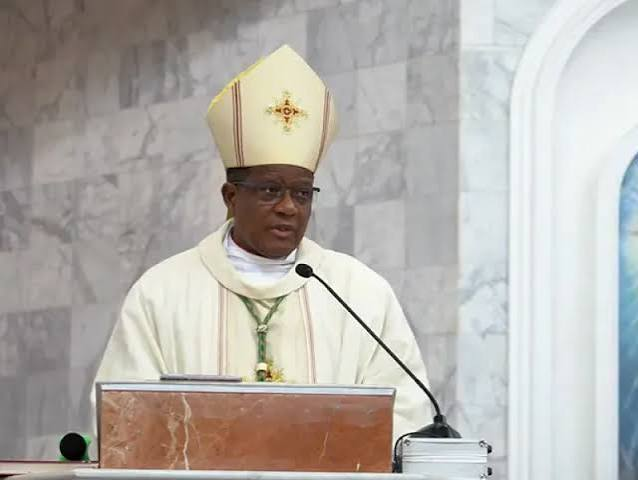
Preaching at the Mass marking the 100th birthday of Mrs. Ann Ani, mother of Rev. Fr. Prof. Dr. Ikechukwu Ani, at St. Augustine Catholic Chaplaincy, Institute of Management and Technology (IMT), Enugu, Bishop Godfrey Igwebuike Onah delivered a deeply reflective homily on fidelity, family, gratitude, and the values that sustain Christian civilization.
The Mass drew together an impressive assembly of shepherds of the Church: Bishop Callistus Valentine Chukwuma Onaga of Enugu, Bishop John Ifeanyichukwu Okoye of Awgu, Bishop Godfrey Igwebuike Onah of Nsukka, Auxiliary Bishop Ernest Anezichukwu Obodo of Enugu, and Emeritus Bishop Anthony Okonkwo Gbuji of Enugu. The sanctuary was equally filled with priests in solidarity with one of them.
Bishop Onah reminded the congregation that fidelity is measured not by how one begins but by how one finishes. Death, which has no redirect for human rank, may come early, as in the case of the Archbishop who passed away yesterday before attaining the age of seventy, or after a century of life, as exemplified by the celebrant who has reached one hundred years. The calendar merely counts our days; it is fidelity that gives them weight. What ultimately matters, he said, is remaining faithful to God until the end.
Reflecting on the lives of the celebrant’s children, he paid tribute to the late Peter “the Rock” Ani and his wife, Mrs. Ann Ani, for the values they handed down to their children. The greatest inheritance parents can leave, he stressed, is not wealth but faith, discipline, virtue, and a sound Christian education. Wealth may fill a house, but only character fills a life. There is no nobler vocation than raising children in the fear of God.
He remarked that successfully raising eight children is more demanding than a university, for it requires sacrifice, patience, perseverance, and commitment. It is, in many respects, the first and most enduring school, where every lesson is taught not so much by words as by example.
Bishop Onah warned that those who wish to remain faithful must be prepared for the trials that inevitably arise in human relationships. Many of the difficulties confronting families spring from human frailty, yet fidelity demands perseverance despite every disappointment. Every civilization, he implied, is tested first in the home before it is tested in history.
Commenting on contemporary society, he lamented the growing challenges confronting families today. While some members strive to preserve the faith handed down by their parents, others preach a return to roots they neither know nor understand. He observed that the increasing resort to DNA testing reflects a deeper crisis of trust and fidelity within marriage.
Turning to the place of mothers, he reminded the congregation that nothing anyone does for a mother can equal what she has done for her child from conception. Gratitude to God should therefore be accompanied by gratitude to one’s parents. He urged children to be patient with their ageing parents, observing that as memory fades, elderly people may repeat the same questions many times. Every repetition, he said, deserves the same patient and loving response, for love does not count the number of times it serves.
Bishop Onah also reflected on the strengths of African family life. Liberation from the fear of nature emboldened people to investigate the natural order. They embraced God’s command to subdue the earth, though, he noted with gentle humour, they almost neglected the accompanying command to “be fruitful and multiply.” While Africans have learnt much from the West in science and technology, many Western societies now struggle with weakening family life and declining birth rates. Every civilization, he suggested, borrows from another, but it also has something indispensable to give. Africa must therefore preserve her culture of strong family bonds and communal solidarity, lest she lose what others are beginning to search for again.
He warned that if society abandons Christian values, the consequences could prove more devastating than war itself. Wars destroy cities; moral decay destroys civilizations. Echoing the Psalmist, he urged Christians to place their trust not in worldly power but in the name of the Lord.
Bishop Onah concluded with a delightful personal anecdote explaining how he escaped becoming a palm wine tapper. Looking back on his childhood, he remarked that had the missionaries not brought Christianity and Western education to his community, he might well have spent his life tapping palm wine. His point was not to disparage honest labour but to illustrate the liberating and transformative power of the Gospel and education. Without that intellectual and spiritual emancipation, he wondered, would discoveries such as the coal deposits in Enugu ever have been made?
The story drew warm laughter from the congregation while reinforcing his central message: that faith enlarges the mind, education expands human possibilities, and fidelity gives enduring meaning to both. Families built on these foundations do not merely survive the passing years; they become, in the truest sense, the quiet architects of nations.