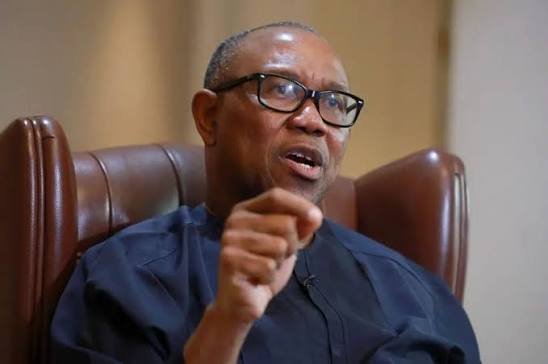
Former Anambra State Governor and Nigeria Democratic Congress presidential candidate, Peter Obi, has once again defended his long-standing claim that he left office in 2014 with approximately $150 million and N36 billion in savings for Anambra State, insisting that the funds were legitimately invested and that every transaction was transparent and open to public scrutiny.
Obi made the clarification during an interview with media entrepreneur Chude Jideonwo, published on Wednesday, where he responded to recurring allegations surrounding the management of the state’s finances during his tenure as governor.
The former governor rejected suggestions that he personally benefited from the funds or used his position to channel public money into financial institutions with which he allegedly had personal interests.
According to him, the investments were made in three commercial banks and were carried out in accordance with established financial procedures, with all records available for verification.
Obi stressed that critics were free to express their opinions but maintained that the facts regarding the investments remained publicly verifiable.
“Whatever you do, people have their views,” he said while addressing the allegations.
Providing details of the investments, Obi stated that Anambra State had $50 million and N12 billion deposited in Diamond Bank at the time he left office in 2014.
He further disclosed that another $50 million and N12 billion was invested in Fidelity Bank, while an additional $50 million and N12 billion was held in Access Bank.
According to him, the funds belonged entirely to Anambra State and were managed as government savings rather than personal assets.
“We had, for example, when I left, I had 50 million dollars in Diamond Bank… Same bank. Does Anambra State have the money? Anambra State savings… 50 million dollars in Fidelity Bank, which is supposed to be the bank I’m involved in… 50 million dollars in Access Bank,” Obi said during the interview.
The former governor explained that the dollar-denominated deposits were invested in bonds at publicly known interest rates, insisting that the investments generated returns for the state rather than losses.
He maintained that the investment strategy was designed to preserve the value of the state’s resources while ensuring that public funds remained secure and productive.
According to Obi, all the financial transactions undertaken during his administration were properly documented and can be independently verified by anyone interested in examining the records.
He argued that transparency and prudent financial management were central to his administration’s governance philosophy, adding that the savings accumulated during his tenure reflected deliberate fiscal discipline and responsible management of public resources.
The issue of Anambra State’s savings has remained one of the defining aspects of Obi’s public record, particularly during his campaigns for higher political office.
Supporters have often cited the reported savings as evidence of prudent financial management, while critics have questioned the circumstances surrounding the investments, including the choice of financial institutions used to hold the funds.
Obi’s latest comments sought to address those concerns by reiterating that the investments were made in reputable commercial banks and that there was no personal benefit derived from the arrangement.
He insisted that the funds remained the property of Anambra State and that their existence could be confirmed through official financial records.
The former governor also argued that responsible governance requires public officials to preserve government resources for future development rather than depleting them through unnecessary spending.
His remarks come amid continued public debate over fiscal responsibility, transparency and accountability in public office, issues that have featured prominently in Nigeria’s political discourse in recent years.
Obi has consistently presented his tenure as governor as an example of disciplined financial management, often pointing to investments in education, healthcare, infrastructure and savings as evidence of his approach to governance.
The former presidential candidate’s renewed defence of the state’s financial records is expected to reignite discussions over his administration’s economic legacy, with supporters viewing the investments as proof of prudent leadership and critics continuing to question aspects of the financial decisions made during his time in office.
The comments also add to the broader national conversation on transparency in public finance, as Nigerians continue to demand greater accountability from elected officials at all levels of government.