By Kio Amachree
I grew up inside international football. My father, Chief Godfrey Kio Jaja Amachree QC, was the first Chairman of the Nigerian Football Association, a post he held twice. I learned early that the game’s true currency is not goals or trophies. It is trust. Take away the belief that the contest is honest, and what remains is theatre. Expensive, cynical theatre.
On Tuesday night in Atlanta, that trust took a blow from which this World Cup may not recover.
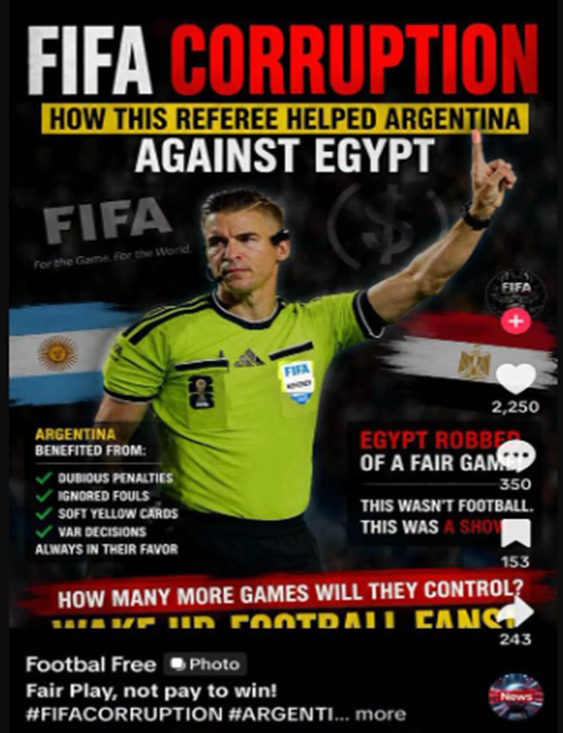
Egypt led the defending champions 2-0 and were playing the football of their lives. Then Mostafa Ziko’s goal, laid on by Mohamed Salah and finished with the composure of a man writing history, was chalked off after a VAR intervention identified a foul far back in the build-up. Fine. The rulebook can be read that way. But rules are only legitimate when they are applied to everyone. When Alexis Mac Allister appeared to grab Hamdy Fathy in the Argentine penalty area, there was no review. When Salah went down in the box in the closing minutes, there was no review. Egypt’s players collected yellow cards, in one observer’s words, for breathing, while the champions marched from 2-0 down to a 3-2 victory sealed in stoppage time.
Alan Shearer put it with English bluntness. Either both incidents are fouls or neither is. Egypt’s coach, Hossam Hassan, put it with the weariness of a man who has seen African teams absorb these verdicts for decades. The cup, he said, is directed towards Argentina. And then he did something remarkable. As he protested, Hassan crossed his arms in front of his chest, FIFA’s own approved gesture for signalling a racist incident. For that, he was shown a yellow card. Sit with that image for a moment. An African coach using the anti-racism signal FIFA itself created, and being booked for it.
I do not need to allege a conspiracy. The documented record is damning enough.
Consider what happened only days earlier. Folarin Balogun of the United States received a red card, carrying an automatic one-match suspension, a rule applied without exception for more than sixty years of World Cup football. Then the President of the United States telephoned Gianni Infantino. Days later, for the first time in the tournament’s history, FIFA suspended the suspension. UEFA, hardly a radical body, declared that FIFA had crossed a red line, calling the decision unprecedented, incomprehensible and unjustifiable. Belgium’s appeal was ruled inadmissible on a procedural technicality. Mr. Trump then stood in the Oval Office and took credit.
So the governing body of world football has now demonstrated, in a single week, that its disciplinary rules bend to a phone call from a head of state, and that its video review system can intervene decisively against one side while declining to examine comparable incidents against the other. Once that is established, every subsequent decision is contaminated by reasonable doubt. That is not paranoia. That is the ordinary logic of institutions. Credibility, once spent, cannot be selectively reclaimed.
There is a further dimension that world football would prefer not to discuss. The player who scored Argentina’s winner, Enzo Fernandez, is the same man who in 2024 broadcast his squad singing a racist chant about France’s Black players, an episode that drew a formal complaint from the French federation and a club investigation, and ended, as these episodes reliably do, in apologies and institutional amnesia. Argentina’s football culture has a documented, repeated problem with racism, layered atop a national history in which the Afro-Argentine population was marginalised into near-invisibility. None of this proves anything about Tuesday’s officiating. But it explains why, when an African side is on the wrong end of every marginal call in a match of this magnitude, the wound lands where old wounds already are, and why Hassan’s crossed arms carried a meaning FIFA cannot referee away with a yellow card.
What must happen now is not complicated.
First, FIFA must release the full VAR audio and decision logs from the Atlanta match, as it has done selectively in the past. If the officiating was defensible, transparency costs nothing. If it was not, the public is owed the truth.
Second, an independent review, genuinely independent and seated outside FIFA’s patronage system, must examine both the Balogun reversal and the consistency of VAR intervention thresholds across this tournament. CONMEBOL’s referees’ committee has already felt compelled to publicly defend one of its own officials against political pressure. When confederations are issuing statements defending referees from heads of state, the governance crisis is no longer deniable.
Third, FIFA’s statutes prohibiting political interference must be enforced against FIFA itself. A rule that binds Nigeria’s federation but not the White House is not a rule. It is a hierarchy.
My father’s generation built football institutions in newly independent African nations because they believed the game could be a commons, one arena where a boy from Buguma competed on equal terms with a boy from Buenos Aires. That belief is the World Cup’s entire moral inventory. Egypt’s players earned the right to lose fairly or win fairly on Tuesday night. They were denied both. Until FIFA explains why, openly, verifiably, and without another statement about the independence of bodies that plainly answer to power, the confetti that falls on this tournament’s final will settle on a competition the world no longer fully believes.
The whistle still blows. But authority is a different thing from noise, and in Atlanta the difference was audible to everyone.
Amachree is the Founder and President of Worldview International, Stockholm.