By Iniobong Udoh II
I know Facebook people are yet to catch up with the Prince Adeniyi Adeyemi versus Femi Gbajabiamila controversy, one that “may” have exposed just how deeply corruption has eaten into the APC and BAT government.
I have attached authentic documents, official letters, budget pages and screenshots, so that the propagandists won’t blame it on Ai, and so that you don’t have to take my word for it. Read them yourself.

Now, let me explain this in the simplest way possible.
Imagine tomorrow the Presidency tells Nigerians that the Independent National Electoral Commission (INEC) never existed.
You would laugh.
Why?
Because INEC has offices across the country.
It has staff.
It has a budget.
It receives government funding.
It writes official letters.
Other government agencies write to it.
Nobody can simply wake up and pretend it never existed.
That is exactly why this Presidential Foreign Intervention Promotion Council (PFIPC) story refuses to go away.
The Presidency has publicly said that the PFIPC is not an official government agency.
Ordinarily, that should have ended the matter.
But instead, every new document that surfaces seems to raise even more questions.
And there is another part that makes the Presidency’s position even more difficult to understand.
This is not an agency that suddenly appeared in 2026.

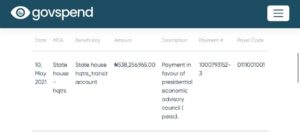
From publicly available records, the PFIPC had already existed during the administration of former President Muhammadu Buhari. In fact, records indicate that as far back as 2021, the agency had budgetary allocations running into hundreds of millions of naira.
So if the agency existed under Buhari, received government funding, and continued to operate into the Tinubu administration, how does it suddenly become an agency that “never existed”?
Government institutions don’t simply disappear from history.
If it was an illegal agency, Nigerians deserve to know who created it, who approved its budgets over the years, who supervised it, and why it continued operating across two administrations.
But if it was a legitimate government agency, then why is the Presidency now denying its existence?
That is one of the biggest questions in this entire controversy, and Nigerians deserve a clear, evidence-based answer instead of blanket denials.

Now let us come to the allegation itself.
According to Prince Adeniyi Adeyemi, he paid ₦400 million through a middleman as part of a ₦600 million arrangement connected to his appointment as Director General of the PFIPC.
He further alleged that Femi Gbajabiamila later asked him to surrender 48% of the agency’s proposed ₦24 billion take off fund.
According to him, he refused.
A disagreement allegedly followed.
Then, on June 11, 2026, the Presidency publicly distanced itself from the PFIPC.
Prince Adeyemi responded by petitioning the police.
In that petition, he reportedly named the middleman involved in the transaction as the key witness.
Then came the part that sounds like something from a political thriller.
The key witness reportedly died in a hotel fire just one day after the petition was submitted.
Prince Adeyemi has also alleged that there have been attempts on his life and that his phone was stolen during one of those incidents.
Those are serious allegations that deserve a transparent investigation.
But even if we completely ignore those allegations, there are still questions that remain unanswered.
Let’s leave emotions aside and focus only on documented facts that anyone can verify.
The 2026 Appropriation Act reportedly contains a budget allocation of about ₦1.3 billion for the PFIPC.
So here is the first question.
How does a government agency that supposedly does not exist receive over one billion naira in the national budget?
Who requested the money?
Who approved it?
Who signed off on it?
Who inserted it into the budget?
Then another document surfaced.
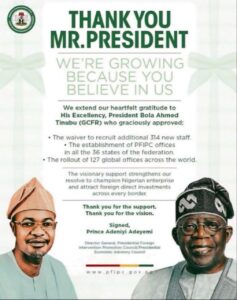
According to documents published by TheCable, the Office of the Head of the Civil Service approved a special waiver for the PFIPC to recruit 300 members of staff.
Remember, there was an embargo on recruitment into the civil service.
Yet this agency reportedly received a special exemption.
The approval covered directors, assistant directors, accountants, lawyers, investment officers, planning officers, procurement officers, statisticians, drivers, confidential secretaries and many more.
The same approval reportedly instructed the agency to comply with the Federal Character principle, reserve 5% of positions for persons living with disabilities, obtain Budget Office clearance before recruitment, and allow officials from the Office of the Head of the Civil Service to monitor the recruitment process.
Think about that.
Government officials were allegedly preparing to supervise recruitment into an agency that the Presidency now says never existed.
Does that make sense?
Then there is even more.
The PFIPC reportedly had an office inside the Federal Secretariat.
It had a Central Bank of Nigeria account.
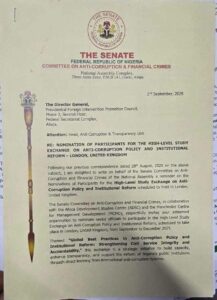
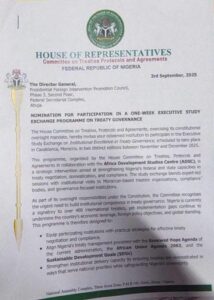
It exchanged official correspondence with the Senate.
It exchanged official correspondence with the House of Representatives.
It held meetings with government agencies, including the EFCC.
So Nigerians are left with two possibilities.
Either several powerful government institutions were all deceived into recognising and funding a fake agency.
Or somebody is not telling Nigerians the complete truth.
Whichever one it is, Nigerians deserve answers.
This is no longer about politics.
This is about accountability.
This is about public money.
This is about whether government institutions can simply deny the existence of an agency after official documents appear to show years of government recognition.
In any country that takes accountability seriously, allegations of this magnitude would trigger an independent investigation.
Not because anyone has already been found guilty.
But because the questions are too serious to ignore.
If the allegations are false, let an investigation clear everyone involved.
If the documents have been misunderstood, explain them.
If crimes were committed, prosecute those responsible.
But Nigerians should not be expected to ignore what appears to be an extensive paper trail and simply accept, “The agency never existed.”
A budget.
An office.
A CBN account.
Official letters.
Recruitment approval.
National Assembly correspondence.
Meetings with federal institutions.
These are not rumours.
These are the questions that deserve answers.
Go through every document and screenshot I have attached.
Read them carefully.
Forget political parties for a moment.
Ask yourself one simple question:
If the PFIPC truly did not exist, how did it allegedly receive government funding, government approvals, government office space and recognition from multiple federal institutions?
That is the question every Nigerian should be asking.
The evil politicians that some heartless and bigoted Nigerians are asking you to vote for are “allegedly” selling Ministerial appointments for 600 Million Naira, while they tell the poor masses that they should be grateful for an audio 50k “empowerment” fund to start roadside Akara, roasted corn, and kuli-kuli business.
And by the way, if you think I’ll end this post by telling anyone who can access the internet and read to vote for Peter Obi or NDC, I won’t, we’ll all suffer the consequences of our actions.