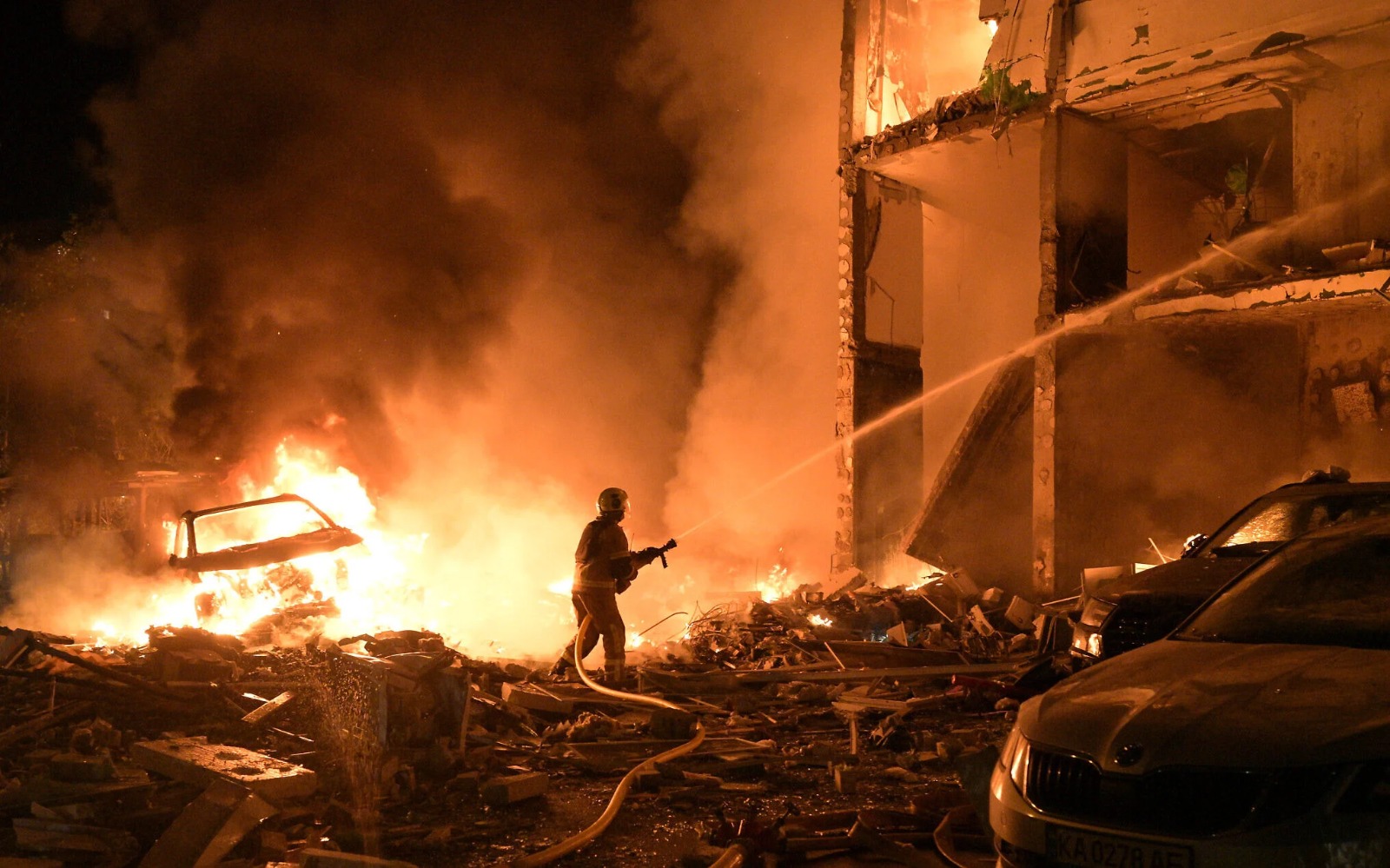
At least 14 people were killed after Russia launched a fresh wave of missile and drone attacks on Ukraine’s capital, Kyiv, early Monday, intensifying the conflict just hours before a crucial North Atlantic Treaty Organization summit where Ukraine’s security needs are expected to dominate discussions.
The latest assault marked the second major attack on Kyiv within a week, raising fresh concerns over the worsening humanitarian situation and prompting renewed appeals from Ukrainian leaders for stronger international military support.
According to Ukrainian authorities, Russian forces fired a combination of ballistic missiles and drones at residential areas, striking apartment buildings and causing widespread destruction across parts of the capital.
One of the missiles carved a massive crater into a multi-storey residential building, tearing through its upper floors and leaving much of the structure severely damaged.
Emergency workers rushed to the scene to search for survivors trapped beneath the rubble as rescue operations continued throughout the day.
Journalists from AFP at the scene reported hearing more than 10 explosions during a nighttime ballistic missile alert, while flashes lit up the sky as air defence systems attempted to intercept incoming projectiles.
The attack came only days after another Russian strike on Kyiv reportedly killed more than 30 people, underscoring the continued intensity of the conflict despite repeated international efforts to encourage a negotiated settlement.
Reacting to the latest assault, Ukrainian President Volodymyr Zelensky urged NATO leaders to take what he described as “strong decisions” to reinforce Ukraine’s air defence capabilities.
Zelensky argued that Ukraine urgently requires additional advanced air defence systems capable of intercepting ballistic missiles, warning that civilian lives remain at risk unless the country’s defensive capacity is significantly strengthened.
The Ukrainian leader has repeatedly appealed to Western allies for more interceptors and additional batteries for the U.S.-made Patriot air defense system, widely regarded as one of the few systems capable of effectively defending against advanced ballistic missile attacks.
According to Ukrainian officials, the latest strike demonstrated the continuing challenge posed by Russia’s use of difficult-to-intercept ballistic missiles alongside attack drones, placing enormous pressure on Ukraine’s existing air defence network.
The attack also prompted renewed expressions of concern from the European Union, which stressed that Ukraine requires additional air defence reinforcements to better protect its cities and civilian population from ongoing aerial bombardments.
European officials have consistently maintained that strengthening Ukraine’s defensive capabilities remains essential as Russian attacks continue to target critical infrastructure and residential areas.
The missile strike comes at a particularly significant diplomatic moment as NATO leaders prepare to meet for a summit beginning on Tuesday in Ankara, where continued military assistance to Ukraine is expected to feature prominently on the agenda.
During the summit, Zelensky is expected to hold talks with U.S. President Donald Trump on the sidelines of the gathering.
The meeting is anticipated to focus on the state of the war, Ukraine’s immediate military needs and broader security cooperation between Kyiv and its Western partners.
The latest attack is likely to reinforce Ukraine’s argument that sustained international military assistance remains critical as the conflict continues with no immediate resolution in sight.
Since Russia launched its full-scale invasion of Ukraine in February 2022, repeated missile and drone attacks have targeted cities across the country, causing extensive civilian casualties and widespread damage to homes, hospitals, schools and energy infrastructure.
Although Ukraine’s air defence systems have intercepted many incoming projectiles over the course of the war, officials say the increasing use of ballistic missiles presents a particularly difficult challenge because of their speed and flight characteristics.
Emergency responders continued rescue operations on Monday, carefully searching damaged buildings for survivors while medical teams treated the injured.
Authorities warned that the casualty figure could rise as rescue workers gained access to additional sections of collapsed structures.
Residents described scenes of panic as explosions echoed across Kyiv during the night, forcing many people to seek shelter in underground stations and designated safe locations while emergency sirens sounded across the city.
The renewed assault highlights the fragile security situation facing Ukraine despite ongoing diplomatic engagement between Kyiv and its international partners.
As NATO leaders prepare for high-level discussions on regional security and continued support for Ukraine, the latest Russian strikes are expected to add urgency to calls for enhanced military assistance, particularly in the area of air defence.
For Ukraine, the attack serves as another reminder of the continuing human cost of the conflict, while for its allies it reinforces the challenge of balancing military support, diplomatic efforts and long-term security planning as the war enters another critical phase.