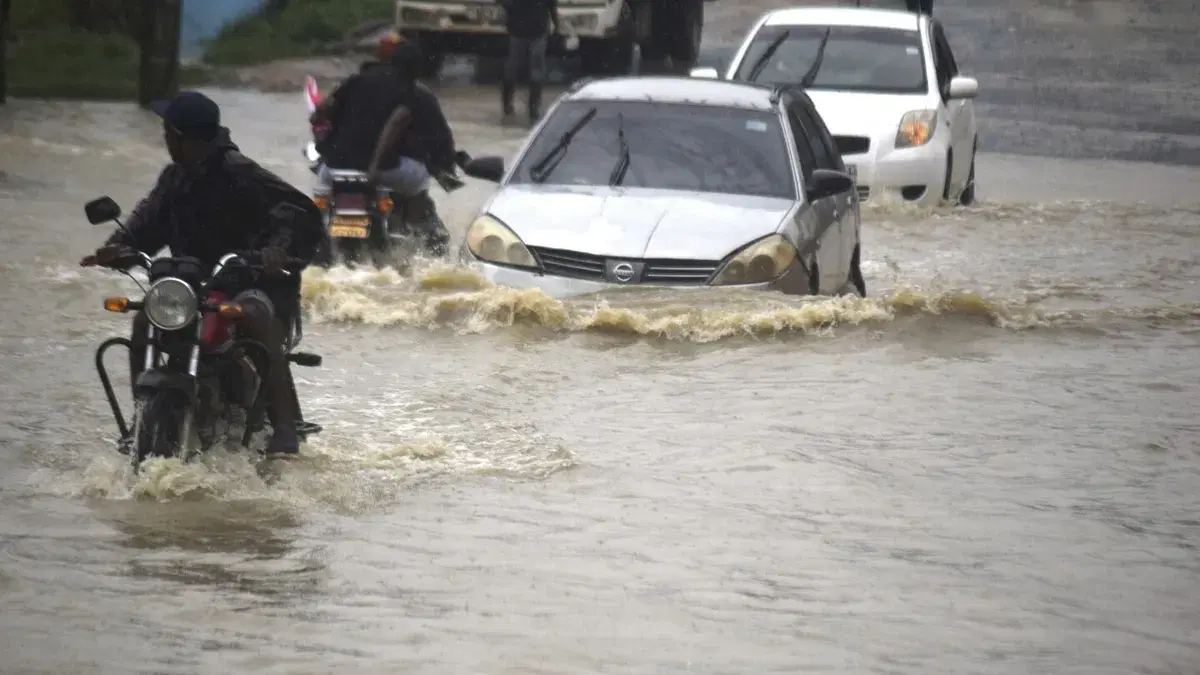
A catastrophic deluge has paralyzed major parts of Lagos State, completely cutting off the coastal hub of Ajah and the mainland community of Mafoluku, leaving hundreds of residents stranded and properties worth millions submerged.
The intense rainfall, which began late Thursday night and persisted into Friday morning, quickly overwhelmed the state’s drainage infrastructure. By daybreak, major commuter routes had transformed into rushing rivers, trapping thousands of residents in their homes and bringing vehicular movement to a grinding halt.
In the Lekki-Epe expressway axis, the flooding reached critical levels, with water rising to waist-height in several residential estates around Ajah. The popular Addo Road and the Ajah Jubilee Bridge underbelly were entirely impassable.
Hundreds of vehicles were abandoned by motorists as engines succumbed to the rising waters. With commercial buses off the roads, stranded commuters were seen wading through dirty, waist-deep water, while informal local canoe and kayak operators emerged to ferry desperate residents across flooded streets for exorbitant fees.
Premium residential estates in the area suffered severe breaches, with ground-floor apartments flooded and electronic appliances destroyed. Meanwhile, on the mainland, the perennially vulnerable community of Mafoluku in Oshodi faced an equally grim reality.
Because Mafoluku serves as a key transit artery near the Murtala Muhammed International Airport, the localized flooding triggered a massive vehicular backlog that spilled onto the Oshodi-Apapa Expressway, trapping air travelers and workers alike.
Small businesses, schools, and informal markets in the area were forced to shut down entirely as water breached shops and warehouses.Disappointed and panicked residents took to social media to share videos of floating cars and submerged living rooms, calling for immediate government intervention.
The Lagos State Emergency Management Agency (LASEMA) and the Ministry of the Environment have deployed emergency response teams to assess the hardest-hit zones. In a midday statement, officials urged residents in low-lying areas to evacuate immediately or remain indoors where safe.
“Our drainage maintenance teams are currently out on critical channels to clear flash-flood bottlenecks,” the ministry stated. “We urge calmness but strongly advise against non-essential travel until water levels recede.
“With meteorologists predicting continued heavy rainfall across the West African coast over the next 48 hours, Lagosians face a tense weekend as the city’s infrastructure is pushed to its absolute limit.