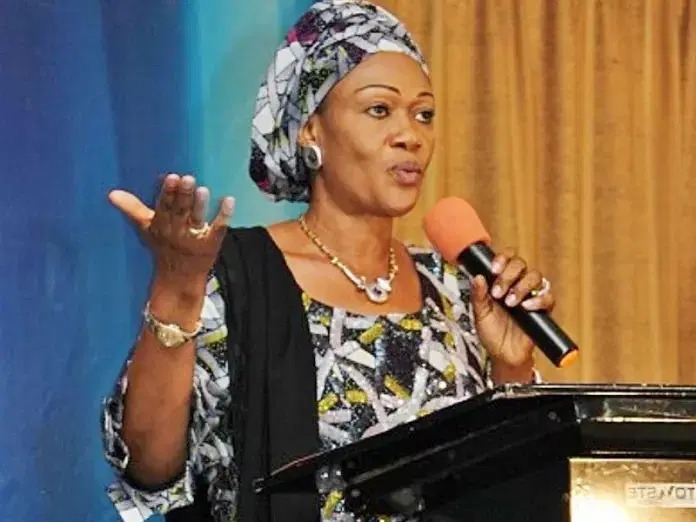
Nigeria’s First Lady, Oluremi Tinubu, has come under criticism on social media following remarks in which she encouraged Nigerians to consider starting small-scale businesses such as selling akara, roasted corn and kuli-kuli, saying such ventures require little capital to establish.
The comments, which were made during an interaction with State House Correspondents after the second-quarter meeting of the Renewed Hope Initiative with wives of state governors at the State House in Abuja on Wednesday, sparked widespread reactions after a video of the event was shared on Friday.
During the briefing, the First Lady spoke about the activities of the Renewed Hope Initiative, explaining that the programme had continued to provide financial support to vulnerable Nigerians through grants designed to help beneficiaries establish sustainable means of livelihood.
According to her, the initiative deliberately provides grants instead of loans in order to reduce the financial burden on recipients and encourage them to start income-generating businesses without the pressure of repayment.
“We’re trying to give hope, and to start Akara business doesn’t take a lot of money. To start roasting corn, or somebody even said kuli-kuli doesn’t take much. We didn’t give them a loan; we gave it to them as a grant.
“So we’ve encouraged Nigerians as best as we could. What is within our hands, I have given, and I keep giving,” she said.
The remarks quickly gained traction online, with many Nigerians taking to various social media platforms to express differing opinions about the First Lady’s comments.
Some critics argued that while small-scale businesses can indeed provide livelihoods, the comments did not adequately reflect the economic realities currently facing many Nigerians, including rising inflation, increasing food prices, high transportation costs and the growing cost of doing business.
Several users maintained that even businesses traditionally regarded as low-capital ventures now require significant startup funds because of the rising prices of cooking oil, beans, maize, groundnuts, charcoal, transportation and other essential materials.
Others questioned whether promoting informal businesses should be the primary message from government officials at a time when many young Nigerians are seeking broader employment opportunities, improved access to finance and policies that stimulate economic growth.
Some social media commentators also argued that although grants are beneficial, many Nigerians expect more comprehensive economic measures capable of addressing unemployment, improving purchasing power and reducing the high cost of living.
However, not all reactions were critical.
Some supporters defended the First Lady’s remarks, saying she was merely encouraging entrepreneurship and self-reliance among vulnerable citizens who may not have access to substantial startup capital.
They noted that thousands of Nigerians have successfully built sustainable livelihoods through food vending and other micro-enterprises, stressing that such businesses remain an important source of income for many households.
Supporters also pointed out that the First Lady’s comments were made in the context of explaining the objectives of the Renewed Hope Initiative rather than prescribing small businesses as the only solution to Nigeria’s economic challenges.
The Renewed Hope Initiative, championed by Senator Oluremi Tinubu, has in recent months rolled out various intervention programmes aimed at supporting women, youths, persons with disabilities and other vulnerable groups through grants, empowerment schemes and humanitarian assistance.
According to the First Lady, the initiative is focused on providing practical support to Nigerians by helping beneficiaries establish businesses and improve their economic well-being without placing them under debt obligations.
Her emphasis on grants rather than loans, she explained, is intended to ensure that recipients are able to use the funds directly for business development without the pressure of repayment.
The latest controversy highlights the growing scrutiny faced by public officials over comments relating to Nigeria’s economic situation, particularly at a time when many households continue to grapple with rising living costs and declining purchasing power.
As discussions continue online, the remarks have once again underscored the broader national conversation about economic hardship, entrepreneurship, government intervention programmes and the expectations of citizens regarding policies aimed at improving livelihoods.
Despite the criticism, the First Lady reiterated that the Renewed Hope Initiative would continue providing support to vulnerable Nigerians within the resources available, maintaining that the programme’s objective remains giving hope and creating opportunities for citizens to become economically self-reliant.