By Darlington Onedibe
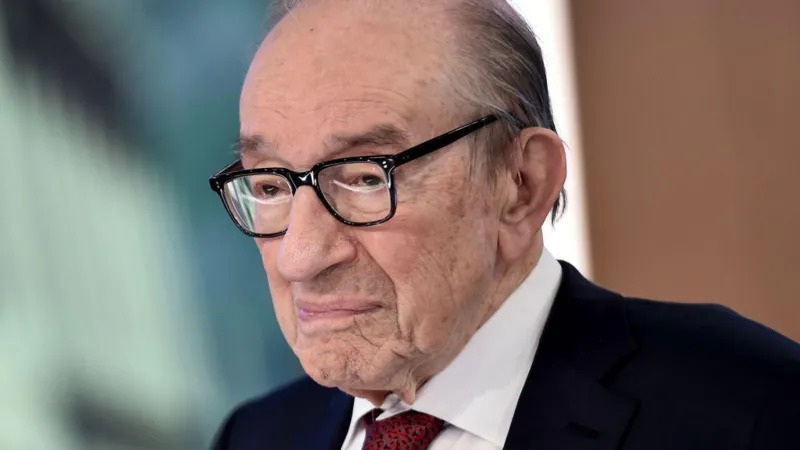
Alan Greenspan, the towering and influential economist who steered the United States Federal Reserve for more than 18 years across four presidential administrations, died Monday at the age of 100. His passing was confirmed in a statement by his wife of 29 years, NBC News Chief Washington Correspondent Andrea Mitchell, who noted that Greenspan passed away at their home due to complications from Parkinson’s disease.
”He was a giant of a man who helped shape the U.S. economy for decades under presidents of both parties, but was always honest in acknowledging his mistakes,” Mitchell said.
Appointed as the 13th Chairman of the Federal Reserve by President Ronald Reagan in August 1987, Greenspan went on to serve until January 2006. His historic tenure, the second-longest in modern Fed history spanned the administrations of Reagan, George H.W. Bush, Bill Clinton, and George W. Bush.
During the 1990s and early 2000s, Greenspan achieved near-mythic status on Wall Street and in Washington. Dubbed “The Maestro” by journalist Bob Woodward, his briefest public utterances were parsed meticulously by global investors seeking clues on interest rates.
Under his watch, the U.S. economy experienced its longest official period of peacetime expansion from 1991 to 2001, a period characterized by low inflation and rapid technological growth. The Fed, in a statement expressing deep sadness over his passing, lauded his contribution to monetary policy, noting that under his leadership, the central bank “achieved a sustained era of price stability.”
Greenspan’s legacy, however, remains a subject of intense debate among economists. A staunch advocate of free markets and deregulation, deeply influenced in his youth by his close association with novelist Ayn Rand, Greenspan championed the belief that markets could largely self-regulate.
After successfully pumping liquidity into the markets following the October 1987 stock market crash, investors grew to believe the Fed would always step in to cushion falling asset prices, a phenomenon that critics argued encouraged reckless risk-taking.
In 1996, Greenspan famously coined the term “irrational exuberance” to warn of overvalued asset prices during the dot-com boom—a phrase that became a permanent fixture of financial shorthand.
Following his retirement in 2006, Greenspan faced severe criticism for maintaining historically low interest rates in the early 2000s and resisting the regulation of complex financial derivatives. Critics argued these policies directly sowed the seeds for the subprime housing boom and subsequent 2008 global financial crisis.
In a famous 2008 congressional testimony, Greenspan candidly admitted to lawmakers that he had found a “flaw” in his free-market ideology, acknowledging he had mistakenly assumed lending institutions would do more to protect their own shareholders.
Born in New York City on March 6, 1926, Greenspan initially pursued a career in music, studying clarinet at the Juilliard School and touring with a swing band. He later pivoted to economics, earning his bachelor’s, master’s, and doctoral degrees from New York University.
Before taking the helm at the Federal Reserve, he ran his own economic consulting firm, Townsend-Greenspan & Co., and served as the chairman of the Council of Economic Advisers under President Gerald Ford.