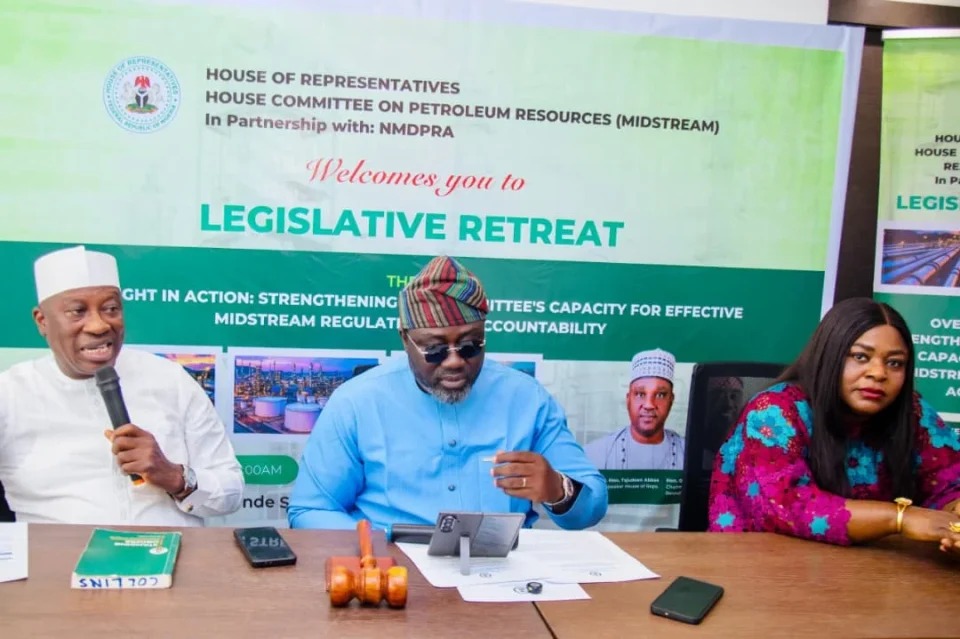
The House of Representatives Committee on Petroleum Resources (Midstream) has declared its readiness to intensify legislative oversight of Nigeria’s midstream petroleum industry, pledging a more proactive approach to monitoring operators and regulators in a bid to strengthen energy security, improve domestic gas utilisation and ensure greater accountability across the sector.
The committee’s renewed commitment emerged following two strategic legislative retreats held recently in Port Harcourt and Lagos, where lawmakers undertook an extensive review of the challenges confronting the nation’s midstream petroleum industry and developed new measures aimed at enhancing parliamentary oversight in line with the provisions of the Petroleum Industry Act (PIA).
Speaking on the outcome of the retreats, Chairman of the Committee, Odianosen Okojie, emphasized that lawmakers could no longer rely exclusively on written reports, official briefings and presentations from agencies and operators when carrying out their constitutional responsibilities.
According to him, effective oversight requires firsthand engagement with facilities, infrastructure and stakeholders operating within the industry.
In a statement made available to journalists on Monday, Okojie said the committee had adopted a more practical and evidence-based approach to understanding developments within the sector.
“Recently, we did something that I believe should become standard practice for every legislative committee in Nigeria: we went to see for ourselves,” he said.
The lawmaker noted that the committee’s visits to key petroleum infrastructure and interactions with industry stakeholders provided valuable insights into the realities confronting the sector, many of which are not fully captured in official reports.
He explained that members of the committee inspected critical midstream facilities and held discussions with regulators, operators and technical experts to better understand operational challenges, investment concerns and opportunities for growth.
According to Okojie, the experience reinforced the need for lawmakers to move beyond traditional oversight methods and embrace direct engagement as a means of ensuring effective governance.
He stressed that Nigeria’s petroleum industry remains a vital component of the national economy and that the midstream segment plays a crucial role in ensuring efficient transportation, processing, storage and distribution of petroleum products and natural gas.
The committee chairman observed that despite the reforms introduced through the Petroleum Industry Act, several challenges continue to hinder optimal performance within the sector.
These challenges, he noted, include infrastructure deficits, regulatory bottlenecks, insufficient domestic gas utilisation, funding constraints and concerns about compliance with industry standards and operational guidelines.
Okojie said the committee is determined to work closely with relevant stakeholders to address these issues while ensuring that operators comply with applicable laws and regulations.
He explained that enhanced legislative scrutiny would focus not only on identifying shortcomings but also on promoting policies capable of unlocking the full potential of Nigeria’s vast petroleum and gas resources.
The lawmaker highlighted the strategic importance of natural gas in Nigeria’s economic future, describing it as a critical resource for industrialisation, electricity generation and economic diversification.
He noted that increasing domestic gas utilisation remains a major national priority, especially as the country seeks to expand access to cleaner energy sources and reduce dependence on imported fuels.
According to him, lawmakers are committed to supporting initiatives that encourage investments in gas infrastructure, processing facilities and distribution networks capable of driving economic growth and job creation.
Okojie further emphasized that accountability would remain at the centre of the committee’s activities, noting that Nigerians expect transparency in the management of petroleum resources.
He said the committee would intensify its monitoring of both public institutions and private operators to ensure that resources are managed efficiently and in accordance with established regulations.
The chairman explained that oversight activities would include regular facility inspections, stakeholder consultations, performance reviews and evaluations of regulatory compliance.
He added that lawmakers would also closely monitor the implementation of policies and programmes designed to strengthen the midstream petroleum industry.
Industry observers believe the committee’s decision to adopt a more hands-on oversight strategy could improve transparency and strengthen confidence among investors, particularly at a time when Nigeria is seeking to attract greater investment into its energy sector.
The Petroleum Industry Act, which introduced far-reaching reforms to the oil and gas industry, was designed to create a more transparent, efficient and commercially viable framework for managing petroleum resources.
However, experts have repeatedly stressed that effective implementation and oversight are essential to achieving the objectives of the legislation.
The retreats in Port Harcourt and Lagos reportedly provided lawmakers with an opportunity to assess progress made since the enactment of the PIA while identifying areas requiring legislative attention and policy intervention.
Participants at the sessions examined regulatory developments, infrastructure needs, investment opportunities and emerging challenges affecting the midstream segment of the petroleum industry.
Stakeholders also discussed strategies for improving operational efficiency, strengthening regulatory compliance and enhancing collaboration between government agencies and industry players.
Okojie said the committee remains committed to supporting reforms that promote sustainable growth and long-term stability within the sector.
He reiterated that effective oversight is not intended to hinder operators but rather to ensure that the industry functions in a manner that benefits the nation and its citizens.
The lawmaker expressed confidence that greater engagement between legislators, regulators and industry stakeholders would contribute to improved policy outcomes and stronger institutional accountability.
As Nigeria continues efforts to reposition its petroleum industry and maximise the benefits of its abundant energy resources, the House Committee’s renewed focus on rigorous oversight is expected to play a significant role in shaping the future of the midstream sector.
With lawmakers promising more frequent inspections, deeper stakeholder engagement and stricter monitoring of regulatory compliance, industry stakeholders will be closely watching how the committee translates its commitments into tangible actions in the months ahead.
The initiative signals a growing determination within the National Assembly to ensure that the promises of the Petroleum Industry Act are fully realised, while promoting energy security, economic growth and sustainable development for the benefit of all Nigerians.